Harmanpreet Singh India Hockey World Cup
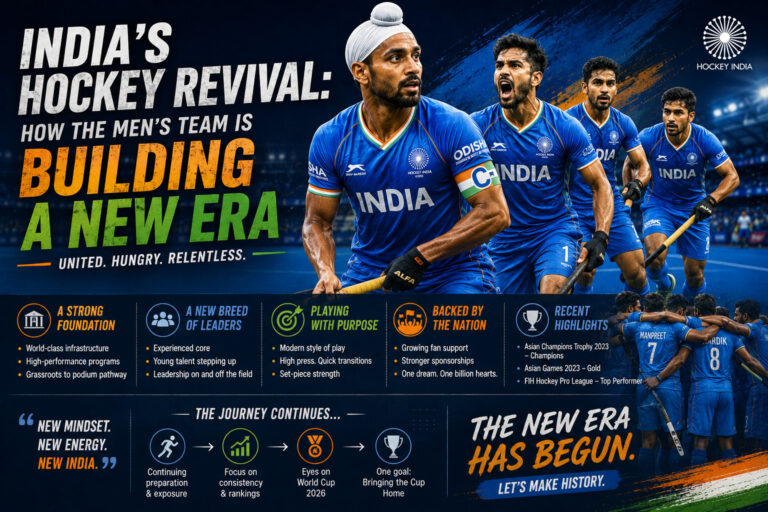
Indian hockey enters the 2026 FIH Men’s Hockey World Cup with an ambitious target: ending a title drought that has lasted more than five decades. At the centre of that challenge stands captain Harmanpreet Singh, one of the most influential defenders and penalty-corner specialists in modern international hockey.
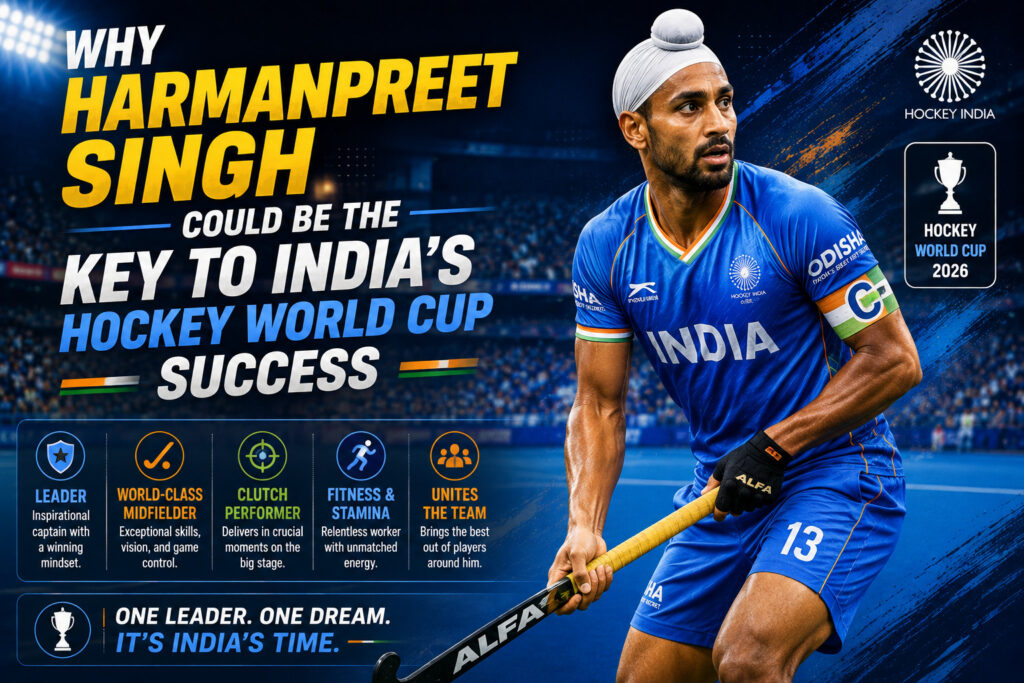
Harmanpreet is not simply India’s captain. He is one of the team’s biggest attacking weapons, an experienced defender, a penalty-corner specialist and a player who has repeatedly delivered in high-pressure matches.
That combination makes his role especially important as India begins its World Cup campaign.
The 2026 tournament is being hosted by Belgium and the Netherlands from August 14 to 30, with India drawn in Pool D alongside England, Wales and Pakistan. India has entered the competition with serious ambitions after winning the 2025 Asia Cup.
For Harmanpreet, however, the tournament carries an additional personal challenge.
He is leading India at the World Cup for the second time, and he wants to achieve something no Indian captain has managed since 1975: lift the World Cup trophy. Hockey India’s official website has highlighted his ambition to follow in the footsteps of Ajit Pal Singh, who captained India to its only World Cup title in 1975.
So, why could Harmanpreet be the key to India’s success?
More Than Just a Defender
At first glance, Harmanpreet’s primary responsibility is defensive.
He plays at the back, organizes India’s defensive structure and helps the team build attacks from deep.
But modern hockey has changed dramatically.
A defender is no longer expected simply to stop opponents. Elite defenders must also initiate attacks, distribute the ball accurately and contribute to the scoreboard.
Harmanpreet fits that modern role perfectly.
His drag-flicking ability makes him particularly dangerous during penalty corners. Whenever India earns a set-piece opportunity inside the attacking circle, Harmanpreet becomes one of the team’s biggest scoring threats.
That means opponents cannot focus exclusively on India’s forwards.
They also have to worry about what Harmanpreet can produce from a penalty corner.
This dual role makes him difficult to replace.
The Numbers Behind His Importance
Harmanpreet’s international record demonstrates just how significant his contribution has become.
According to Hockey India’s official player profile, he has represented India more than 260 times and scored more than 200 international goals. His international career began in 2015, and he has already competed at three Olympic Games.
His Olympic record is particularly impressive.
He was part of India’s bronze-medal-winning teams at both Tokyo 2020 and Paris 2024.
At Paris 2024, he captained India and finished as the tournament’s leading scorer with 10 goals. Two of those goals came in the bronze-medal match against Spain, helping India secure another Olympic medal.
Those performances explain why expectations around him are so high.
When India needs a goal from a penalty corner, Harmanpreet is one of the first players opponents prepare for.
The Captaincy Factor
Being India’s leading goal threat would already make Harmanpreet important.
Being captain adds another layer.
The captain has to communicate with teammates, manage momentum, encourage players after mistakes and help the team remain focused during difficult periods.
Hockey is an extremely fast sport. Matches can change direction within seconds.
A team can dominate possession and still concede from one counterattack.
A goal can completely change the psychological atmosphere.
In those moments, the captain’s response matters.
Harmanpreet’s experience gives India someone who has already dealt with major international pressure.
He has played at the Olympics, World Cups, Asian Games and other major tournaments.
That experience can become particularly valuable when India faces high-quality opponents in knockout matches.
The World Cup Pressure Is Different
India has not won the men’s Hockey World Cup since 1975.
That means the current generation is carrying a historical burden.
The previous two World Cups, both hosted in India, ended without the medal that fans expected. Harmanpreet has acknowledged that history, but he has described the situation more as a responsibility than pressure.
That distinction could be important.
Pressure can cause players to become overly cautious.
Responsibility can create focus.
For India to succeed in 2026, the team cannot spend every match thinking about the 51-year wait.
It has to concentrate on the next pass, the next defensive challenge and the next penalty corner.
Harmanpreet’s leadership will be crucial in maintaining that mentality.
India Has Prepared for a Tough World Cup
India’s preparations have included matches in the FIH Pro League, where the team has faced strong international opposition.
Harmanpreet recently said the team had worked extensively on both attacking and defensive strategies and that he felt physically fresh heading into the World Cup.
That is encouraging because India’s success cannot depend entirely on penalty corners.
Opponents know Harmanpreet’s importance.
They will attempt to minimize India’s set-piece opportunities and prevent him from finding the space required for his drag flick.
India therefore needs to create scoring chances through open play as well.
Harmanpreet’s contribution will be most effective when the rest of the team creates enough attacking pressure to give him opportunities.
England, Wales and Pakistan: The First Challenge
India’s Pool D opponents are England, Wales and Pakistan.
The group stage may look manageable on paper, but the World Cup offers very little room for complacency.
England have the experience and tactical discipline to punish mistakes.
Wales can make matches physically demanding and difficult to control.
Pakistan brings an enormous historical rivalry and emotional intensity.
For Harmanpreet, the group stage will therefore be about establishing rhythm rather than simply collecting points.
India needs its captain to set the tone from the beginning.
A strong start could build confidence for the knockout rounds.
Harmanpreet vs the World’s Best Defenders
One of the most interesting aspects of Harmanpreet’s game is that he is simultaneously competing against the world’s best defenders and trying to outsmart them.
International teams study his drag flick.
They analyze his body position.
They watch where he prefers to place the ball.
Goalkeepers prepare specifically for his penalty corners.
That creates a constant tactical battle.
Harmanpreet cannot simply repeat the same shot every time.
He needs variation.
Sometimes power is the answer.
Sometimes placement is more important.
Sometimes India can use a variation instead of allowing Harmanpreet to take the direct shot.
The more unpredictable India’s penalty-corner routines become, the harder it becomes for opponents to defend them.
Why Penalty Corners Could Decide India’s Campaign
Penalty corners have always been an important part of international hockey.
At the highest level, matches can be decided by one or two set pieces.
That makes Harmanpreet particularly valuable.
If India earns several penalty corners in a close knockout match, the captain could potentially change the entire game within minutes.
However, this also creates a tactical problem.
India cannot become overly dependent on him.
If opponents successfully prevent penalty corners, India needs alternative scoring routes.
The best version of India will therefore be one where Harmanpreet’s penalty-corner threat complements rather than replaces open-play attacking.
The Importance of India’s Young Players
Harmanpreet’s leadership will be important, but he cannot win the World Cup alone.
India’s squad contains a mixture of experienced players and emerging talent. The balance between the two could determine how far the team progresses.
Young forwards and midfielders need to create chances.
Midfielders must maintain possession and transition quickly.
Defenders need to protect against counterattacks.
The goalkeeper must remain composed under pressure.
Harmanpreet’s role is to connect these parts.
That is what makes his captaincy so important.
A good captain does not simply score goals.
He helps other players perform at their best.
His Defensive Role Is Still Crucial
The attacking side of Harmanpreet’s game receives most of the attention because of his goal-scoring record.
But his defensive responsibilities remain equally important.
As a defender, he must read attacking movements, intercept passes and help India manage transitions.
This becomes especially important against teams that counterattack quickly.
If Harmanpreet moves too far forward while taking an attacking role, India can potentially leave space behind him.
That means his decision-making must be precise.
Knowing when to attack and when to stay back is part of the responsibility of an elite modern defender.
Fitness Could Be a Major Advantage
Modern hockey is incredibly physical.
Players constantly sprint, change direction, press opponents and recover.
Harmanpreet and his teammates have emphasized the importance of fitness throughout India’s preparations.
Hockey India’s official website recently highlighted the exceptional fitness standards within the Indian team after former India cricketer Virat Kohli praised the physical demands of elite hockey. Harmanpreet explained that the team’s training and fitness benchmarks have become an important part of its preparation.
That fitness can become particularly valuable during the World Cup.
A team may play several high-intensity matches in a short period.
Recovery becomes essential.
The captain must remain physically capable while also carrying the mental responsibilities of leadership.
The Ajit Pal Singh Comparison
There is an interesting historical connection surrounding Harmanpreet’s 2026 campaign.
India’s only World Cup-winning captain is Ajit Pal Singh, who led the team to the 1975 title.
Harmanpreet is now captaining India at his second World Cup and has openly expressed his desire to repeat that historic achievement.
Hockey India has specifically pointed to the similarity between the two captains’ World Cup journeys.
Of course, history does not guarantee results.
The game has changed enormously since 1975.
But the comparison adds another layer to Harmanpreet’s campaign.
He is not simply chasing another medal.
He is trying to lead India to a trophy that the country has been waiting more than five decades to see again.
What Harmanpreet Must Do Differently
If India wants to win the World Cup, Harmanpreet will need to be more than a penalty-corner specialist.
He must remain defensively disciplined.
He must choose attacking moments carefully.
He must keep his teammates calm.
And he must continue producing goals when India needs them most.
Perhaps most importantly, he needs to avoid allowing the weight of expectation to affect his decision-making.
A captain can be at his best when he plays the game rather than the occasion.
The World Cup final may carry enormous historical significance, but reaching that final requires winning one match at a time.
Harmanpreet himself has emphasized that India needs to approach the tournament on a match-by-match basis.
Can Harmanpreet Lead India to the Final?
There is no guarantee.
International men’s hockey is extremely competitive.
The Netherlands, Belgium, Germany, Australia, England and other nations have experienced squads capable of winning the tournament.
India will have to overcome several of them if it progresses deep into the competition.
But India’s captain has already shown that he can perform when the stakes are highest.
His two goals in the Paris Olympic bronze-medal match are a perfect example.
When India needed him, he delivered.
The challenge in 2026 is to produce that level of influence across an entire tournament.
The Bigger Legacy of Harmanpreet Singh
Regardless of what happens at the 2026 World Cup, Harmanpreet has already established himself as one of the defining players of his generation.
He has won Olympic medals.
He has captained India.
He has scored more than 200 international goals.
He has played a central role in India’s return to the Olympic podium.
His career also represents the evolution of Indian hockey.
The modern Indian defender is expected to be physically powerful, technically skilled and capable of contributing to the attack.
Harmanpreet embodies that transformation.
His drag flick has become one of the most recognizable weapons in international hockey.
The World Cup Could Define His Captaincy Era
Every great captain eventually faces a defining tournament.
For Harmanpreet, the 2026 World Cup could be that tournament.
India has the talent.
It has international experience.
It has the momentum of winning the 2025 Asia Cup.
And it has a captain who has already experienced Olympic success.
The missing piece is the World Cup.
India has not lifted the trophy since 1975.
Harmanpreet wants to change that.
Final Verdict: Why Harmanpreet Could Be India’s X-Factor
India’s World Cup campaign will depend on the entire squad, not one individual.
But if there is one player capable of changing a match through a single penalty corner, one defensive interception or one moment of leadership, it is Harmanpreet Singh.
His value comes from the combination of skills he brings.
He can defend.
He can score.
He can create pressure.
He can lead.
That makes him more than India’s captain.
He is one of the central pieces of India’s World Cup strategy.
The 2026 tournament presents Harmanpreet with an opportunity to write another major chapter in his career. He has already won Olympic medals and established himself as one of the world’s leading drag-flick specialists.
Now he faces perhaps his biggest challenge yet: leading India back to the top of world hockey.
The task will be enormous.
The opponents will be prepared.
The pressure will be intense.
But Harmanpreet has already shown that he thrives when the stakes are high.
If his penalty corners are accurate, his defensive decisions are sharp and his leadership keeps India focused, Harmanpreet Singh could be the difference between another respectable World Cup campaign and a historic Indian triumph.
And after 51 years of waiting, Indian hockey fans will be hoping their captain is ready to make history.