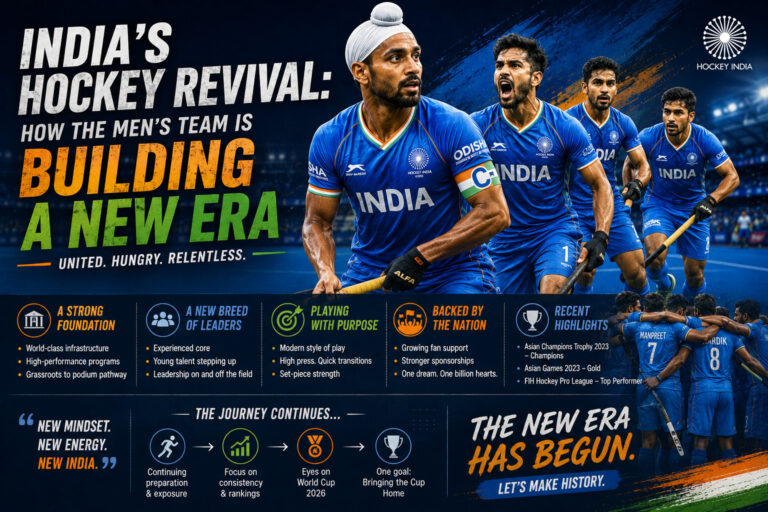
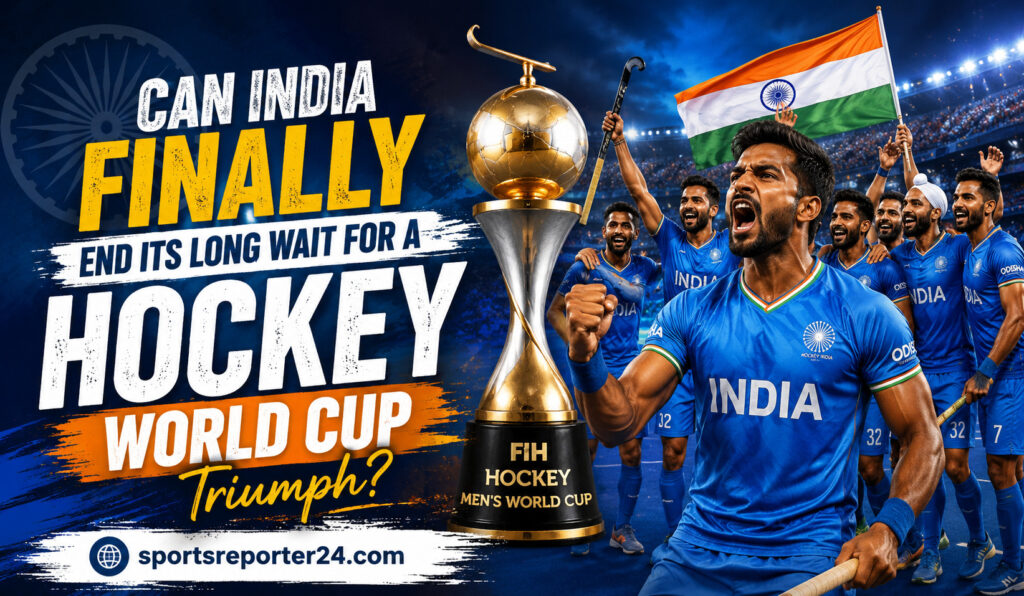
For generations, Indian hockey fans have dreamed of seeing the men’s national team lift the Hockey World Cup again. That dream has remained unfulfilled since 1975, when India defeated Pakistan 2-1 in Kuala Lumpur to win its only men’s World Cup title. More than five decades later, India is entering the 2026 FIH Hockey World Cup with another opportunity to rewrite its history.
The timing could hardly be more interesting. India has rebuilt its reputation on the international stage through back-to-back Olympic bronze medals at Tokyo 2020 and Paris 2024. The team has also continued to perform strongly in Asian hockey, while a younger generation is increasingly contributing alongside experienced players.
But winning a World Cup is a different challenge.
As the 2026 tournament begins in Belgium and the Netherlands from August 15 to 30, the biggest question is whether Harmanpreet Singh’s team has finally developed the consistency, tactical discipline and mental strength required to challenge for the trophy.
India’s 51-Year World Cup Wait
India’s relationship with the Hockey World Cup has been complicated.
The country won the inaugural men’s Olympic hockey tournament in 1928 and went on to establish one of the greatest dynasties in Olympic sport. However, World Cup success has been much harder to achieve.
India reached the final in 1973 before winning the tournament two years later. Since that historic 1975 triumph, the team has never returned to the World Cup final. Its recent home tournaments were particularly disappointing, with India finishing sixth in 2018 and ninth in 2023.
That makes the current drought more than a statistic. It represents a major psychological challenge for a team carrying the expectations of a hockey-loving nation.
Captain Harmanpreet Singh has described the situation as a responsibility rather than simply pressure. The team knows the history, but it also understands that focusing too heavily on the past can become a distraction.
Why 2026 Could Be Different
There are several reasons why optimism around Indian hockey is stronger now than it was before previous World Cups.
The most obvious is India’s Olympic consistency.
Winning bronze at Tokyo 2020 ended a 41-year Olympic medal wait. Repeating the achievement at Paris 2024 demonstrated that the Tokyo success was not an isolated moment. India had become capable of competing for medals against the world’s strongest teams.
That progression matters because the World Cup requires exactly the same qualities: physical preparation, tactical discipline, squad depth and the ability to perform under enormous pressure.
The current Indian side also has considerably more international experience than many previous World Cup squads.
Harmanpreet Singh has established himself as one of the world’s leading defenders and penalty-corner specialists. Alongside him are experienced players who have competed at Olympic, World Cup and Pro League level.
At the same time, younger players are adding energy and unpredictability to the squad.
Hockey India’s 20-member World Cup squad combines established names with players who are eager to make their mark on the biggest stage.
Craig Fulton’s Tactical Approach
Another major factor is head coach Craig Fulton.
The South African coach has emphasized tactical discipline and consistency rather than relying purely on individual brilliance. That approach reflects the reality of modern international hockey.
The sport has become faster and more physically demanding. Teams need to transition quickly between defense and attack, maintain their structure under pressure and make intelligent decisions in the final third.
For India, this represents an important evolution.
Indian hockey has traditionally been associated with skill, creativity and attacking flair. Those qualities remain valuable, but modern opponents can punish defensive mistakes almost immediately.
Fulton’s challenge is therefore to combine India’s natural attacking talent with a more organized tactical structure.
The coach has also made it clear that the team wants to create its own history rather than constantly trying to recreate the achievements of the 1975 generation.
That mentality could be crucial.
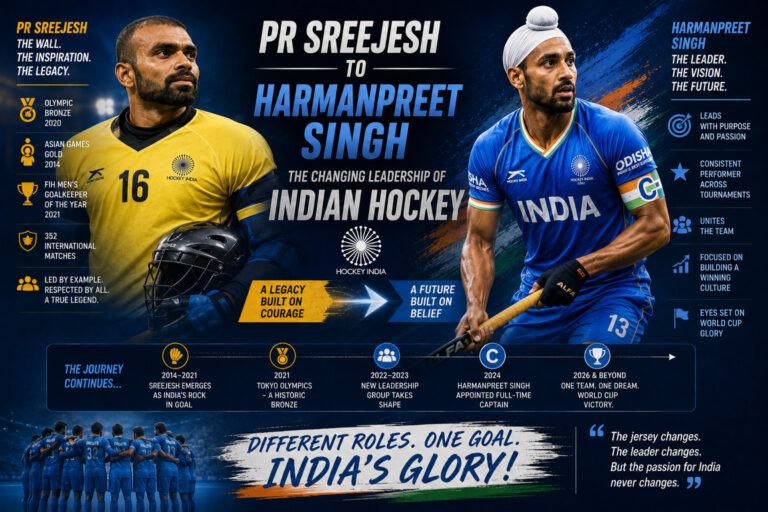
Harmanpreet Singh: India’s Key Leader
If India is going to challenge for the World Cup, Harmanpreet Singh will likely play a central role.
As captain, he has to manage both tactical responsibilities and the emotional demands of leading India at one of its most important tournaments in decades.
His penalty-corner ability is another major weapon.
In tight World Cup matches, goals from set pieces can determine the outcome. India therefore needs Harmanpreet to remain reliable from penalty corners while also organizing the defense.
However, his influence extends beyond scoring.
The captain is responsible for keeping the team composed when matches become chaotic. A World Cup knockout game can change in seconds, and India’s ability to remain disciplined could ultimately separate it from its rivals.
India’s Young Players Can Make the Difference
India’s revival is not built entirely around established stars.
The emergence of younger players has increased competition for places in the national squad. That depth is essential during a tournament where injuries, suspensions and tactical changes can quickly alter a team’s plans.
The development pathway has also shown encouraging signs outside the senior team. India’s U18 men’s side won the 2026 U18 Asia Cup, defeating Japan 4-1 in the final. Success at junior level does not guarantee senior international glory, but it indicates that the country’s development system is producing players capable of competing internationally.
For the current World Cup squad, younger players can bring pace, energy and fresh ideas.
Their biggest challenge will be handling the pressure of playing in matches where every mistake can have major consequences.
A Challenging Pool Awaits India
India has been placed in Pool D alongside England, Pakistan and Wales.
The group contains both familiar opponents and difficult challenges. England represents a strong European opponent, Wales can be dangerous if underestimated, while the India-Pakistan match will attract enormous global attention.
The Pakistan fixture, scheduled for August 19, will be particularly emotional for fans.
However, India cannot afford to become distracted by the rivalry.
Every pool match is important because the new World Cup format has changed the traditional route to the semi-finals. With the quarter-final stage removed, teams must navigate multiple phases successfully before reaching the final four.
That makes consistency even more important.
One poor performance could create a difficult path later in the tournament.
What India Must Get Right
If India wants to end its World Cup drought, several areas will be critical.
First, the team must convert its penalty-corner opportunities. Against top-level opposition, chances can be limited, making set pieces extremely valuable.
Second, defensive concentration must remain strong throughout the match. India cannot afford to concede soft goals after building pressure.
Third, the midfield needs to control transitions. Losing possession in dangerous areas can allow technically strong opponents to launch rapid counterattacks.
Finally, India must remain mentally calm.
This may be the biggest challenge of all.
The 51-year wait will be discussed repeatedly throughout the tournament. Players will hear questions about 1975, previous World Cup disappointments and India’s failure to reach the podium in recent editions.
The best response will be to focus on the next match rather than the weight of history.
Can India Win the Trophy?
Realistically, India has a chance, but winning the World Cup will be extremely difficult.
Coach Craig Fulton has reportedly described India’s chances in modest terms while embracing the underdog tag. At the same time, he has made clear that the team’s ambition is to challenge for a podium place.
That combination of realism and ambition could benefit India.
The team does not need to be considered the overwhelming favorite. It needs to be good enough at the right moments.
A World Cup campaign can change quickly. A strong defensive performance, an early penalty-corner goal or a decisive save can completely alter the momentum of a knockout match.
India has already demonstrated that it can defeat top teams and compete for major medals.
The remaining question is whether it can maintain that level across an entire World Cup campaign.
The Bigger Goal Beyond 2026
Even if India does not win the 2026 World Cup, the tournament should be viewed as part of a larger rebuilding process.
The country has already developed a stronger hockey structure, improved its international competitiveness and created a generation that is comfortable playing against elite opposition.
The Hockey India League has also helped provide competitive exposure and opportunities for players to play alongside international stars. Such domestic experience can strengthen the pipeline between Indian club hockey and the national team.
The ultimate objective should therefore extend beyond one trophy.
India needs to become a regular World Cup contender rather than a team that produces occasional bursts of success.
A Chance to Rewrite History
India’s men’s hockey team is approaching the 2026 World Cup with something it has not always had in recent decades: genuine belief backed by recent results.
Two consecutive Olympic bronze medals have restored confidence. The team has experienced players, promising young talent and a coach determined to establish a modern tactical identity.
But history will not win matches.
The 1975 champions can inspire the current generation, but Harmanpreet Singh and his teammates must create their own story.
The 2026 World Cup begins on August 15, and India’s journey starts with Wales before the crucial encounters against England and Pakistan.
Can India finally end its long wait?
A World Cup title may still be a difficult target, but reaching the podium is a realistic ambition. If India can combine its defensive strength, penalty-corner quality, attacking speed and mental discipline, the team could finally break the cycle that has followed Indian hockey since 1975.
For millions of Indian fans, the dream is simple: another World Cup celebration.
After 51 years, the opportunity has arrived again.