
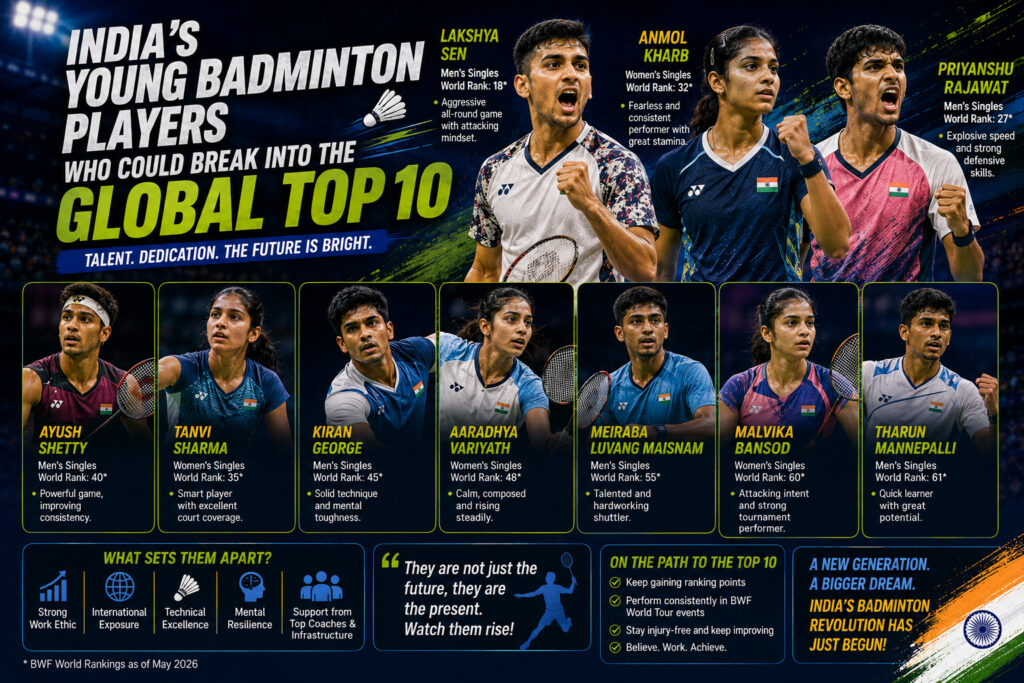
Indian badminton is entering an exciting transition period. PV Sindhu, Lakshya Sen, Satwiksairaj Rankireddy and Chirag Shetty remain major names on the international circuit, but behind them a new generation is beginning to make a serious impact.
What makes this generation particularly interesting is that several young Indian players are no longer satisfied with simply participating at major tournaments. They are beating established opponents, reaching deep stages of international events and collecting the ranking points needed to move closer to the world’s elite.
The most obvious example is Ayush Shetty. The 20-year-old produced one of India’s biggest breakthroughs of 2026 by reaching the Badminton Asia Championships final after defeating three Top 10 opponents during his run.
But Shetty is not the only young player with Top 10 potential.
Unnati Hooda, Tanvi Sharma, Devika Sihag, Tharun Mannepalli, Rounak Chouhan, Sathish Karunakaran and several other emerging shuttlers are building their own paths toward international success.
India’s 2026 Asian Games squad itself reflects this changing landscape, with young players including Ayush Shetty, Tanvi Sharma and Unnati Hooda selected alongside established stars.
The question is no longer whether India has another generation of badminton talent.
The bigger question is: which young Indian players have the ability to break into the global Top 10?
Ayush Shetty: The Strongest Top 10 Candidate
If one young Indian men’s singles player currently looks closest to breaking into the global elite, it is Ayush Shetty.
The Karnataka-born shuttler has made remarkable progress at just 20 years of age.
His breakthrough came at the 2026 Badminton Asia Championships, where he reached the final after defeating three Top 10 players. His run included victories over several highly ranked opponents and demonstrated that he was capable of handling the speed and pressure of elite badminton.
Reaching the final was historically significant as well. Shetty became the first Indian men’s singles player in more than six decades to reach the final of the Badminton Asia Championships.
His performances have already changed expectations.
Instead of asking whether Shetty can become a good international player, coaches and observers are now discussing whether he can become a Top 10 player.
That is a completely different level of expectation.
What Makes Ayush Shetty Different?
One of Shetty’s biggest strengths is his physicality.
Indian badminton has traditionally produced players known for speed, touch and tactical intelligence. Shetty brings considerable power and athleticism to that mix.
He can attack from the rear court, maintain long rallies and put pressure on opponents with his physical presence.
His confidence is another important factor.
At the Badminton Asia Championships, he did not simply try to survive against higher-ranked opponents. He believed he could beat them.
That mentality could become one of his greatest weapons.
However, reaching the Top 10 requires consistency rather than one outstanding tournament.
Shetty’s recent results have also shown the challenges of staying at that level. A minor elbow injury in June disrupted his momentum, followed by several early exits.
His next challenge is therefore clear: stay healthy, remain consistent and convert strong performances into ranking points.
Tanvi Sharma: India’s Teenage Women’s Singles Hope
On the women’s side, Tanvi Sharma is one of India’s most exciting young prospects.
She is still in the early stages of her senior career, but her rapid rise has already attracted considerable attention.
Tanvi’s name has increasingly appeared alongside India’s established women’s singles stars, and she was selected for India’s 2026 Asian Games squad.
Her development is particularly important because Indian women’s badminton is entering a period of transition.
PV Sindhu has already established one of the greatest careers in Indian sport. But the country needs a new generation capable of maintaining India’s presence at the top of women’s singles.
Tanvi could become part of that group.
Her biggest advantage is that she has time on her side.
At such a young age, she can still develop physically, improve her tactical game and gain experience against higher-ranked international opponents.
The next few seasons will be about turning potential into consistency.
Unnati Hooda: A Young Player Already Moving Up
Unnati Hooda is another name who deserves serious attention.
Her rise has been one of the clearest signs that India’s women’s singles pipeline is becoming deeper.
Hooda has already gained international experience at a young age and has demonstrated that she can compete against senior opponents.
Her inclusion in India’s 2026 Asian Games squad alongside PV Sindhu is particularly significant. She is not merely being viewed as a future prospect anymore; she is becoming part of India’s senior international setup.
That transition can be difficult.
Junior tournaments and senior World Tour events are completely different environments. The pace is faster, the physical demands are greater and opponents are much more experienced.
Hooda’s ability to handle that transition will determine how quickly she can climb the world rankings.
But if her development continues steadily, a Top 10 position is certainly an achievable long-term target.
Devika Sihag: Another Name Rising Fast
Devika Sihag is another young Indian women’s singles player who has been gaining ground.
Her progress matters because India’s future strength may come from having several competitive players rather than one dominant star.
A deep women’s singles group creates internal competition. Players train together, compete for national selection and learn from one another.
Sihag’s development could therefore benefit the entire Indian system.
She was included in India’s women’s squad for the 2026 Asian Games, showing that selectors see her as part of the country’s next generation.
The next step is to establish herself consistently on the BWF World Tour.
If she can regularly defeat higher-ranked players and reach quarterfinals and semifinals at bigger tournaments, her ranking could rise rapidly.
Tharun Mannepalli: A Men’s Singles Player to Watch
India’s men’s singles future is also becoming increasingly competitive.
Tharun Mannepalli is one of the younger players who could eventually challenge for a place among the world’s best.
He has already produced notable results on the international circuit and has been identified as one of India’s emerging power players.
Indian badminton analysts have highlighted Mannepalli alongside Ayush Shetty, Sathish Karunakaran, Sanskar Saraswat and Rounak Chouhan as part of a younger generation expected to make an impact.
Mannepalli’s game is particularly interesting because of its physical dimension.
Modern men’s singles increasingly rewards players who can combine explosive attacking with the stamina required for long rallies.
If he can improve consistency and build more experience against Top 20 opponents, he could gradually move toward the higher levels of the rankings.
Rounak Chouhan: The Player Who Can Surprise
Rounak Chouhan may not yet have the same profile as Ayush Shetty, but he is another player Indian badminton fans should watch closely.
Badminton Association of India Secretary General Sanjay Mishra recently highlighted Chouhan among India’s promising young players and pointed to his victory over a world No. 6 opponent at the US Open as evidence of his potential.
That kind of victory matters.
Beating a highly ranked player shows that a young athlete has the ability to compete at the highest level.
The next challenge is doing it repeatedly.
A Top 10 player cannot rely on occasional upsets. They must consistently defeat lower-ranked opponents, compete strongly against the Top 20 and take advantage of opportunities against elite players.
Chouhan’s development will therefore be worth following over the next few seasons.
Sathish Karunakaran: Power Could Be His Biggest Weapon
Another young men’s singles player with considerable potential is Sathish Karunakaran.
He has been identified as part of India’s emerging generation of physically powerful players.
That physicality could become increasingly important in modern badminton.
The sport is becoming faster and more athletic, with players expected to cover enormous areas of the court while maintaining attacking pressure.
Karunakaran has the physical tools to compete in that environment.
What he needs now is refinement.
Better shot selection, improved consistency and experience in high-pressure matches could determine whether his potential becomes a sustained Top 20 or Top 10 career.
Malvika Bansod: Experience Could Help Her Climb
Although Malvika Bansod is slightly more experienced than some of the teenage prospects on this list, she remains an important part of India’s next generation.
She has already established herself as one of India’s leading women’s singles players and has competed against some of the world’s best.
Her advantage is experience.
Unlike very young prospects who are still learning the international circuit, Bansod has already experienced the pressure of major tournaments.
That means her path to the Top 10 could be more immediate if she can find greater consistency.
She is also part of a wider group that includes Sindhu, Tanvi, Unnati, Devika and others.
Competition within that group could push every player to improve.
The Women’s Singles Pipeline Is Getting Deeper
One of the most encouraging developments in Indian badminton is the number of young women’s singles players emerging simultaneously.
India’s current generation includes names such as:
- Tanvi Sharma
- Unnati Hooda
- Devika Sihag
- Malvika Bansod
- Isharani Baruah
- Anmol Kharb
- Tanya Hemanth
The strength of this group is its depth.
Not every player will become a Top 10 star.
But having multiple athletes capable of competing internationally significantly increases the chances that one or more will break through.
The development of juniors is also being recognized by the Badminton Association of India, which has spoken about greater emphasis on grassroots coaching, sports science and long-term junior development.
That could become crucial for the next stage of India’s badminton growth.
The Men’s Singles Situation Is Equally Interesting
The men’s side has an impressive collection of emerging talent too.
Ayush Shetty currently appears to be the standout prospect, but he is surrounded by players such as Tharun Mannepalli, Rounak Chouhan and Sathish Karunakaran.
There are also established competitors such as Lakshya Sen, HS Prannoy and Kidambi Srikanth who can provide valuable experience.
That combination could be beneficial.
Young players can learn from experienced athletes while simultaneously competing with them for tournament opportunities.
The result could be a healthier pipeline where India consistently has several players ranked inside the global Top 50.
Why Breaking Into the Top 10 Is So Difficult
Being a Top 10 badminton player is not simply about talent.
The difference between a player ranked 20th and one ranked 8th can be extremely small.
One player may have a better tournament schedule.
Another may struggle with injuries.
A third may lose several close matches.
Ranking points accumulate through consistent results, so players must perform week after week.
They also need to handle travel.
The international badminton calendar requires players to move between countries regularly. Recovery becomes critical, particularly for young athletes who are still developing physically.
Then there is the mental pressure.
Once a player enters the Top 20, opponents begin studying their game more carefully.
Once they enter the Top 10, every match becomes a target.
That is when tactical adaptability becomes essential.
The Importance of Beating Top Players
One of the strongest indicators that a young player could eventually break into the Top 10 is the ability to defeat established stars.
Ayush Shetty’s 2026 Badminton Asia Championships campaign is the perfect example.
He did not simply accumulate ranking points through victories over lower-ranked opponents. He defeated three Top 10 players on his way to the final.
That tells us something important.
He already possesses the level required to compete with elite players.
The question is whether he can reproduce that level regularly.
Rounak Chouhan’s victory over a world No. 6 player is another encouraging sign.
For players such as Tanvi Sharma and Unnati Hooda, similar breakthrough victories could accelerate their development.
India’s Biggest Advantage: A Stronger Talent Pipeline
India’s badminton success over the past decade has created a powerful cycle.
Successful players inspire children to take up badminton.
More children create a larger talent pool.
Better academies identify promising athletes.
International success creates more funding and attention.
That produces even more opportunities for the next generation.
Players such as Sindhu, Lakshya, Satwik and Chirag have therefore done more than win medals.
They have helped build a pathway for younger players.
The emerging generation now has better examples of what an international badminton career can look like.
Can Ayush Shetty Become India’s Next Top 10 Men’s Singles Player?
Of all the young players discussed, Shetty currently looks like the most obvious candidate.
His age, physical ability, confidence and 2026 breakthrough make him a compelling prospect.
His Badminton Asia Championships run proved that he can beat the best.
But he still needs to prove that he can maintain his level over an entire season.
His elbow injury and subsequent inconsistent results provide a reminder that development is rarely linear.
If he can stay healthy and improve his consistency, a Top 10 ranking could become a realistic medium-term target.
Which Young Women Could Break Into the Top 10?
The women’s side is more difficult to predict because several players are developing at roughly the same time.
Tanvi Sharma has enormous long-term potential.
Unnati Hooda is already making progress at senior level.
Devika Sihag is another player who could rise quickly.
Malvika Bansod has the advantage of greater international experience.
Anmol Kharb and Isharani Baruah also add depth.
The competition among these players could become one of the most interesting stories in Indian badminton.
Rather than one player replacing Sindhu, India could eventually have several women ranked inside the global Top 20.
From that group, one or two could make the final jump into the Top 10.
2026 World Championships: A Major Opportunity
The 2026 BWF World Championships in New Delhi could become an important moment for India’s younger players.
The tournament is scheduled for August 17-23 and will bring the world’s leading badminton players to India.
Ayush Shetty faces an especially difficult first-round assignment against world No. 1 Shi Yuqi.
It may appear to be an unfortunate draw, but it is also an opportunity.
Shetty’s coach has suggested that the difficult matchup could work in his favour because it allows him to play without the same pressure as a favourite.
A victory over the world No. 1 would immediately become one of the biggest results of his career.
Even a competitive performance could provide valuable experience.
For India’s other young players, the tournament offers another opportunity to learn what the world’s biggest badminton stage demands.
What Could Stop These Players From Reaching the Top 10?
Talent alone will not guarantee success.
The biggest obstacles are likely to be:
Injuries: Badminton places enormous stress on the knees, ankles, shoulders and lower back.
Consistency: Young players often produce spectacular wins followed by early tournament exits.
Mental pressure: Expectations can grow quickly after a breakthrough result.
Tactical development: International opponents adapt quickly, so players must continue adding new weapons.
Scheduling: Playing too many tournaments can lead to fatigue and injuries, while playing too few can slow ranking progress.
Managing these factors could be as important as technical ability.
The Next Era of Indian Badminton
The most exciting aspect of India’s young badminton generation is that there is no single path to success.
Ayush Shetty represents power and physicality.
Tanvi Sharma represents teenage potential.
Unnati Hooda brings early international experience.
Devika Sihag represents another rising women’s singles option.
Tharun Mannepalli and Sathish Karunakaran add depth to men’s singles.
Rounak Chouhan has already shown that he can surprise higher-ranked opponents.
Together, they represent a broader transformation.
India is moving toward a badminton system where young players are expected not merely to participate internationally but to challenge established stars.
Final Thoughts
Breaking into the global Top 10 is one of the hardest achievements in badminton.
For India’s young players, the journey will require patience, fitness, tactical growth and consistent performances across the BWF World Tour.
But the signs are encouraging.
Ayush Shetty has already demonstrated that he can defeat Top 10 opponents and reach the final of a major continental championship. Tanvi Sharma and Unnati Hooda are emerging as important names in women’s singles, while Devika Sihag, Malvika Bansod and Anmol Kharb provide additional depth. On the men’s side, Tharun Mannepalli, Rounak Chouhan and Sathish Karunakaran offer further reasons for optimism.
Not all of these players will reach the Top 10.
Some may plateau.
Others may become doubles specialists.
A few could surprise everyone.
That uncertainty is exactly what makes India’s next badminton generation so exciting.
The foundations have already been laid by players such as PV Sindhu, Lakshya Sen, Satwiksairaj Rankireddy and Chirag Shetty.
Now the next generation has a chance to take Indian badminton even higher.
And if Ayush Shetty’s breakthrough is any indication, India may not have to wait very long for its next global Top 10 star.