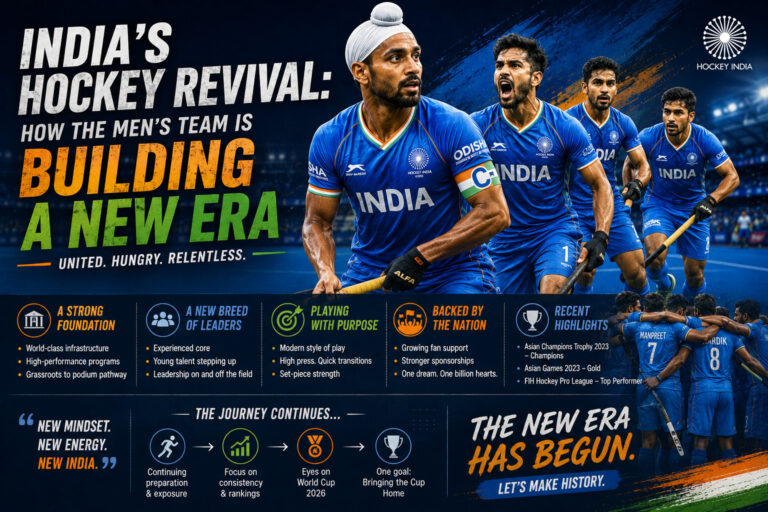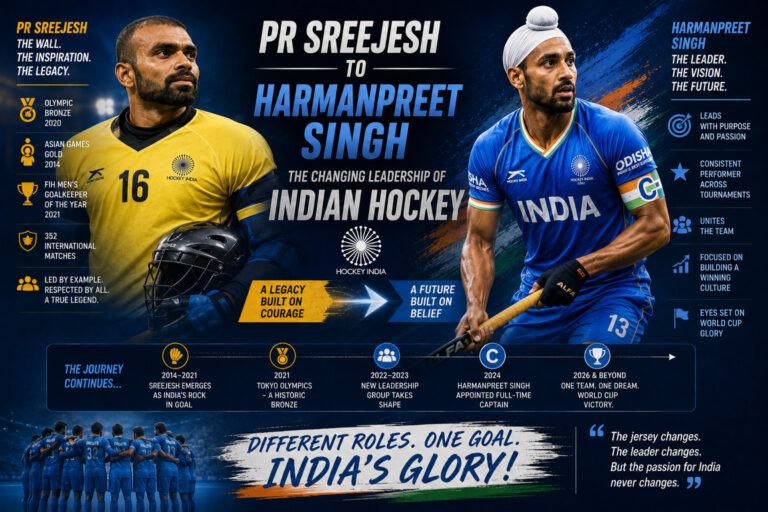

Indian hockey is entering an exciting phase. The country’s men’s team has already rebuilt much of its reputation after winning consecutive Olympic bronze medals at Tokyo 2020 and Paris 2024, but the long-term future of the sport will depend on the players coming through behind the established stars.
The next generation is already beginning to make its presence felt. Several young players have moved into senior-level competition, while others are pushing for recognition through domestic tournaments, the Hockey India League and junior international hockey. Hockey India’s senior camps have also increasingly brought together experienced players and emerging talent as part of preparations for major competitions.
For Indian hockey, this depth could prove crucial. The current senior side has experienced names such as Harmanpreet Singh, Manpreet Singh and Amit Rohidas, but the future will eventually belong to a younger group capable of carrying the team toward the 2028 Los Angeles Olympics and beyond.
Here are some of the Indian players who could become important figures in the next era of men’s hockey.
Vivek Sagar Prasad: Already a Leader of the Next Generation
Vivek Sagar Prasad is no longer an unknown youngster, but at just 26, he still represents the future of Indian midfield.
His international journey began remarkably early. Prasad made his senior India debut as a teenager and quickly developed into one of the country’s most promising midfielders. His ability to carry the ball, link defense with attack and read the game has made him an important part of India’s long-term plans.
What makes Vivek particularly valuable is his experience despite his relatively young age. He has already played at the Olympics and major international tournaments, meaning the transition from promising youngster to established international has already happened.
His continued presence in India’s 2026 squads shows how important he has become to the team’s midfield structure. Hockey India’s Asian Games squad, for example, lists Vivek alongside experienced midfielders such as Hardik Singh and Manpreet Singh.
If he continues developing his leadership and consistency, Vivek could become one of the central figures of Indian hockey during the next Olympic cycle.
Raj Kumar Pal: A Midfielder With Big-Match Potential
Raj Kumar Pal is another player who has steadily grown into an important part of India’s midfield.
His journey is particularly interesting because his route to international hockey was not straightforward. After coming through the domestic system, he eventually established himself at senior level and became part of India’s successful Olympic campaign in Paris.
Raj Kumar Pal brings energy and mobility to midfield. He can help India move the ball forward quickly while also contributing defensively.
His inclusion in India’s 2026 Asian Games squad demonstrates that the coaching setup continues to trust him as part of the team’s midfield options.
At 28, he is slightly older than some of the players usually described as prospects, but he still belongs to the generation that can take Indian hockey into its next era.
The next step for him is consistency. If he can establish himself as a dependable starter in major tournaments, his importance to India could grow considerably.
Rajinder Singh: A Player to Watch
Rajinder Singh is one of the younger midfielders receiving increasing attention.
He was included in India’s senior setup for the 2026 season and is part of the country’s Asian Games squad. Hockey India has specifically identified Rajinder alongside Raj Kumar Pal and Vivek Sagar Prasad as part of its midfield group.
For a young midfielder, competing alongside players with Olympic experience can be extremely valuable.
Rajinder’s development will depend on how quickly he adapts to the intensity of senior international hockey. The difference between junior and senior competition can be significant, particularly in terms of speed, physical strength and tactical decision-making.
If he continues receiving international opportunities, he could become an important midfield option over the next few seasons.
Abhishek: India’s Young Attacking Option
India’s future will also depend heavily on its ability to produce goal-scoring forwards.
Abhishek is one of the attacking players who could become increasingly important. His pace and attacking movement give India another option when trying to break through organized defensive systems.
Hockey India has included Abhishek among the forwards selected for major 2026 assignments, showing the confidence the national setup has in his ability to contribute at the highest level.
Modern hockey demands forwards who can do more than score. They must press defenders, create space, recover possession and transition quickly between attack and defense.
That makes Abhishek’s development particularly interesting.
If he can become more consistent in front of goal while improving his decision-making inside the shooting circle, he could eventually become one of India’s leading attacking players.
Sukhjeet Singh: Speed and Attacking Intelligence
Sukhjeet Singh has already established himself as an important attacking option for India, but he still has room to develop into an even bigger star.
His movement and ability to find space make him dangerous in the attacking third. He is also part of India’s senior setup for major competitions, including the 2026 Asian Games.
One of the biggest advantages Sukhjeet offers is his ability to operate in a fast-paced attacking system.
India increasingly wants to play modern, high-intensity hockey, and forwards who can make quick runs behind defenders are essential to that approach.
His next challenge is turning promising performances into consistent match-winning contributions.
If he can regularly produce goals and assists against Europe’s strongest teams, his reputation could grow significantly.
Aditya Arjun Lalage: A Name for the Future
Aditya Arjun Lalage is another younger player worth monitoring.
He has been included in India’s senior international group and represents the kind of developing talent that can benefit from exposure to experienced players.
For emerging players like Lalage, the Hockey India League can be especially important. The competition provides young Indian players with opportunities to play alongside international athletes and learn how different hockey systems operate.
The 2026 Hockey India League auction also highlighted the growing emphasis on young Indian talent, with junior players attracting attention from franchises.
Lalage’s development will require patience. Not every promising player immediately becomes an international star. But continued exposure to senior hockey can accelerate his tactical and physical development.
Mohith: An Unusual Goalkeeping Story
Mohith is one of the more unusual names in India’s emerging hockey group.
His journey to the national hockey setup is particularly fascinating because he previously played volleyball as a spiker before moving into hockey goalkeeping. He has subsequently adapted to the demands of the goalkeeper position and earned an opportunity on India’s biggest stage.
Goalkeeping requires extraordinary reflexes, positioning and mental strength. A goalkeeper can remain relatively quiet for long periods before suddenly being required to make a match-saving intervention.
Mohith’s unusual sporting background could actually help him. Experience in another high-level sport can contribute to agility, hand-eye coordination and overall athletic awareness.
His progress will be worth following as India searches for long-term depth in the goalkeeping department.
Why the Hockey India League Matters
The development of India’s next generation is not happening only through the national team.
The Hockey India League has become an important platform for young players to gain experience in a professional environment.
Playing alongside international stars can expose young Indians to different playing styles and tactical approaches. It also teaches them how to handle the pressure of competitive matches outside the national-team environment.
This pathway is particularly important because international hockey is unforgiving. A player who performs well at junior level still needs to understand the speed and physical demands of senior competition.
The HIL can help bridge that gap.
It also creates greater competition for national-team places, which can ultimately improve the quality of India’s senior squad.
India’s Junior Pipeline Is Showing Promise
The future looks even more encouraging when India’s junior teams are considered.
In 2026, India’s men’s U18 side won the U18 Asia Cup after defeating Japan 4-1 in the final. Success at this level matters because it gives young players experience in international competition before they move toward senior hockey.
Junior tournaments can also help coaches identify players with the technical ability and temperament needed for the next stage.
The challenge is ensuring that promising juniors continue progressing once they leave age-group hockey.
A strong transition system is essential. Young players need regular high-level matches, professional coaching, fitness support and opportunities to compete against experienced opponents.
What Will Determine Their Success?
Talent alone will not guarantee that these players become international stars.
The modern game requires extraordinary fitness and tactical discipline. Young players must also learn to handle pressure, recover from mistakes and remain consistent across an entire tournament.
Mental development will be just as important as technical improvement.
India’s coaching staff has increasingly focused on preparing players for the psychological demands of elite competition. The national team’s previous preparation has included experiences designed to improve resilience and help younger players cope with high-pressure environments.
That could make a significant difference when these players eventually become the leaders of the national team.
The Next Generation Could Define India’s 2028 Olympic Campaign
The 2026 season is an important bridge toward the next Olympic cycle.
India will have major competitions to use as preparation for Los Angeles 2028, including the Asian Games. The men’s Asian Games tournament is especially significant because the champion earns qualification for the 2028 Olympics.
That means players currently developing within the senior squad could become central figures by the time India reaches Los Angeles.
Vivek Sagar Prasad could evolve into a senior midfield leader. Rajinder Singh and Aditya Lalage could become established midfield options. Abhishek and Sukhjeet Singh could form part of India’s future attacking core.
Other young players will inevitably emerge along the way.
The Future Looks Brighter Than Ever
Indian hockey’s revival is not simply about the current generation of established stars. Its real strength will be measured by whether the country can continuously replace experienced players with equally talented successors.
The signs are encouraging.
India has a growing pool of young players competing at senior level, a professional league that gives emerging talent valuable exposure and junior teams capable of winning international tournaments.
The current generation has already shown that India can compete with the world’s best. The next generation now has the opportunity to take that progress even further.
The road to becoming an international hockey star is long and demanding. Some of today’s promising players will eventually become household names, while others may take different paths. But the depth emerging through India’s hockey system gives fans plenty of reasons to be optimistic.
The next great Indian hockey era may already be taking shape.
And if these young players continue to develop, the country could enter the 2028 Olympic cycle with not just a strong team, but an entirely new generation ready to carry Indian hockey forward.