Indian hockey has always carried a unique place in the country’s sporting history. From the golden era of Olympic dominance to decades of rebuilding, the men’s national team has experienced extraordinary highs and difficult lows. But in recent years, Indian hockey has started to look different. The team is no longer relying only on its glorious past. Instead, it is building a modern identity around fitness, tactical discipline, strong leadership and a new generation of players.
The current phase of Indian men’s hockey is particularly important. With the 2026 FIH Hockey World Cup underway and the Asian Games scheduled later this year, India has an opportunity to turn its recent progress into a sustained era of success. The team enters this period as the world No. 8 side, while its recent Olympic medals and Asia Cup triumph have provided evidence that India can compete with the strongest teams in international hockey.
From Olympic Success to a New Beginning
The revival of Indian hockey did not happen overnight. It has been built through several years of consistent performances at major tournaments.
India won bronze at the Tokyo 2020 Olympics and repeated that achievement at the Paris 2024 Olympics. These back-to-back Olympic medals were significant because they showed that Indian hockey had developed the ability to compete successfully on the biggest stage.
The Paris campaign was especially important for the team’s confidence. Instead of treating the Tokyo bronze as an isolated achievement, India demonstrated that it could maintain its position among the world’s leading hockey nations.
The next challenge, however, is to move beyond Olympic bronze. The team now wants to compete for gold medals and major tournament titles rather than simply securing a place on the podium.
That ambition is visible in the team’s approach under head coach Craig Fulton and captain Harmanpreet Singh.
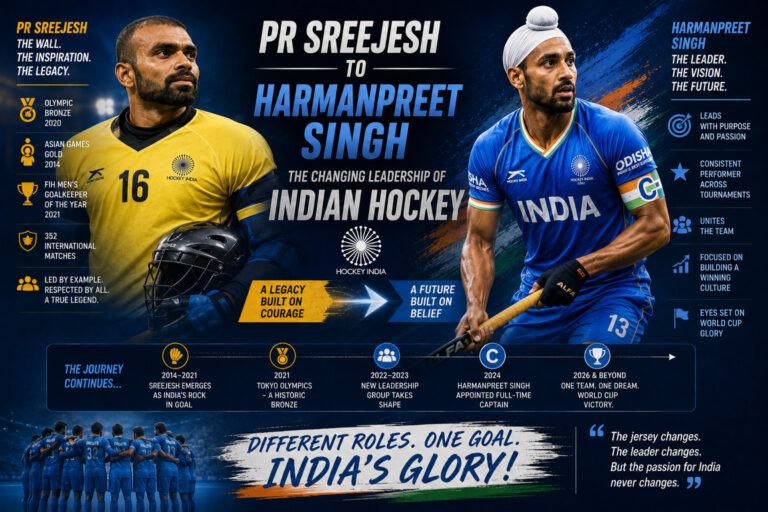
Harmanpreet Singh and the New Leadership Model
Harmanpreet Singh has become one of the central figures of India’s hockey revival. The defender is not only an important penalty-corner specialist but also a leader responsible for guiding a squad that combines experienced campaigners with younger players.
His leadership represents a transition in Indian hockey. Earlier generations were defined by legendary names whose achievements created enormous expectations. Today’s players have the difficult task of respecting that history while creating their own identity.
Harmanpreet has repeatedly emphasized responsibility rather than simply feeling pressure. Ahead of the 2026 World Cup, he acknowledged India’s long wait for another World Cup medal while focusing on the opportunity in front of the current squad. India has not won a men’s Hockey World Cup since 1975 and has not returned to the podium since that historic triumph.
That makes the current generation particularly important. It has the chance to end a decades-long wait and establish a completely new chapter in Indian hockey.
The Rise of a Younger Generation
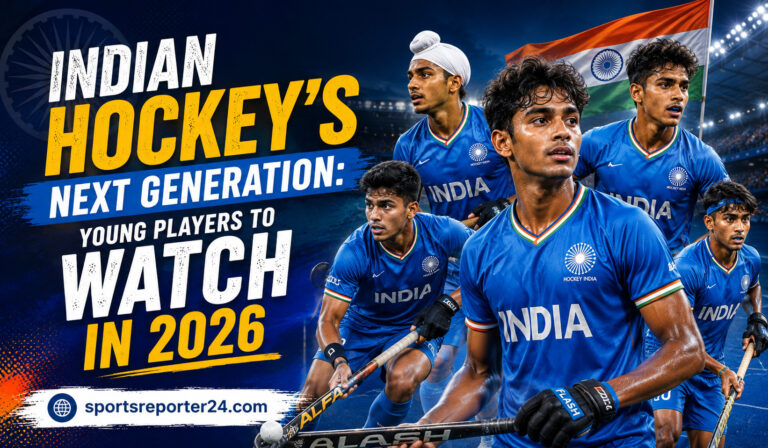
One of the biggest signs of India’s hockey revival is the increasing presence of younger players.
The national team is gradually developing greater depth instead of depending on a small group of established stars. Players such as Vivek Sagar Prasad, Raj Kumar Pal, Rajinder Singh, Shilanand Lakra and others represent the next phase of Indian hockey.
The 2025 Asia Cup was an important example of this transition. India won the tournament in Rajgir, defeating Korea 4-1 in the final and ending an eight-year wait for the continental title. The competition also provided opportunities for emerging players to demonstrate that they could handle international pressure.
The development pipeline looks equally promising. In June 2026, India’s men’s U18 team won the U18 Asia Cup after defeating Japan 4-1 in the final. Results like this matter because international success at youth level can create a stronger pathway toward the senior national team.
This depth could become one of India’s biggest advantages in the coming years.
A More Modern Style of Hockey
India’s hockey revival is not simply about producing talented players. The game itself has changed, and the Indian team has had to change with it.
Modern international hockey demands extraordinary fitness, rapid transitions, structured defensive systems and intelligent decision-making. Individual skill remains important, but teams can no longer depend entirely on flair and improvisation.
India’s recent progress has reflected a greater emphasis on tactical organization. The team has worked to become more disciplined without losing the attacking creativity traditionally associated with Indian hockey.
The defensive structure has also become increasingly important. Players such as Harmanpreet Singh and Amit Rohidas provide experience at the back, while midfielders are expected to connect defense with attack quickly.
At the other end, India’s forwards bring pace and movement that can create opportunities inside the opposition circle.
The result is a team attempting to balance traditional Indian creativity with the physical and tactical demands of modern hockey.
The Hockey India League Effect
Domestic competition has also played an important role in developing Indian hockey talent.
The Hockey India League has provided players with opportunities to compete alongside and against international stars. According to Hockey India, the revamped league helped fringe players push for senior-team selection, while the national team benefited from a long period of high-level competition.
This is valuable for young players because international hockey can be difficult to replicate in domestic training environments. Playing against experienced international athletes exposes developing players to different tactical approaches, greater speed and higher levels of physical competition.
The league can therefore function as more than an entertainment product. It can become an important bridge between domestic hockey and international competition.
If this pathway continues to improve, India’s talent pool could become deeper and more competitive.
World Cup 2026: The Biggest Test Yet
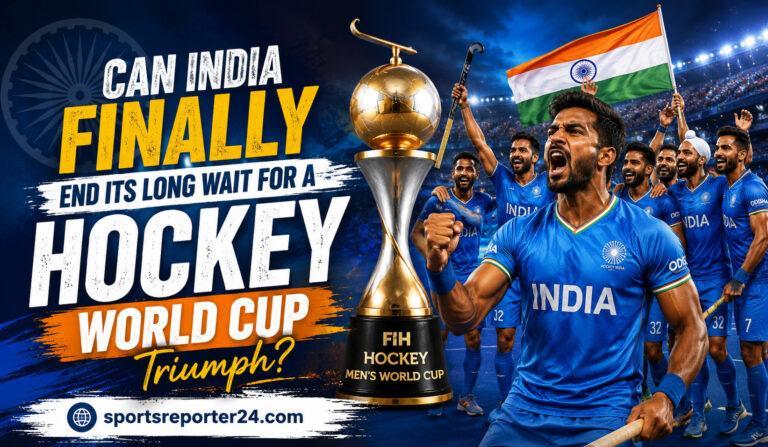
The 2026 FIH Hockey World Cup represents one of the most important opportunities for India’s current generation.
The tournament is being hosted by Belgium and the Netherlands from August 15 to August 30. India enters the competition with a difficult objective: ending a 51-year wait for a men’s World Cup medal.
India’s opening matches include Wales, England and Pakistan in the pool stage. The Pakistan fixture will naturally attract enormous attention because of the historic rivalry between the two hockey nations.
But the larger objective goes beyond one rivalry or one tournament.
A strong World Cup performance would prove that India’s Olympic revival has developed into consistent global competitiveness. A podium finish could also provide the psychological boost required to build an even stronger hockey culture across the country.
Asian Games and the Road to Los Angeles 2028
The World Cup is not India’s only major assignment in 2026. The Asian Games in Aichi-Nagoya, Japan, will also be crucial.
Hockey India has selected a 20-member men’s squad for the Asian Games, with Harmanpreet Singh as captain and experienced midfielder Manpreet Singh included alongside younger players. India enters the tournament as the defending men’s hockey champion after winning gold at the 2022 Asian Games.
The Asian Games have added importance because the men’s champion earns qualification for the 2028 Los Angeles Olympics. That makes the tournament a critical step in India’s Olympic planning.
Winning the Asian Games would allow India to secure its Olympic place early and maintain continuity in its preparation for Los Angeles.
Building More Than a Team
The revival of Indian hockey should not be measured only through medals.
A genuine new era requires a stronger development system, better facilities, improved grassroots participation and a reliable pathway from junior hockey to international competition.
The recent success of India’s U18 side is encouraging because it suggests that the pipeline is producing competitive teams. The emergence of players from different regions can further expand the sport’s reach and create greater competition for places in the senior squad.
India’s 2026 Asian Hockey5s title also provided another example of growing depth. The men’s team went unbeaten throughout the tournament and defeated Pakistan 3-1 in the final.
Such achievements may not carry the same global significance as Olympic medals, but they contribute to a broader ecosystem in which Indian players gain confidence and competitive experience.
Can India Return to the Top of World Hockey?
India still has considerable work to do.
The gap between being a strong international team and becoming a consistent title-winning side is significant. European teams remain extremely competitive, and tournaments such as the World Cup leave little room for mistakes.
India will need to improve its consistency, penalty-corner conversion, defensive concentration and ability to control matches against elite opponents.
The pressure will also increase as expectations rise. Fans who once celebrated simply reaching the Olympic podium now want India to challenge for gold and major international trophies.
That pressure can become a strength if the team learns to manage it effectively.
Coach Craig Fulton has made it clear that India wants to create its own history rather than constantly comparing the current squad with the champions of the past. His vision is particularly relevant because the team is entering an important period with the World Cup and Asian Games coming close together.
The Beginning of a New Era
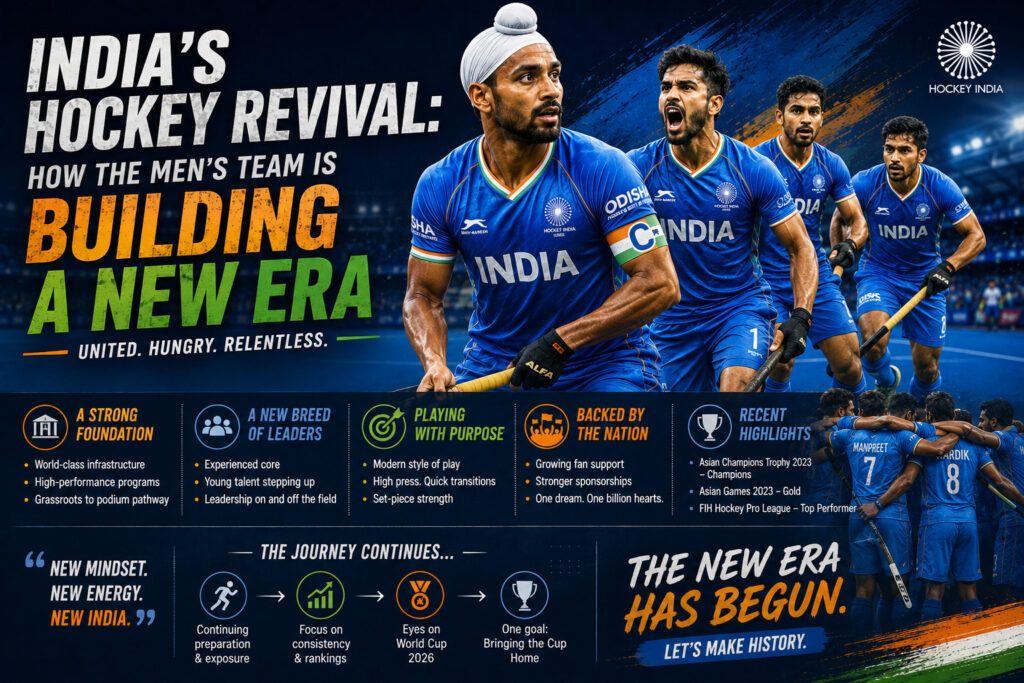
India’s hockey revival is best understood as a process rather than a single achievement.
The back-to-back Olympic bronze medals, the 2025 Asia Cup triumph, the emergence of younger players and the development of stronger domestic competition have created a promising foundation. The success of India’s youth teams adds another reason for optimism.
Now, the challenge is to turn that foundation into sustained excellence.
The 2026 World Cup could become a defining moment. A medal would end India’s long World Cup drought and give the current generation a place in hockey history. The Asian Games could then provide another opportunity to secure Olympic qualification and strengthen India’s position in Asian hockey.
For a country with such a rich hockey tradition, the goal is no longer simply to remember the past. India’s men’s team is trying to build a future in which international success becomes regular rather than exceptional.
The revival is already visible. The next step is to turn that revival into a new era of Indian hockey dominance.