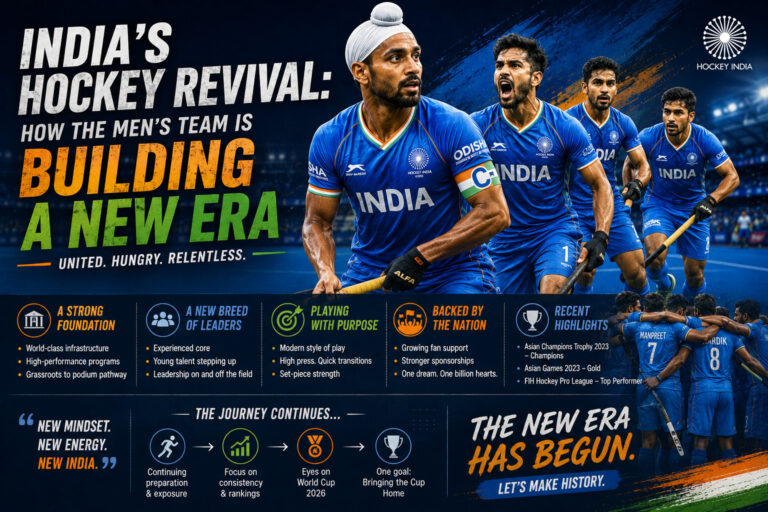

The Hockey World Cup 2026 arrives at an important moment for Indian hockey. With the Indian men’s team preparing to compete in Belgium and the Netherlands, attention is not only on established names such as Harmanpreet Singh, Manpreet Singh and Hardik Singh, but also on a group of younger players who could become the next generation of Indian hockey stars.
India enters the tournament with a blend of experience and youth. The squad announced by Hockey India includes promising youngsters in midfield and defence, while the attacking unit also has players capable of creating opportunities and changing the momentum of a match. India has been drawn in Pool D alongside England, Pakistan and Wales, with its pool matches scheduled in Amstelveen, Netherlands.
For these emerging players, the FIH Hockey World Cup 2026 is more than another international tournament. It is an opportunity to demonstrate that Indian hockey has the depth required to compete consistently against the world’s strongest teams.
A New Generation Is Emerging in Indian Hockey
Indian hockey has undergone a significant transformation over the past decade. The success of the national teams at major international tournaments has helped create greater belief among young players. At the same time, domestic competitions and international exposure have given emerging hockey players more opportunities to develop their skills.
The 2026 World Cup reflects this changing landscape.
The Indian men’s squad contains experienced players who understand the pressure of international hockey, but it also features youngsters who are looking to establish themselves at the highest level. Hockey India has specifically highlighted players such as Rajinder Singh and Aditya Arjun Lalage among the promising young midfield options in the World Cup squad.
Their presence is significant because modern hockey requires midfielders to contribute in almost every phase of the game. They must defend, carry the ball forward, create scoring opportunities and quickly transition between attack and defence.
For young players, performing these responsibilities against elite opposition can be a major test. However, it can also be the stage where a relatively unknown player becomes a household name.
Rajinder Singh: A Midfield Opportunity
One of the youngsters attracting attention ahead of the tournament is Rajinder Singh.
Hockey India has included Rajinder among the promising midfield options alongside established names such as Manpreet Singh, Hardik Singh and Vivek Sagar Prasad.
The presence of experienced midfielders around him could be particularly valuable. Rather than carrying the entire responsibility of controlling the middle of the pitch, a young player can learn from senior teammates while gradually taking on more responsibility.
Rajinder’s challenge will be to maintain composure when the intensity rises. World Cup matches can change within seconds, and midfielders often have very little time to make decisions.
A successful tournament could give Rajinder more than just World Cup experience. It could establish him as one of the players India can depend on in the years ahead.
Aditya Arjun Lalage: Another Young Midfield Talent
Aditya Arjun Lalage is another emerging name included among India’s midfield options for the 2026 World Cup. His selection reflects India’s effort to introduce younger talent while maintaining a strong core of experienced players.
For Lalage, the World Cup provides a unique learning environment. Training alongside established international players and competing against top teams can accelerate a young player’s development.
Midfield is also one of the most demanding areas of modern hockey. A player needs stamina, speed, technical ability and tactical awareness. The ability to move the ball quickly can be just as important as individual skill.
If Lalage gets meaningful opportunities during the tournament, his performances could be closely watched by Indian hockey supporters.
Mohith HS: A Goalkeeper With a Big Opportunity
The goalkeeper position comes with enormous responsibility. One mistake can change a match, while one outstanding save can keep a team alive.
Mohith HS is among the young Indian players identified by Hockey India as a rising talent ahead of the 2026 Men’s Hockey World Cup.
For a young goalkeeper, being part of a World Cup squad can be a valuable step in development. Even when an experienced goalkeeper is the first choice, training in a major tournament environment exposes a younger player to the speed, tactical preparation and pressure associated with elite international hockey.
The World Cup could therefore become an important chapter in Mohith’s development.
Yashdeep Siwach: A Young Defender to Watch
Defence has traditionally been an important part of India’s hockey identity, and the national team’s future will depend on developing reliable defenders who can handle fast international attacks.
Yashdeep Siwach is another rising Indian player highlighted by Hockey India ahead of the 2026 World Cup.
For defenders, the modern game demands much more than simply stopping opposition attacks. They need to read the game early, win possession cleanly and help launch counterattacks.
A young defender also needs strong communication with the goalkeeper and senior defenders. At the World Cup level, small positional mistakes can create dangerous scoring opportunities for opponents.
Siwach’s opportunity is therefore about more than individual performance. It is about showing that India has a strong defensive pipeline for the future.
India’s Attack Still Has Plenty of Firepower
While young defenders and midfielders are attracting attention, India’s attack also contains players capable of making a difference.
The 2026 squad lists Mandeep Singh, Dilpreet Singh, Abhishek, Sukhjeet Singh and Shilanand Lakra among the attacking options.
This attacking group combines experience, speed and different styles of play. For India’s younger players, having experienced forwards around them can create opportunities to learn how to operate under World Cup pressure.
Modern hockey is increasingly fast and transitional. Teams can move from defence to attack within seconds, making quick decision-making crucial.
India’s attacking players will therefore need to make the most of limited opportunities. Against strong opponents, there may not be many clear chances during a match. Converting even one or two opportunities could decide the result.
Why Young Players Could Be Important for India
The importance of India’s rising stars goes beyond the 2026 tournament.
International hockey is becoming increasingly competitive. Teams cannot rely on a small group of senior players forever. Injuries, workload, form and retirement mean that every successful hockey nation needs a steady supply of new talent.
Young players provide that depth.
The 2026 World Cup can help India identify which emerging players are ready for regular international responsibilities. A strong performance could also increase competition for places in future Pro League campaigns, Asian Games competitions and Olympic preparations.
The transition between generations is one of the biggest challenges faced by any national team. India appears to be approaching that transition by combining experienced leaders with younger options.
Learning From Experienced Leaders
One of India’s biggest advantages is the presence of senior players.
Harmanpreet Singh leads the Indian men’s team, while players such as Manpreet Singh, Hardik Singh and Vivek Sagar Prasad provide experience in midfield.
For emerging players, this experience can be invaluable.
A young hockey player may have the technical ability to compete internationally but still need to learn how to handle pressure, manage difficult moments and maintain concentration throughout an intense match.
Experienced teammates can help bridge that gap.
The younger players also bring something valuable to the squad: energy, hunger and a desire to establish themselves. That combination can create healthy competition within the team.
The Pressure of the Hockey World Cup
Playing at a Hockey World Cup is very different from playing domestic hockey.
Every mistake receives greater attention. Every match can have major consequences. Opponents study each other carefully, and tactical adjustments can happen throughout a game.
For India’s rising stars, handling this pressure could be their biggest challenge.
They will have to remain focused even when the atmosphere becomes intense. A young player who makes an early mistake cannot afford to lose confidence. Similarly, a player who scores or makes an important defensive contribution must remain disciplined instead of becoming overly aggressive.
Mental strength could ultimately determine which youngsters make the biggest impact.
India’s Pool Will Test the Youngsters
India’s position in Pool D alongside England, Pakistan and Wales means the team will face opponents with different playing styles and levels of tactical challenge.
England can provide a physically demanding contest, while matches against Pakistan carry their own historical significance. Wales can also present a tactical challenge that requires India to remain disciplined.
For young players, this variety is valuable.
Instead of facing only one type of opponent, India’s emerging stars will experience different tactical situations during the pool stage. That experience could prove useful throughout their international careers.
A strong start would also help the younger players gain confidence before the knockout stages.
The Bigger Picture for Indian Hockey
The 2026 World Cup is not only about winning matches. It is also about building the future of Indian hockey.
India has a long and proud hockey tradition, but maintaining success requires continuous investment in young players. The presence of emerging names in the senior World Cup squad shows that the pathway from youth and domestic hockey to the international level continues to develop.
The International Hockey Federation describes junior competitions as an important platform for young players, highlighting their role in developing future international talent.
The challenge now is to ensure that promising players receive enough international exposure to turn potential into consistency.
Can the Rising Stars Become World Cup Heroes?
The biggest question surrounding India’s young hockey players is simple: Can they handle the biggest stage?
Nobody expects every youngster to become a star overnight. Some may spend most of the tournament learning from the experienced players. Others could receive an opportunity because of tactical requirements, injuries or match situations.
But tournaments often produce unexpected heroes.
A crucial goal from a young forward, a last-second save from a goalkeeper or a perfectly timed defensive interception can change the narrative around a player.
That is what makes the World Cup so exciting.
India’s rising stars enter the tournament with an opportunity that many young athletes dream about. They have already crossed one major barrier by earning selection for the senior World Cup squad. The next step is turning that opportunity into performances.
What Could the Future Look Like?
Regardless of how far India goes in the 2026 Hockey World Cup, the experience gained by its younger players could be extremely important.
Players such as Rajinder Singh, Aditya Arjun Lalage, Mohith HS and Yashdeep Siwach represent the broader development of India’s next hockey generation. Their progress will be closely connected to India’s ambitions beyond 2026.
If these players develop alongside established stars, India could have a stronger and deeper squad in future international competitions.
The objective should not simply be to produce one successful World Cup team. It should be to create a generation of players capable of competing consistently at the highest level.
Final Thoughts
The India Hockey World Cup 2026 campaign represents both a challenge and an opportunity.
Experienced players will provide leadership, but the emerging generation could give India the energy and depth required to compete against the world’s best. With Rajinder Singh, Aditya Arjun Lalage, Mohith HS and Yashdeep Siwach among the youngsters attracting attention, Indian hockey supporters have several new names to watch.
The tournament could become an important stepping stone for these players. A few strong performances may turn promising youngsters into established international stars.
For Indian hockey, that is perhaps the most exciting part of the 2026 World Cup. The tournament is not only about the players carrying India’s hopes today it could also introduce the players who will carry those hopes tomorrow.