Indian hockey has always produced iconic leaders. From the legendary Ajit Pal Singh of the 1970s to modern-day stars such as PR Sreejesh and Harmanpreet Singh, the captaincy of the Indian men’s hockey team has evolved alongside the sport itself.
Leadership in hockey is not simply about wearing the captain’s armband. It is about handling pressure, guiding younger players, responding after setbacks and delivering when the team needs a moment of inspiration.
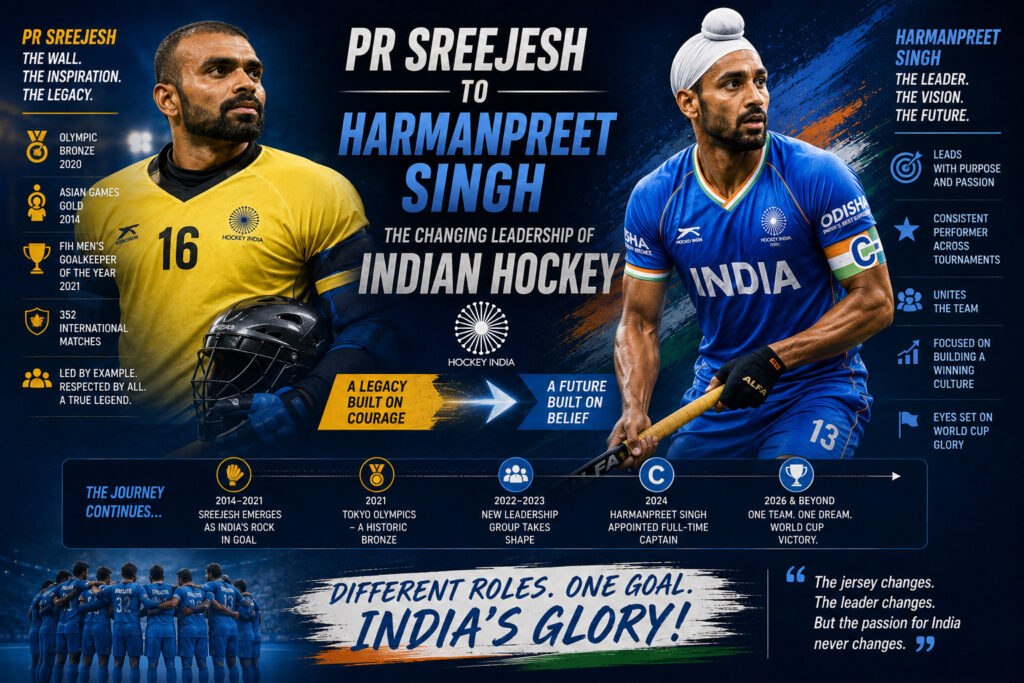
Over the last decade, PR Sreejesh and Harmanpreet Singh have represented two different but equally important versions of Indian hockey leadership.
Sreejesh became the emotional backbone of the team during a period when Indian hockey was rebuilding its international reputation. Harmanpreet, meanwhile, has inherited that responsibility during a new era in which India expects to compete for medals consistently.
The transition from Sreejesh to Harmanpreet is therefore more than a change in captaincy. It represents a changing Indian hockey team.
One generation helped restore belief.
The next generation is being asked to turn that belief into trophies.
PR Sreejesh: The Leader Behind the Mask
PR Sreejesh’s leadership story is unusual because his primary responsibility was not scoring goals or controlling midfield.
He was a goalkeeper.
Yet, for years, Sreejesh was one of the most recognizable leaders in Indian hockey.
His career stretched across multiple generations of players. He represented India at four Olympic Games and became one of the most experienced players in the national setup. He also played a crucial role in India’s Olympic bronze-medal campaigns at Tokyo 2020 and Paris 2024.
Sreejesh’s importance went beyond statistics.
Goalkeepers have a unique view of the entire field. From the back of the pitch, they can see defensive gaps, attacking movements and the positioning of teammates.
That perspective helped Sreejesh become a natural communicator.
His voice could be heard throughout matches, especially during defensive situations.
He was constantly organizing the players in front of him.
That made his leadership visible even when he was not wearing the captain’s armband.
Sreejesh’s Greatest Contribution: Restoring Belief
There was a period when Indian hockey struggled to reproduce the success associated with its golden era.
India had tremendous history but found it difficult to consistently compete for medals at the biggest international tournaments.
Sreejesh became one of the central figures in changing that narrative.
His performances helped India regain confidence at major competitions.
The Tokyo Olympics were particularly significant.
India ended a 41-year wait for an Olympic men’s hockey medal by winning bronze.
For a generation of Indian hockey players, that moment changed everything.
Suddenly, Olympic success no longer felt like something belonging only to India’s past.
Sreejesh was one of the emotional faces of that revival.
The Paris Olympics Added Another Chapter
If Tokyo represented the beginning of India’s modern hockey revival, Paris 2024 demonstrated that the success was not a one-time event.
India won another bronze medal.
Sreejesh was again an important part of the campaign.
The Paris Games ultimately became the final Olympic appearance of his international career.
Retirement after the tournament brought an emotional end to one of the most celebrated careers in Indian hockey.
Sreejesh left the international game with two consecutive Olympic bronze medals and a reputation as one of India’s greatest goalkeepers.
His departure created a huge leadership gap.
The question was obvious:
Who would carry Indian hockey forward?
The answer was Harmanpreet Singh.
Harmanpreet Singh: A New Type of Leader
Harmanpreet’s leadership style is very different from Sreejesh’s.
He is a defender rather than a goalkeeper.
He is also one of India’s most dangerous attacking weapons because of his exceptional penalty-corner ability.
This makes him a fascinating captain.
He leads from the back while simultaneously contributing to India’s attack.
His responsibilities are therefore both tactical and psychological.
As a defender, he must organize India’s defensive structure.
As a penalty-corner specialist, he can change a match with one powerful drag flick.
As captain, he must keep the entire team focused.
That combination makes Harmanpreet one of the most important players in Indian hockey.
From Young Defender to National Captain
Harmanpreet’s journey to leadership began long before he became captain.
He emerged as one of India’s most promising young defenders and gradually developed into an established international player.
His penalty-corner skills became one of his biggest weapons.
Over time, he became one of the world’s leading drag-flick specialists.
But his development was not limited to scoring.
He became increasingly comfortable organizing India’s defensive unit and taking responsibility during crucial moments.
That evolution eventually made him a natural candidate for captaincy.
Harmanpreet Has Already Delivered Under Pressure
The biggest argument in favour of Harmanpreet’s leadership is his record in major tournaments.
At the Paris Olympics, he captained India to a second consecutive bronze medal.
He also finished as the tournament’s leading scorer with 10 goals.
His two goals in the bronze-medal match against Spain were particularly memorable.
India needed its captain to deliver.
He did.
Those performances demonstrated that Harmanpreet can handle the pressure that comes with leading India at the biggest sporting events.
Two Captains, Two Leadership Styles
Comparing Sreejesh and Harmanpreet is not really about deciding who was the better captain.
Their leadership styles developed under different circumstances.
Sreejesh was the emotional guardian.
He inspired teammates through experience, communication and spectacular saves.
Harmanpreet is the tactical leader.
He influences matches through defensive organization, penalty corners and decision-making.
Sreejesh’s leadership often began from the goal line.
Harmanpreet’s leadership operates from the defensive line and extends into attack.
Both approaches have been valuable.
Sreejesh’s Emotional Leadership
Sreejesh was known for his energy and passion.
A goalkeeper can become the emotional centre of a hockey team because every major defensive moment is visible.
A spectacular save can lift an entire team.
A mistake can change the momentum.
Sreejesh understood that dynamic.
His communication with defenders was constant.
He also became a mentor for younger goalkeepers and players entering the national team.
That mentorship is an important part of his legacy.
Leadership is not only about what happens during a match.
It is also about what experienced players teach the next generation.
Harmanpreet’s Calm Leadership
Harmanpreet’s style is comparatively composed.
He does not need to constantly dominate the spotlight.
His influence often comes through his positioning, communication and decision-making.
That can be particularly valuable in modern hockey.
The sport is incredibly fast.
Players have only seconds to make decisions.
A captain who remains calm under pressure can help the team avoid unnecessary mistakes.
Harmanpreet’s experience at multiple Olympic Games and major international tournaments gives him that perspective.
The Importance of Experience
One of the biggest similarities between Sreejesh and Harmanpreet is experience.
Both have played alongside multiple generations of Indian hockey players.
That experience matters because international hockey is unpredictable.
A team can dominate possession and still lose.
A single penalty corner can change a match.
One defensive mistake can eliminate a team from a major tournament.
Experienced players understand those realities.
Harmanpreet has inherited that knowledge from Sreejesh’s generation and now has to pass it on to younger teammates.
India’s Hockey Culture Has Changed
The leadership transition has happened alongside a broader transformation in Indian hockey.
India is now operating with greater professionalism in areas such as fitness, sports science, tactical preparation and international exposure.
The players are also more accustomed to competing against the world’s strongest teams.
This means the captain’s role has changed.
Earlier, leadership could be heavily focused on motivation.
Today, it also requires tactical understanding, communication with coaching staff and managing a squad through a demanding international schedule.
Harmanpreet represents this modern version of leadership.
The Rise of Fitness in Indian Hockey
Fitness has become one of the defining characteristics of India’s modern hockey team.
The speed of international hockey means players must be able to sprint, recover and repeat high-intensity movements throughout a match.
Sreejesh witnessed this transformation throughout his career.
Harmanpreet is now leading a team that places enormous emphasis on physical preparation.
That change is important because India increasingly wants to compete with European powerhouses on equal terms.
The captain has to set the standard.
From Tokyo to Paris: A Legacy Passed Forward
The Tokyo Olympics were a turning point for Indian hockey.
The Paris Olympics then confirmed that India had built a sustainable medal-winning team.
Sreejesh was part of both moments.
Harmanpreet was also part of both.
This makes the transition particularly interesting.
It is not as if one generation disappeared and another suddenly arrived.
There was an overlap.
Sreejesh helped establish the culture.
Harmanpreet was there to learn from it.
Now Harmanpreet has to lead that culture forward.
What Harmanpreet Inherits From Sreejesh
Harmanpreet inherits more than a captaincy role.
He inherits expectations.
Sreejesh helped create a belief that India could consistently challenge for Olympic medals.
That belief now exists within the team.
Indian fans expect more than participation.
They expect victories.
They expect medals.
They expect India to compete with Australia, Belgium, Germany and the Netherlands.
For Harmanpreet, that is both an advantage and a challenge.
The advantage is that the team enters major tournaments with confidence.
The challenge is that expectations are significantly higher.
The World Cup Challenge
The biggest test of Harmanpreet’s leadership is likely to come at the 2026 Hockey World Cup.
India enters the tournament with ambitions of ending a long wait for a World Cup title.
India’s only men’s Hockey World Cup victory came in 1975.
More than five decades later, Harmanpreet has the opportunity to lead a new generation toward the same prize.
That creates enormous historical significance.
But Harmanpreet has repeatedly emphasized focusing on the tournament rather than becoming consumed by the past.
That mindset could be crucial.
Harmanpreet’s Penalty Corner: A Leadership Weapon
One of the biggest differences between Sreejesh and Harmanpreet is that Harmanpreet can directly influence the scoreboard.
His drag flick is one of India’s most dangerous weapons.
Whenever India wins a penalty corner, opponents know that Harmanpreet could be the player taking the shot.
That creates psychological pressure.
Defenders must react quickly.
Goalkeepers have to anticipate his variations.
India’s coaching staff can also design different routines around his abilities.
This means Harmanpreet’s technical skills become part of his leadership value.
But India Cannot Depend Only on Harmanpreet
This is where Harmanpreet’s leadership will be tested.
A successful captain cannot become the team’s only solution.
Opponents understand his importance.
They can work to restrict India’s penalty corners.
They can pressure him during build-up play.
They can attempt to isolate him defensively.
India therefore needs other players to step forward.
Forwards must score.
Midfielders must create opportunities.
Defenders must remain disciplined.
The goalkeeper must provide confidence at the back.
Harmanpreet’s role is to make the whole team better, not simply score goals himself.
The Next Generation Needs His Guidance
Every leadership era eventually becomes a mentorship era.
Sreejesh once guided younger players.
Now Harmanpreet must perform a similar role.
Young Indian players need to understand what international pressure feels like.
They need advice on dealing with difficult matches.
They need to learn how to recover after mistakes.
And they need to understand the standards required to remain at the top.
Harmanpreet’s experience can help them make that transition.
This could ultimately become one of his most important contributions to Indian hockey.
Leadership Beyond the Captain’s Armband
One lesson from Sreejesh’s career is that leadership does not always depend on official titles.
A player can lead through performance.
Another can lead through communication.
Someone else can provide emotional support.
Harmanpreet has inherited the formal captaincy, but India’s leadership group is likely to include several senior players.
That is healthy for the team.
A strong leadership group reduces the pressure on one individual.
It also helps younger players feel supported.
The Future After Harmanpreet
Even Harmanpreet’s captaincy will eventually end.
That is inevitable.
The question is whether the next generation will be ready.
The best way to honour Sreejesh and Harmanpreet is not simply to celebrate their careers.
It is to develop players who can eventually replace them.
Indian hockey needs young defenders, midfielders, forwards and goalkeepers who are comfortable carrying responsibility.
The leadership transition must therefore continue.
Sreejesh replaced earlier legends.
Harmanpreet succeeded Sreejesh’s generation.
One day, another player will inherit Harmanpreet’s role.
Why This Transition Matters
The move from Sreejesh to Harmanpreet symbolizes something larger.
Indian hockey is no longer trying merely to return to its past.
It is attempting to build a new future.
The 1970s remain a legendary period in Indian hockey history.
But today’s players cannot simply recreate that era.
They need to create their own.
Sreejesh’s generation restored Olympic success.
Harmanpreet’s generation now wants to establish India as a consistent contender across all major tournaments.
That is a much bigger challenge.
Can Harmanpreet Build on Sreejesh’s Legacy?
The answer will depend on what happens during the next few years.
Sreejesh leaves behind an extraordinary legacy.
He helped India regain Olympic relevance and became one of the most respected goalkeepers in world hockey.
Harmanpreet now has the opportunity to take the next step.
He has already won Olympic medals.
He has already captained India successfully.
He has already established himself as one of the world’s best penalty-corner specialists.
But the World Cup remains a major prize.
Winning it would transform his captaincy legacy.
Final Thoughts
The journey from PR Sreejesh to Harmanpreet Singh is one of the most fascinating leadership transitions in modern Indian hockey.
Sreejesh represented resilience, experience and emotional strength. His goalkeeping and leadership helped India overcome years of disappointment and return to the Olympic podium.
Harmanpreet represents the next phase.
He is younger, tactically influential and capable of directly changing matches with his penalty-corner expertise. He has inherited a team that no longer sees medals as an unrealistic dream.
That is perhaps the biggest difference between the two eras.
Sreejesh helped India believe again.
Harmanpreet is being asked to make that belief permanent.
The challenge ahead is enormous.
India wants to compete for major international titles, end its long World Cup drought and establish itself among the world’s strongest hockey nations.
If Harmanpreet can combine his scoring ability with calm decision-making and strong leadership, he could become one of the defining captains in Indian hockey history.
And when future generations look back at this period, they may see the transition from Sreejesh to Harmanpreet not as the end of one era, but as the beginning of another.