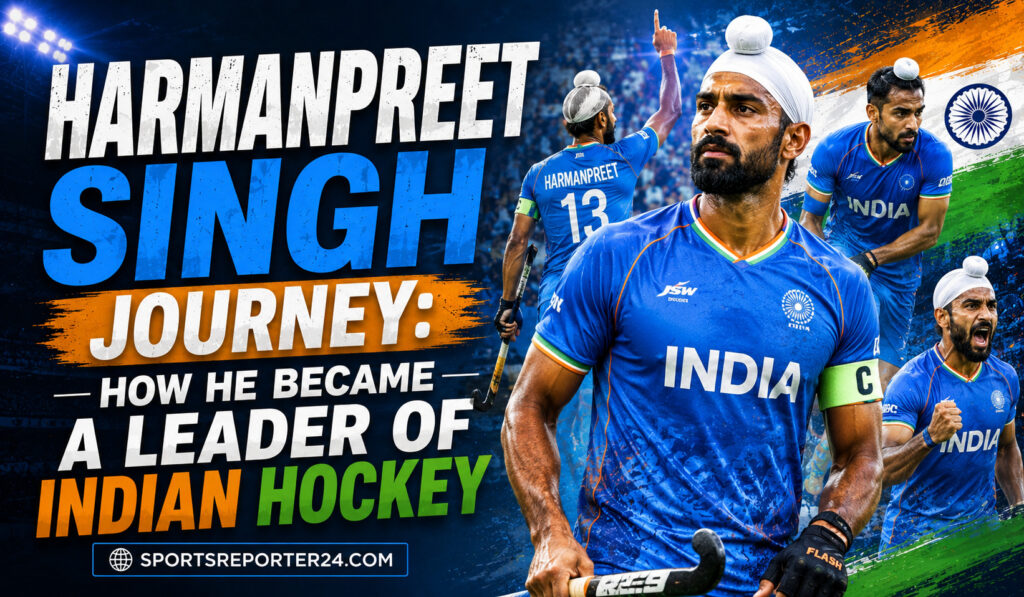
Harmanpreet Singh Journey
Harmanpreet Singh’s rise is one of the most compelling stories in modern Indian hockey. From a talented youngster who broke into the national setup in 2015 to becoming the captain of India’s men’s hockey team, his career has been shaped by persistence, defensive discipline, penalty-corner expertise and an ability to perform when the pressure is highest.
Today, Harmanpreet is much more than a defender. He is one of India’s most important penalty-corner specialists, an experienced international player and the leader of a team attempting to end a long wait for a Hockey World Cup medal.
With India heading into the FIH Hockey World Cup 2026, Harmanpreet’s role has become even more significant. Hockey India has named him captain of the 2026 World Cup squad, with India beginning its campaign against Wales on August 15.
His journey from a promising young defender to one of the biggest names in Indian hockey offers a closer look at how India’s new generation has helped revive the country’s fortunes on the international stage.
The Early Years of Harmanpreet Singh
Born on January 6, 1996, Harmanpreet Singh grew up in Punjab, a region with a deep connection to Indian hockey. His early development eventually took him into India’s junior hockey system, where his ability as a defender and drag-flicker began to attract attention.
Hockey India records his international debut as coming in 2015. His early breakthrough arrived during the junior level, where he became part of an Indian generation that would later make a significant impact on senior international hockey.
Rather than being known purely for defensive work, Harmanpreet quickly developed a dangerous attacking weapon: the drag-flick.
That skill would eventually become one of the defining features of his career.
The 2015 Junior Asia Cup Breakthrough
One of the important early milestones in Harmanpreet’s career came at the 2015 Men’s Hockey Junior Asia Cup in Malaysia.
India won the tournament, giving the young defender valuable international experience and a taste of success at a major competition. Hockey India’s records list the junior Asia Cup gold among his early achievements.
For a young player, winning a major junior tournament can provide confidence. But Harmanpreet’s progression did not stop there.
The following year would become even more important.
Junior World Cup Glory in 2016
In 2016, Harmanpreet was part of the Indian team that won the Men’s Hockey Junior World Cup in Lucknow.
The tournament was a major moment for Indian hockey because several players from that generation would go on to become important members of the senior national team.
Harmanpreet was one of them.
His performances helped establish his reputation as a defender capable of contributing at both ends of the pitch. His penalty-corner ability gave India another attacking option, while his defensive work made him increasingly valuable to the team.
The Junior World Cup title became an important stepping stone before his transition into senior international hockey.
The 2016 Champions Trophy That Changed His Career
The next major turning point came at the 2016 FIH Champions Trophy in London.
India won the silver medal, and Harmanpreet emerged as one of the tournament’s most exciting young players. Hockey India notes that he was recognised as the Rising Player of the Tournament after an impressive campaign.
This performance helped accelerate his move into the spotlight.
Harmanpreet was no longer simply a promising junior player. He was demonstrating that he could compete against experienced international opponents.
His powerful drag-flicks became a particular talking point. Penalty corners can often determine close hockey matches, and India suddenly had a young defender capable of turning those opportunities into goals.
From Youngster to Olympian
Harmanpreet’s rapid rise earned him a place in India’s squad for the Rio 2016 Olympics.
At that stage of his career, simply reaching the Olympics was a major achievement. He was among the youngest players in India’s squad and was entering an environment where every match carried enormous pressure. Hockey India records India’s Rio campaign as ending in eighth place.
The result was not what India wanted, but the experience was invaluable.
For Harmanpreet, the Olympics provided exposure to the highest level of international competition. It also gave him an understanding of what would be required if India wanted to compete for medals at future Games.
That lesson would become important several years later.
Establishing Himself in the Senior Team
After Rio, Harmanpreet continued to develop into a regular member of India’s senior side.
He contributed to India’s 2017 Asia Cup gold medal, the 2018 Champions Trophy silver medal and the 2018 Asian Games bronze medal. He was also part of India’s gold-winning Asian Champions Trophy campaign in 2018.
These tournaments gradually transformed his status.
He was no longer simply one of India’s young prospects. He had become an established international defender.
At the same time, his drag-flicking became an increasingly important part of India’s attacking strategy.
The Defender Who Could Score
One of the most unusual aspects of Harmanpreet Singh’s career is his ability to combine defensive responsibilities with consistent goal-scoring.
A defender is generally expected to stop attacks, protect the circle and help build play from the back. Harmanpreet has added another dimension by becoming one of India’s most dangerous penalty-corner specialists.
His drag-flick allows him to generate tremendous power and accuracy from penalty corners.
This has made him a constant threat whenever India earns a set-piece opportunity.
In modern international hockey, that can be a major advantage. Matches between closely matched teams can be decided by a single penalty corner, making specialists extremely valuable.
The Tokyo Olympics: A Career-Defining Medal
The Tokyo 2020 Olympics, held in 2021 after the Games were postponed, represented one of the biggest moments of Harmanpreet’s career.
India ended a 41-year wait for an Olympic men’s hockey medal by winning bronze.
Harmanpreet was an important part of that campaign, contributing goals and defensive stability throughout the tournament. Hockey India’s profile records the Tokyo bronze as his first Olympic medal.
For Indian hockey, the achievement had enormous significance.
For Harmanpreet personally, it demonstrated that the lessons learned from his difficult Olympic debut in Rio could eventually translate into success on the biggest stage.
The young defender who had entered the Olympics in 2016 had now become an Olympic medallist.
Becoming One of the World’s Best
Harmanpreet’s performances around the Tokyo Olympics also brought individual recognition.
He won the FIH Men’s Player of the Year award for 2020-21, adding another important achievement to his career. Hockey India also lists him as the FIH Men’s Player of the Year for 2021-22.
His performances showed that his influence went beyond penalty corners.
He had become a complete international defender who could organise the backline, contribute to attacks and take responsibility during crucial moments.
His leadership qualities were also becoming increasingly visible.
Asian Games Gold and Leadership Growth
Another major milestone arrived at the 2022 Asian Games in Hangzhou.
India won the men’s hockey gold medal, and the achievement was particularly important because the Asian Games title also carried qualification significance for the Olympic cycle.
Harmanpreet was now operating as one of the senior figures within the team.
His journey was increasingly moving from individual performance toward leadership.
A captain has to think beyond personal statistics. The responsibility includes managing teammates, communicating with coaches, staying composed during difficult matches and setting the standard during training.
Harmanpreet gradually took on those responsibilities.
Leading India at the Paris Olympics
The Paris 2024 Olympics became another memorable chapter.
India won a second consecutive Olympic bronze medal, and Harmanpreet was among the team’s key contributors. Hockey India’s official profile lists both Tokyo 2020 and Paris 2024 bronze medals among his major achievements.
Back-to-back Olympic medals represented a significant achievement for Indian hockey.
The result also showed how far the team had progressed compared with the disappointment of Rio 2016.
For Harmanpreet, it was another indication of his transformation from a promising youngster into one of the leaders of Indian hockey.
The Making of a Captain
Leadership did not happen overnight.
Harmanpreet had spent years playing alongside senior players, experiencing victories and disappointments, and learning how international teams operate.
He had also captained India on previous occasions before becoming the established leader of the men’s team.
Hockey India’s records show that he was entrusted with captaincy responsibilities as early as 2019, when he was named skipper for India’s Olympic Test event in Japan.
That early leadership experience gave him a foundation for his later role.
By 2026, Harmanpreet is not simply wearing the captain’s armband. He is expected to provide direction to a squad that combines experienced players with younger talent.
Harmanpreet Singh and the 2026 Hockey World Cup
The 2026 Hockey World Cup could become one of the most important tournaments of Harmanpreet Singh’s career.
India has a major historical objective: returning to the World Cup podium.
The FIH notes that India won the inaugural World Cup medal in 1971, followed it with silver in 1973 and won the title in 1975, but has not returned to the podium since that 1975 triumph.
That makes the current campaign particularly significant.
Harmanpreet has acknowledged the importance of ending India’s long World Cup medal drought, describing the challenge as a responsibility rather than simply pressure.
India’s 2026 squad is led by Harmanpreet and features a combination of experienced players and emerging talent.
This puts the captain at the centre of India’s World Cup ambitions.
Why His Drag-Flick Could Be Crucial
India’s success in the 2026 World Cup could depend heavily on penalty-corner efficiency.
Harmanpreet is one of the players India will look toward whenever the team earns a penalty corner.
His drag-flick provides India with a direct scoring route, particularly in matches where open-play opportunities are limited.
But opponents know this too.
International teams will study India’s penalty-corner routines, attempt to block Harmanpreet’s preferred angles and look for ways to reduce his influence.
That means India’s captain will have to remain unpredictable.
His ability to vary placement, timing and execution could become extremely important during close matches.
Leadership Beyond the Scoreboard
A captain’s contribution cannot always be measured through goals.
Harmanpreet’s leadership will also be visible in how India responds to setbacks.
If India concedes an early goal, the captain must help the team remain calm. If a young player makes a mistake, he needs to encourage the player rather than allow confidence to disappear.
If India takes the lead, he must ensure the team remains disciplined.
These moments can define leadership.
Harmanpreet’s years of international experience give him an advantage in understanding these situations.
Inspiring the Next Generation
Perhaps one of Harmanpreet’s biggest contributions to Indian hockey will be the example he sets for younger players.
The current generation of Indian hockey prospects can look at his career and see a clear pathway.
He started as a young player, represented India at the Olympics, experienced disappointment, won Olympic medals, collected major international titles and eventually became captain.
That journey demonstrates that international success is rarely immediate.
Development takes time.
The players entering India’s senior squad today can learn from Harmanpreet’s discipline, preparation and ability to keep improving his strongest skills.
Awards That Reflect His Impact
Harmanpreet’s individual achievements provide another indication of his influence.
Hockey India’s official profile lists several major honours, including the Arjuna Award in 2021, the Major Dhyan Chand Khel Ratna Award in 2024, multiple Hockey India Defender of the Year awards and two FIH Men’s Player of the Year honours.
These awards are not simply personal milestones.
They reflect the consistency he has maintained over several seasons.
For a defender, sustaining elite-level performance while also contributing goals is particularly difficult.
The Road Ahead
At 30 years old, Harmanpreet remains a central figure in Indian hockey.
His career has already included junior world glory, Olympic medals, Asian Games gold, continental titles and major individual awards.
But the 2026 World Cup presents a different challenge.
India is chasing a medal in a tournament where the country has historically enjoyed enormous success but has endured a long podium drought.
Harmanpreet now has the opportunity to lead India through that challenge.
The outcome could become one of the defining chapters of his captaincy.
Final Thoughts
Harmanpreet Singh’s journey from young defender to leader of Indian hockey is a story of gradual growth rather than overnight success.
His early junior achievements opened the door. The 2016 Champions Trophy announced his arrival on the international stage. The Rio Olympics gave him experience. The Tokyo and Paris Olympic bronze medals established him as part of a successful generation. His individual awards recognised his excellence, while his progression into captaincy demonstrated the trust placed in his leadership.
Now, with Harmanpreet Singh leading India at the Hockey World Cup 2026, the next chapter is waiting to be written.
For Indian hockey fans, the hope is simple: the same defender who once represented the promise of a new generation can now lead that generation toward a World Cup medal.
And if India succeeds, Harmanpreet’s journey will become more than the story of an outstanding hockey player. It will become the story of a captain who helped guide Indian hockey back toward the top of the world.