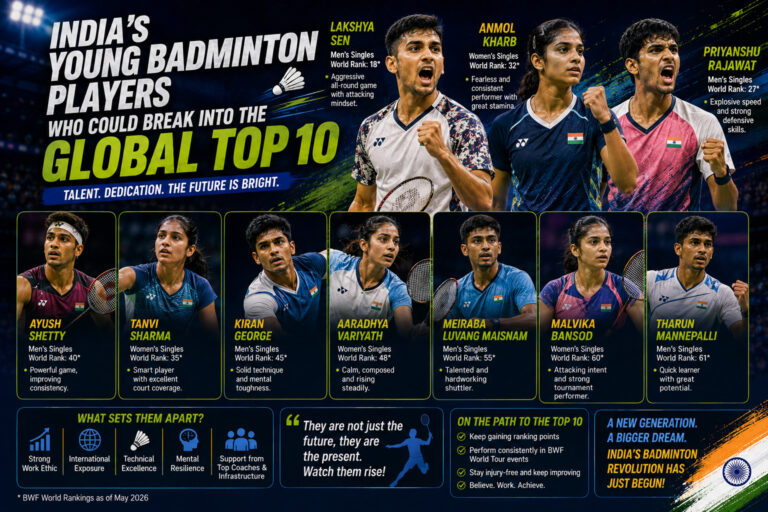

India’s new badminton generation
Indian badminton has reached an interesting turning point.
For years, the sport was strongly associated with names such as Pullela Gopichand, Saina Nehwal, Kidambi Srikanth and PV Sindhu. They helped take Indian badminton from a developing sport to one capable of producing Olympic medals, world champions and major international victories.
Now, a new generation is waiting for its opportunity.
Players such as Ayush Shetty, Unnati Hooda, Simran Singhi and Kavipriya Selvam are among the younger Indian shuttlers preparing to compete at the highest level. Four Indian players are set to make their BWF World Championships debut in New Delhi in August 2026, giving this emerging group an important opportunity on home soil.
The challenge is enormous.
Indian badminton has already established high expectations. The next generation will not simply be asked to participate. They will be expected to compete against the world’s strongest players and eventually carry the country’s medal hopes.
A New Chapter After the Previous Generation
Indian badminton’s recent success created a difficult standard for young players.
PV Sindhu became a two-time Olympic medallist and a world champion. Saina Nehwal became India’s first badminton Olympic medallist. Kidambi Srikanth reached the top of the men’s rankings, while other players helped India become a serious force in international competitions.
The doubles team of Satwiksairaj Rankireddy and Chirag Shetty also demonstrated that India’s strength could extend beyond singles.
But sporting generations naturally change.
Senior players eventually face injuries, declining form or retirement, while younger athletes begin pushing for places.
The current transition is therefore not necessarily a sign of weakness. It is part of the normal evolution of a successful sporting system.
The question is whether India’s emerging players can turn potential into sustained international success.
Ayush Shetty Is Leading the Young Charge
Among the new generation, Ayush Shetty has perhaps created the biggest buzz.
The Karnataka-born men’s singles player has enjoyed a rapid rise over the past two seasons.
His breakthrough came at the 2023 BWF World Junior Championships, where he won a bronze medal. He later made the transition to senior badminton and continued producing encouraging results.
In April 2026, Shetty reached the final of the Badminton Asia Championships. That achievement was historic because he became the first Indian men’s singles player in 61 years to reach the tournament’s final. His run included a major victory over reigning world champion Kunlavut Vitidsarn.
That performance changed the conversation around his future.
Shetty is no longer simply a promising youngster.
He is now being viewed as a player capable of challenging established international stars.
His next challenge is consistency.
Reaching one major final is impressive. Repeating that level of performance across an entire season is much harder.
The Biggest Test Could Come at the World Championships
The 2026 BWF World Championships provide an ideal test for India’s emerging players.
The tournament is being held in New Delhi from August 17 to 23, bringing the world’s best shuttlers to India.
For the younger Indian players, competing at home adds another layer of pressure.
They will have familiar surroundings and home support, but expectations can become much higher.
Ayush Shetty faces an especially difficult opening challenge. He has been drawn against China’s Shi Yuqi, the defending champion and current world No. 1.
It is a demanding assignment, but these are precisely the kinds of matches that can accelerate a young player’s development.
A strong performance would give Shetty valuable confidence.
More importantly, it would demonstrate that India’s next generation can compete with the very best.
Unnati Hooda Represents the Women’s Future
The women’s singles department is also looking for new stars.
Unnati Hooda is one of the young Indian players attracting attention.
She has already gained experience on the international circuit and has shown that she can compete against stronger opponents.
Her development is particularly important because India has traditionally relied heavily on a small number of established women’s singles players.
PV Sindhu remains an enormous figure in Indian badminton, but the sport needs younger players who can eventually carry the responsibility.
Hooda’s progression will therefore be closely watched.
She does not need to become another Sindhu.
Her goal should be to develop her own style and establish herself at the highest level.
Simran Singhi and Kavipriya Selvam Add More Depth
The next generation is not limited to singles.
Simran Singhi and Kavipriya Selvam are among the Indian players making their World Championships debut in 2026.
Their inclusion matters because India’s future success will depend on building depth across different disciplines.
For years, Indian badminton’s international attention was concentrated heavily on singles.
That has gradually changed.
The success of Satwik and Chirag has shown that Indian doubles players can compete against the best in the world.
The next objective is to create a wider pipeline of doubles talent capable of reaching major tournaments.
India’s Doubles Revolution Has Changed Expectations
The emergence of Satwiksairaj Rankireddy and Chirag Shetty has had an important impact on Indian badminton.
Their success demonstrated that Indian players could develop the physicality, attacking style and tactical discipline required for elite doubles.
This has encouraged greater interest in doubles.
The next generation now has a successful example to follow.
However, replacing a world-class partnership is never easy.
India needs to develop several strong pairs rather than depend on one combination.
That depth could become increasingly important over the next Olympic cycle.
Lakshya Sen Still Has a Role in the Transition
The phrase “new generation” should not suggest that every established player has become irrelevant.
Lakshya Sen remains an important part of India’s men’s singles landscape.
He has already competed at the Olympics and major international tournaments and therefore possesses experience that younger players do not yet have.
His role could become particularly valuable as India develops players such as Ayush Shetty.
Competition between players can also raise standards.
If one player performs well, others have an incentive to improve.
That can ultimately benefit the national team.
The Biggest Challenge Is Consistency
India has produced several talented badminton players who looked capable of becoming global stars.
The difficult part has often been maintaining that level.
International badminton is extremely competitive.
A player can defeat a top-ranked opponent one week and lose in the opening round of another tournament.
The physical demands are also intense.
Badminton requires explosive movement, rapid changes of direction and repeated high-intensity rallies.
Injuries can therefore interrupt development at critical stages.
For India’s young players, managing fitness could be just as important as improving technique.
Mental Strength Will Matter as Much as Skill
Another challenge is psychological pressure.
Young Indian players now enter international tournaments with greater expectations than previous generations.
Fans know their names.
Social media follows their performances.
A single major victory can create enormous hype.
But the same attention can become difficult when results decline.
The younger generation will need to learn how to deal with both sides of fame.
A player cannot become discouraged after one early exit.
Similarly, one major victory should not create unrealistic expectations.
Long-term success requires emotional stability.
Training and International Exposure Are Crucial
Young players need opportunities to compete against different styles.
European, Asian and other international opponents bring different tactical approaches.
Regular international exposure can help players understand what works at the highest level.
Training systems are also evolving.
Modern badminton increasingly combines traditional coaching with strength and conditioning, sports science, nutrition and data analysis.
India’s emerging players will need access to all of these areas if they want to compete consistently with countries that have long-established badminton systems.
The Road to Los Angeles 2028 Has Already Begun
Although the 2026 World Championships are the immediate focus, India’s young players are also building towards the next Olympic cycle.
The Los Angeles 2028 Olympics will arrive quickly.
Players who are still developing today could become major medal contenders by then.
That makes the next two years particularly important.
Every international tournament provides experience.
Every difficult defeat can reveal weaknesses.
Every victory against a top-ranked player can build confidence.
The players who handle this development period best could enter the 2028 Olympics as completely different athletes.
India Needs More Than One Superstar
The biggest goal should not be finding one player who can replace PV Sindhu or Lakshya Sen.
India needs a deeper group.
Imagine having multiple competitive men’s singles players, several women’s singles contenders and strong pairs in men’s and women’s doubles.
Such depth would reduce pressure on individual athletes.
It would also give selectors more options at major team competitions.
The rise of Ayush Shetty and other young players is therefore important not only because of individual success but because it can strengthen the entire system.
Home Advantage Could Create a Special Moment
Hosting the World Championships in New Delhi gives India’s players an unusual opportunity.
Playing in front of home fans can create tremendous energy.
The crowd can help players through difficult rallies and close matches.
But home advantage can also become pressure.
Every Indian victory will receive enormous attention.
Every early defeat will be analysed.
For young players, learning to manage that atmosphere could become one of the most valuable experiences of their careers.
What the Future Could Look Like
India’s badminton future is unlikely to be defined by one superstar.
Instead, it could be shaped by a group of players developing at the same time.
Ayush Shetty could become a major men’s singles figure.
Unnati Hooda and other young women could strengthen the singles pipeline.
New doubles partnerships could emerge behind Satwik and Chirag.
Lakshya Sen and other established players can provide experience while the younger generation develops.
That combination of youth and experience could be India’s biggest advantage.
Conclusion
India’s new badminton generation is ready for its biggest test.
The 2026 BWF World Championships in New Delhi provide a major opportunity for young Indian shuttlers to demonstrate that the country’s badminton future is in safe hands.
Ayush Shetty has already made history by reaching the Badminton Asia Championships final, while Unnati Hooda, Simran Singhi and Kavipriya Selvam are among the young players stepping onto the biggest stage.
But potential alone will not be enough.
The next generation must learn to handle pressure, remain consistent, avoid injuries and compete against the world’s best over long periods.
The legacy of Sindhu, Saina, Srikanth, Lakshya and the doubles pioneers has raised expectations.
Now it is time for a new group of Indian shuttlers to create their own story.
The biggest test is arriving but so is the biggest opportunity.