
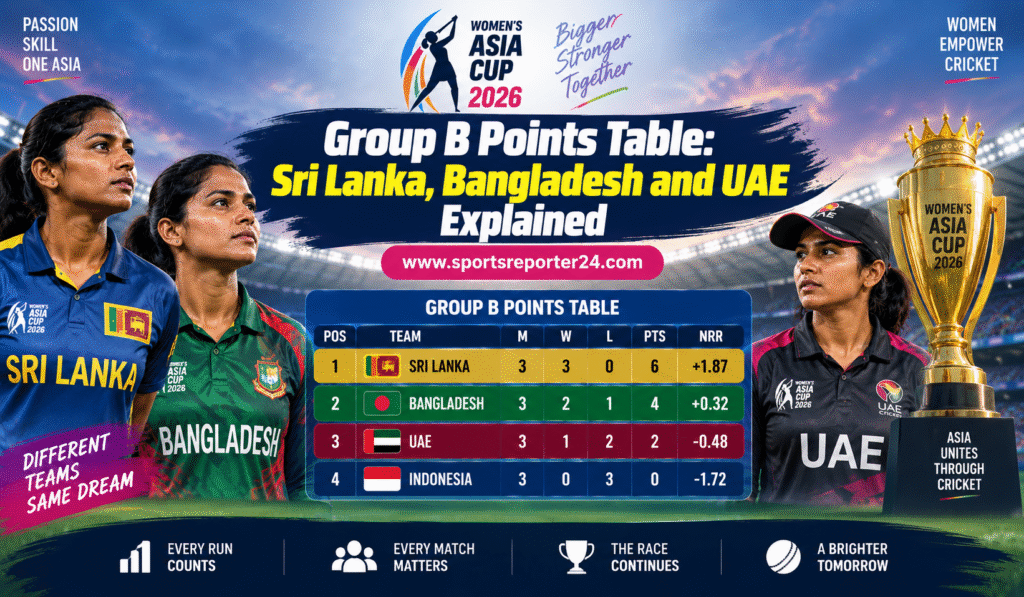
The Group B points table in the Women’s Asia Cup 2026 gives a clear picture of how the teams performed during the group stage. Sri Lanka Women finished at the top after winning all three of their matches, while Bangladesh Women secured the second qualification spot with two victories. UAE Women finished third after recording one win from their three games.
With only three matches available to each team, every result was important. There was little room for mistakes, and the points earned in each match directly influenced the final qualification picture. Net Run Rate (NRR) also added another important layer to the table, especially because it shows the difference between a team’s scoring rate and the rate at which it conceded runs.
The final Group B standings were:
| Position | Team | P | W | L | NR | Pts | NRR |
| 1 | Sri Lanka Women | 3 | 3 | 0 | 0 | 6 | +2.730 |
| 2 | Bangladesh Women | 3 | 2 | 1 | 0 | 4 | +1.688 |
| 3 | UAE Women | 3 | 1 | 2 | 0 | 2 | -1.116 |
Sri Lanka and Bangladesh moved through to the semi-finals, while UAE’s campaign ended at the group stage.
Sri Lanka Women Finish Top of Group B
Sri Lanka were the strongest side in Group B based on the final standings. They played three matches and won every one of them, giving them the maximum possible six points.
Their record was simple: three matches, three wins and no defeats.
That consistency made Sri Lanka’s qualification comfortable. They did not have to rely on other teams losing or on complicated calculations at the end of the group stage. Their results alone were enough to secure the top position.
The six points also gave Sri Lanka a two-point advantage over Bangladesh and a four-point advantage over UAE.
Another impressive part of Sri Lanka’s campaign was their +2.730 Net Run Rate. A high positive NRR indicates that the team performed strongly with both bat and ball across its group matches.
What Six Points Mean for Sri Lanka
In a standard group-stage points system, a win provides two points. Sri Lanka won all three of their matches, giving them:
3 wins × 2 points = 6 points
There was no way for another team to match Sri Lanka’s six points because each side had only three matches.
Their unbeaten record therefore guaranteed first place.
This is the ideal situation for any team in a short tournament. Winning every game removes much of the uncertainty that can surround qualification.
Sri Lanka also entered the knockout stage with confidence because they had already shown that they could perform consistently against the teams in their group.
Sri Lanka’s +2.730 NRR
Sri Lanka’s +2.730 NRR was another standout number in the Group B table.
Net Run Rate measures the difference between a team’s average runs scored per over and its average runs conceded per over. A positive number generally indicates that a team has scored faster than its opponents over the course of its matches.
Sri Lanka’s figure was considerably higher than Bangladesh’s +1.688 and far above UAE’s -1.116.
While Sri Lanka did not need NRR to secure qualification because they finished ahead on points, such a strong number shows the quality of their overall performances.
It also gives an indication of how dominant their campaign was rather than simply showing that they won their matches.
Bangladesh Women Secure Second Place
Bangladesh Women finished second in Group B with four points.
They played three matches, winning two and losing one.
Their final record was:
- Three matches played
- Two wins
- One loss
- Four points
- +1.688 NRR
The two victories gave Bangladesh enough points to finish ahead of UAE.
Although Bangladesh did not enjoy a perfect campaign like Sri Lanka, their ability to win two matches proved enough to secure a place in the semi-finals.
Their positive NRR also strengthened their final position and reflected a generally strong group-stage performance.
Bangladesh’s One Loss Did Not End Their Campaign
A defeat in a three-match group can create immediate pressure, but Bangladesh responded well.
Instead of allowing the loss to affect their entire campaign, they collected two victories from their remaining opportunities.
That gave them four points, which was enough to finish second.
This is an important feature of tournament cricket. A team does not necessarily need to win every match. It needs to win enough games to finish among the qualifying teams.
Bangladesh managed to do exactly that.
Their campaign also demonstrates why teams should focus on the next match rather than allowing an earlier defeat to affect their confidence.
Bangladesh’s +1.688 NRR
Bangladesh ended the group stage with a +1.688 NRR.
That was the second-best NRR in Group B.
The positive figure indicates that Bangladesh’s overall run-scoring rate was higher than the rate at which they conceded runs.
Although their points total was already enough to put them ahead of UAE, having a positive NRR was another indication of their strong performances.
In a different group scenario, such a figure could become extremely important. If Bangladesh had finished level on points with another team, their NRR could have been used to determine the higher-ranked side, depending on the competition’s rules.
UAE Women Finish Third
UAE Women finished third in Group B with two points.
They played three matches and recorded one victory.
Their final record was:
3 matches, 1 win, 2 losses, 2 points and -1.116 NRR.
The single victory showed that UAE were capable of producing a successful performance, but two defeats prevented them from challenging Bangladesh for the second qualification position.
In a group with only three matches, losing twice is particularly difficult to overcome.
There simply are not enough remaining games to recover the lost points.
Understanding UAE’s Two Points
UAE collected two points from their one victory.
With two defeats producing no points, they ended the group stage with two points in total.
That left them two points behind Bangladesh and four points behind Sri Lanka.
The difference may look small, but in a short competition it is significant.
If UAE had converted one of their defeats into a victory, their total would have risen to four points. That could have created a much closer qualification battle with Bangladesh.
This shows how one match can completely change the outlook of a short group.
UAE’s -1.116 NRR
UAE’s final -1.116 NRR was another factor that separated them from the two qualifying teams.
A negative NRR means that, across their group matches, UAE’s overall scoring rate was lower than the rate at which their opponents scored.
This does not mean that the team performed badly in every innings. NRR is calculated over multiple matches, so one strong performance can exist alongside results that bring the overall number down.
For UAE, the combination of one win, two losses and a negative NRR meant their campaign ended in third place.
Why NRR Is Important in a Short Tournament
The Group B table also demonstrates why NRR deserves attention.
Points are always the first priority because winning matches is the most direct way to qualify. However, NRR can become extremely important if teams finish level on points.
A large victory can improve NRR, while a heavy defeat can damage it.
For example, imagine two teams both finish with four points. One team may have won its matches comfortably, while the other may have scraped through with narrow victories. Their points would be identical, but their NRR could be very different.
This is why teams often try to maintain a strong performance even after a match appears to be under control.
The Difference Between Sri Lanka, Bangladesh and UAE
The final Group B table creates a clear performance ladder.
Sri Lanka won three matches and finished with six points.
Bangladesh won two matches and finished with four points.
UAE won one match and finished with two points.
This means that each additional victory translated directly into a higher position in the table.
The NRR figures followed a similar pattern:
Sri Lanka: +2.730
Bangladesh: +1.688
UAE: -1.116
The numbers show a clear difference between the three campaigns.
Why Every Match Mattered
With only three matches per team, there was almost no room for a poor result.
Sri Lanka’s perfect record allowed them to finish first without any qualification uncertainty.
Bangladesh’s two wins were enough to secure second place.
UAE, despite winning once, could not recover from their two defeats.
This is why group-stage cricket can be so demanding. A team has to make the most of every opportunity because there are fewer matches available to correct mistakes.
A defeat in the first match can put pressure on the second. Another defeat can then make qualification almost impossible.
Three Main Lessons From Group B
- Consistency is extremely valuable. Sri Lanka won all three matches and finished comfortably at the top.
- Two wins can be enough. Bangladesh did not have a perfect record but still qualified with four points.
- One win may not be sufficient. UAE’s two points were not enough to reach the semi-finals.
These three outcomes explain the basic nature of a short group competition.
Sri Lanka’s Strong Position After the Group Stage
Sri Lanka’s first-place finish gives them a strong platform heading into the knockout stage.
Their unbeaten record means they completed the group phase without losing a match. Their +2.730 NRR also suggests that their victories were backed by strong overall performances.
However, the semi-finals are a different challenge.
A team cannot depend on its group-stage record once the knockout stage begins. One poor match can end the tournament, regardless of how well the team performed earlier.
Sri Lanka will therefore need to maintain the same level of discipline and consistency.
Bangladesh’s Successful Recovery
Bangladesh can be pleased with their ability to recover from one defeat.
Four points were enough to put them into the semi-finals, and their +1.688 NRR showed that they had performed strongly enough to maintain a positive scoring-rate balance.
The next stage will demand even more from the team.
Bangladesh will need to handle pressure, make better use of important moments and ensure that their batting and bowling units perform together.
Their group-stage qualification gives them the opportunity to continue their campaign and challenge for a place in the final.
What UAE Can Take Forward
For UAE, the group-stage exit will be disappointing, but their one victory provides something positive to build on.
The biggest improvement would be consistency.
Winning one match proves that UAE can compete successfully. The next step is turning competitive performances into more victories.
Avoiding heavy defeats could also become important in future tournaments because protecting NRR can provide an advantage when teams are separated by only a few points.
With more experience in high-level tournaments, UAE can use this campaign as a learning opportunity.
Final Group B Analysis
The Women’s Asia Cup 2026 Group B points table provides a simple example of how results, points and NRR work together.
Sri Lanka were the clear leaders. Their three victories gave them six points, while their +2.730 NRR was the best in the group.
Bangladesh finished second with four points after winning two matches. Their +1.688 NRR was also comfortably positive and supported their successful qualification campaign.
UAE finished third with two points after winning one match and losing two. Their -1.116 NRR reflected the difficulty they faced during the group stage.
The final table was therefore:
Sri Lanka — 6 points — First
Bangladesh — 4 points — Second
UAE — 2 points — Third
The main lesson from Group B is simple: every match counts. Sri Lanka’s perfect record gave them first place, Bangladesh’s two wins secured qualification, and UAE’s single victory was not enough to keep their semi-final hopes alive.
The table also shows why teams need to think beyond individual matches. Points determine the main qualification picture, while NRR can become crucial when teams are closely matched.
For Sri Lanka and Bangladesh, the group stage ended successfully. For UAE, it marked the end of their Asia Cup campaign. But for all three teams, the Group B results provide a clear picture of how consistency, winning opportunities and overall performance shape a tournament.