India badminton talent
For years, Indian badminton was closely associated with a handful of superstar names.
Saina Nehwal helped put Indian women’s badminton on the global map. PV Sindhu followed with Olympic medals and a World Championship title. In men’s singles, players such as Kidambi Srikanth, HS Prannoy and Lakshya Sen carried India’s hopes at major international tournaments.
But Indian badminton is gradually entering a different phase.
The country is no longer dependent on only one or two players for international success. A younger group is beginning to emerge across men’s singles, women’s singles, men’s doubles, women’s doubles and mixed doubles.
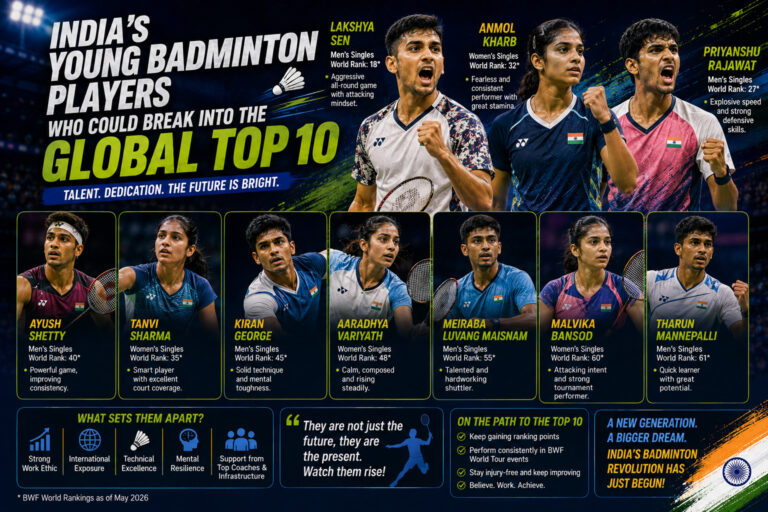
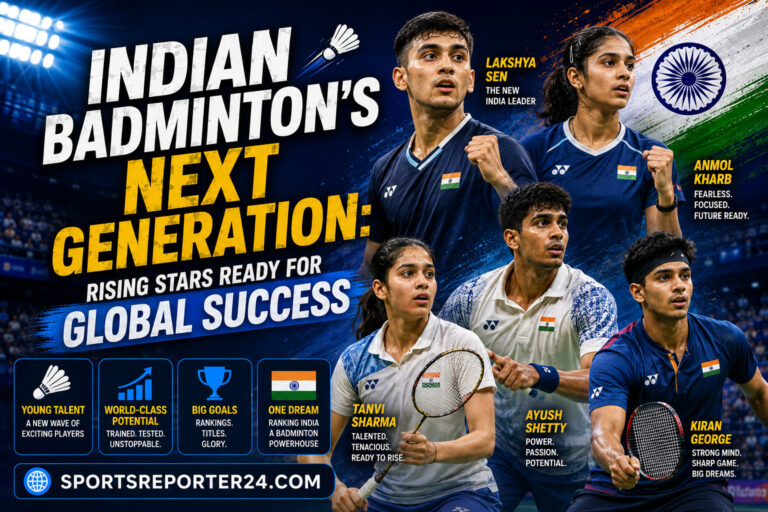
The 2026 Asian Games squad provides a clear example of this growing depth. Alongside established names such as PV Sindhu, Lakshya Sen and Satwiksairaj Rankireddy-Chirag Shetty, India has selected rising players including Ayush Shetty, Tanvi Sharma, Unnati Hooda, Devika Sihag, Isharani Baruah, Simran Singhi and Kavipriya Selvam.
This does not mean the era of Sindhu and Sen is over.
Instead, it suggests that Indian badminton may finally be developing a stronger pipeline behind its established stars.
Ayush Shetty Is Emerging as a Major Men’s Singles Prospect
One of the most exciting names in India’s new badminton generation is Ayush Shetty.
The young Karnataka shuttler has made significant progress since his junior days and has increasingly attracted attention on the senior international circuit.
His biggest breakthrough came at the 2026 Badminton Asia Championships, where he reached the men’s singles final.
That run was particularly significant because Shetty became the first Indian men’s singles player in 61 years to reach the tournament’s final. His performance included a major win over reigning world champion Kunlavut Vitidsarn.
That result changed the perception around him.
Shetty is no longer simply being discussed as a promising youngster. He is now being tested against the world’s strongest players.
His next challenge is consistency.
A breakthrough tournament can introduce a player to the international audience, but staying competitive week after week requires fitness, tactical maturity and mental strength.
Unnati Hooda Is Part of the Women’s Singles Transition
India’s women’s singles future is also becoming more interesting.
Unnati Hooda is among the young players being closely watched as India looks to strengthen its options behind PV Sindhu.
Hooda has already gained senior international experience and has shown the ability to compete in demanding tournaments.
Her development is important because India’s women’s singles success has traditionally been concentrated around a small number of major stars.
Sindhu’s achievements created enormous expectations, but the next stage of Indian badminton requires several players capable of competing internationally.
Hooda does not need to become the next Sindhu.
Instead, her objective should be to develop her own strengths and gradually establish herself as a consistent international player.
Her selection for India’s 2026 Asian Games squad alongside Sindhu demonstrates the importance of the younger generation in the country’s plans.
Tanvi Sharma Could Become Another Important Name
Tanvi Sharma is another player who has added excitement to India’s women’s singles pipeline.
Her performances at junior level have helped establish her reputation as a promising young prospect.
In 2026, she earned selection for India’s Asian Games squad after producing strong performances internationally. She was also part of India’s emerging women’s singles group heading into the year’s major competitions.
The transition from junior badminton to senior competition will be her biggest test.
Junior success can create confidence, but senior badminton is a completely different challenge.
Opponents are stronger, rallies are more demanding and tactical mistakes are punished immediately.
If Sharma can make that transition successfully, India could have another valuable women’s singles option for the next Olympic cycle.
India’s Men’s Singles Department Is Getting More Competitive
For a long time, Indian men’s singles relied heavily on established names.
Now, the picture is becoming more competitive.
Lakshya Sen remains an important part of the national setup, while experienced players such as HS Prannoy and Kidambi Srikanth continue to provide depth.
Behind them, younger players such as Ayush Shetty and Tharun Mannepalli are trying to establish themselves.
The 2026 Asian Games selection included both established and emerging men’s singles players, showing that India is not relying entirely on one generation.
This competition can be beneficial.
Young players get opportunities to learn from experienced athletes, while established players are pushed to maintain their standards.
Doubles Is Becoming an Important Strength
India’s talent pool is also expanding beyond singles.
Satwiksairaj Rankireddy and Chirag Shetty have already transformed expectations around Indian men’s doubles.
Their international success showed that Indian players could compete physically and tactically with the strongest doubles teams in the world.
But India’s long-term goal cannot be to depend on one partnership.
More pairs need to emerge.
Hariharan Amsakarunan and M. R. Arjun are among the men’s doubles combinations being developed, while women’s doubles players such as Treesa Jolly, Gayatri Gopichand, Simran Singhi and Kavipriya Selvam are strengthening India’s options.
The more competitive India’s doubles pipeline becomes, the less dependent the country will be on a single pair.
Treesa Jolly and Gayatri Gopichand Represent Another Path
Treesa Jolly and Gayatri Gopichand have become important names in India’s women’s doubles setup.
Their rise is significant because women’s doubles has historically received less attention in India compared with singles.
A strong and consistent women’s doubles pair can change that.
Their development also provides younger players with a visible pathway.
Instead of seeing badminton success as something limited to singles, emerging athletes can now look towards doubles as a serious international career.
Mixed Doubles Is Also Gaining Attention
Mixed doubles has often been India’s less prominent badminton discipline.
That could gradually change.
Dhruv Kapila and Tanisha Crasto are among the combinations receiving attention in India’s current setup.
Their selection for the 2026 Asian Games highlights the country’s effort to build representation across all five badminton disciplines.
Developing mixed doubles will take time.
Successful partnerships require strong communication, tactical understanding and compatibility between two players.
But even having a stable international-level pair can significantly improve India’s overall depth.
The 2026 World Championships Could Be a Turning Point
The return of the BWF World Championships to India in 2026 provides an important opportunity for this new generation.
New Delhi is hosting the tournament from August 17 to 23.
Four Indian players—Ayush Shetty, Unnati Hooda, Simran Singhi and Kavipriya Selvam—are set to make their World Championships debuts at home.
For young athletes, playing the biggest tournament in badminton in front of Indian fans can be an unforgettable experience.
It will also expose them to a level of pressure that cannot be recreated during ordinary tournaments.
How they respond could tell India a lot about their readiness for the next stage of their careers.
The Biggest Challenge Is Consistency
India has never lacked talented young badminton players.
The bigger question has always been how many can become consistent world-level performers.
A young athlete can defeat a top-ranked opponent and then lose early in the following tournament.
This is normal during development.
Ayush Shetty’s recent results illustrate the challenge. After his impressive Asia Championships run, he faced a difficult period, including early exits and an elbow injury before the World Championships.
That is an important reminder that talent needs time.
Indian badminton’s new generation should not be judged solely on immediate medals.
The development process includes injuries, losses, tactical adjustments and learning how to handle international expectations.
The Asian Games Will Provide Another Major Test
The 2026 Asian Games in Aichi-Nagoya will be another important stage.
India’s squad combines experienced stars with younger players.
That means the tournament can serve two purposes.
Established athletes can compete for medals, while younger players can gain experience in a major multi-sport environment.
The presence of players such as Ayush Shetty, Tanvi Sharma and Unnati Hooda alongside Sindhu, Sen and Satwik-Chirag demonstrates how Indian badminton is trying to combine experience with emerging talent.
For the younger players, performing well at the Asian Games could accelerate their rise.
Why Depth Matters for the Olympics
Building a deeper talent pool is particularly important because the Olympic Games are brutally competitive.
A country cannot rely on one athlete to deliver every four years.
Injuries, rankings, draws and form can completely change medal prospects.
India therefore needs multiple players capable of reaching the later stages of major tournaments.
The same applies to team competitions such as the Thomas Cup and Uber Cup.
A deeper pool gives selectors more combinations and reduces dependence on individual stars.
The Role of Experience Should Not Be Ignored
The rise of young players does not mean experienced athletes have become unnecessary.
In fact, they may be more important than ever.
Sindhu, Sen, Prannoy and other senior players can provide guidance to younger teammates.
They understand the pressure of international competition.
They know how difficult major tournaments can be.
A young player who can learn from that experience while developing their own style has a major advantage.
The transition should therefore be gradual rather than an aggressive replacement of one generation with another.
India Needs More Than One Future Superstar
The most exciting possibility is not finding another Sindhu or another Sen.
It is creating a system where several players can become stars.
Imagine India having multiple competitive men’s singles players, several women’s singles contenders and strong pairs across doubles.
That would completely change the country’s position in world badminton.
A deeper talent pool also creates healthy internal competition.
Players know that another talented athlete is waiting for an opportunity.
That can improve training standards and encourage everyone to keep developing.
Coaching and Sports Science Will Matter
Talent is only one part of the equation.
Modern badminton requires sophisticated physical preparation.
Players need strength training, injury prevention, nutrition, recovery systems and detailed tactical analysis.
As the competition becomes faster and more physical, India’s training programmes will have to keep evolving.
Young players will also need support in managing the mental side of professional sport.
The difference between winning and losing at elite level can sometimes be very small.
Confidence, concentration and decision-making under pressure can become decisive.
The Road to Los Angeles 2028 Is Already Taking Shape
The next Olympic Games may still be some distance away, but India’s future medal hopes are already being shaped.
The players emerging in 2026 could become important members of the Olympic squad in 2028.
Ayush Shetty, Tanvi Sharma, Unnati Hooda and other young shuttlers therefore have a valuable window to develop.
They do not need to reach their peak immediately.
What matters is steady progress.
By the time the Olympic qualification period becomes critical, the players who have handled international pressure and remained healthy could be India’s biggest assets.
A Stronger Pipeline Could Change Indian Badminton
The real success of India’s badminton system will not be measured by how many young players become famous overnight.
It will be measured by how many continue improving.
If several emerging players become top-level competitors, India will have greater flexibility at major tournaments.
The country could enter events with medal possibilities across several disciplines instead of relying heavily on one or two individuals.
That would represent a major evolution.
Conclusion
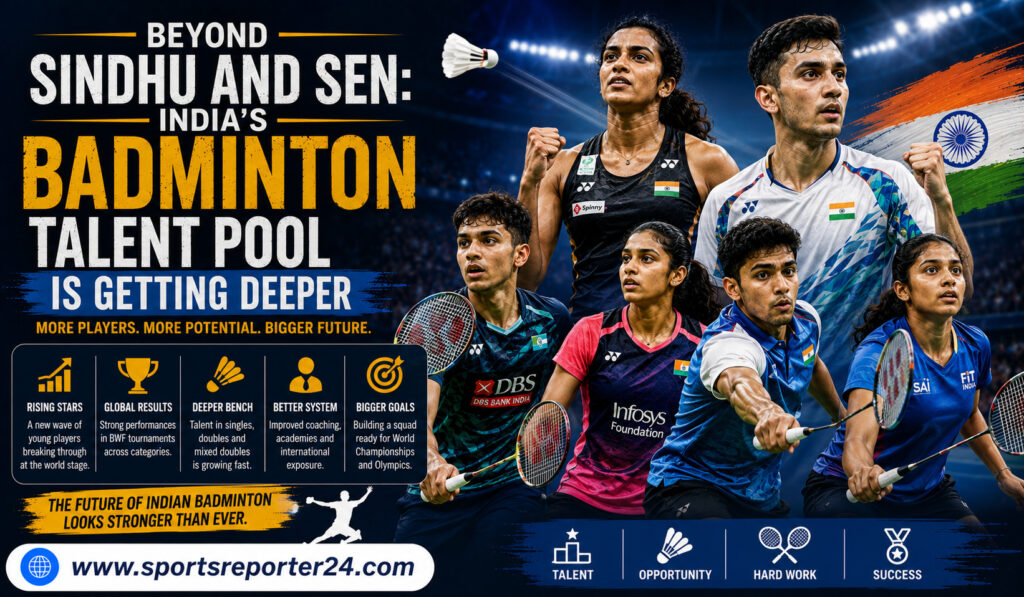
India’s badminton story is gradually moving beyond PV Sindhu and Lakshya Sen.
That does not reduce the importance of the established stars. Instead, their achievements have helped create an environment in which younger players can dream bigger.
Ayush Shetty’s breakthrough at the 2026 Badminton Asia Championships, the emergence of Unnati Hooda and Tanvi Sharma, and the development of new doubles combinations all point towards a broader Indian talent pool. India’s 2026 Asian Games squad is particularly encouraging because it combines experienced champions with a significant group of emerging players.
The next challenge is consistency.
Young players will have to handle injuries, pressure, difficult draws and the demands of international competition.
But the foundations are becoming stronger.
If India’s emerging shuttlers continue developing and the country maintains its investment in coaching, sports science and international exposure, the next generation could make Indian badminton more competitive across all five disciplines.
Sindhu and Sen helped establish India’s modern badminton identity.
Now, players such as Ayush Shetty, Unnati Hooda, Tanvi Sharma, Treesa Jolly, Gayatri Gopichand and other emerging stars have the opportunity to expand it.
India may no longer be waiting for its next badminton star. It may already have a whole generation preparing to emerge.