
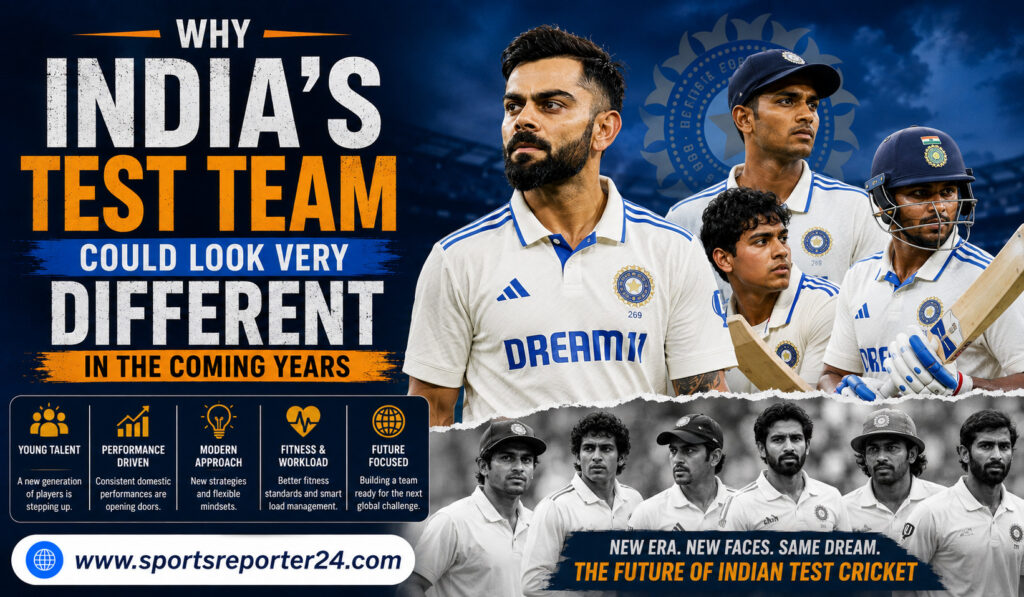
India Test team future
For years, the team was built around players who had already established themselves at the highest level. Virat Kohli, Rohit Sharma, Ravichandran Ashwin, Ravindra Jadeja, Jasprit Bumrah and several other senior stars formed the backbone of an Indian side that became one of the strongest Test teams in the world.
That era is now changing.
Rohit Sharma and Virat Kohli have moved away from Test cricket, while Ravichandran Ashwin has also retired from international cricket. Shubman Gill has taken over as India’s Test captain, marking the beginning of a new leadership phase. The 2025–26 BCCI central-contract structure also reflects this transition, with Gill promoted to Grade A while Kohli and Rohit are now listed in Grade B after their Test retirements.
At the same time, a group of younger players is gradually taking on bigger responsibilities.
This does not mean India’s Test team will suddenly become completely different. But over the next few years, the balance between experience and youth is likely to shift significantly.
Shubman Gill Is Already Leading the New Era
The clearest sign of India’s changing Test team is the appointment of Shubman Gill as captain.
Gill inherited the Test leadership after Rohit Sharma’s retirement from the format. His appointment represents more than a change in captaincy. It signals a move towards a new generation of Indian cricket.
Gill has already established himself as an important batter across formats, but Test captaincy brings a different level of responsibility.
He will now have to manage bowling changes, field placements, player workloads and difficult match situations while maintaining his own batting standards.
The current Sri Lanka Test squad confirms that Gill remains at the centre of India’s red-ball plans, with KL Rahul appointed vice-captain.
If Gill successfully establishes himself as a long-term captain, India’s Test team could eventually be built around his leadership.
Yashasvi Jaiswal Could Become a Long-Term Opening Pillar
One of the biggest reasons India can be optimistic about its batting future is Yashasvi Jaiswal.
The young opener has already shown that he is capable of handling the demands of Test cricket.
His aggressive approach gives India a different option at the top of the order.
Traditionally, Test openers were expected to spend long periods defending and gradually build an innings. Modern cricket has changed that thinking.
Jaiswal can put pressure on bowlers early without completely abandoning the patience required for red-ball cricket.
If he continues developing, he could become one of the main pillars of India’s batting lineup for years.
A future opening partnership involving Jaiswal and another younger batter could eventually define the next generation of Indian Test cricket.
Sai Sudharsan Is Another Name to Watch
Sai Sudharsan has also emerged as an interesting option for India’s Test future.
His development has attracted attention because of his technically sound batting and ability to construct innings.
Unlike some aggressive young batters, Sudharsan has shown an ability to build his game around patience and timing.
That could make him particularly valuable in Test cricket.
India’s current Sri Lanka squad includes Sudharsan, although his availability is subject to fitness.
If he establishes himself at Test level, India could have another young left-handed batter capable of playing a major role in the middle order.
Rishabh Pant Could Become a Senior Figure
Rishabh Pant is no longer the inexperienced wicketkeeper who first burst onto the Test scene.
He is gradually becoming one of the senior members of India’s next generation.
His aggressive batting and unconventional approach have already changed expectations for what a wicketkeeper-batter can contribute in Test cricket.
Pant’s ability to change the momentum of a match makes him extremely valuable.
He can turn defensive situations into attacking ones and put pressure on opposition bowlers.
As the team changes around him, Pant could become one of the experienced players responsible for guiding younger cricketers.
The current Sri Lanka squad includes both Pant and Dhruv Jurel as wicketkeeping options, showing that India already has competition for the position.
Dhruv Jurel Represents the Next Generation
Dhruv Jurel is another player who could become important in India’s Test setup.
He has already shown promise as a wicketkeeper-batter and has earned opportunities alongside Pant.
The competition between the two could become an interesting part of India’s future.
India does not necessarily need to choose between them immediately.
Jurel can continue developing while learning from a player such as Pant.
If Jurel improves his batting consistency and maintains his wicketkeeping standards, he could eventually become a long-term option for the team.
The All-Rounder Department Could Also Change
For years, Ravindra Jadeja and Ravichandran Ashwin gave India enormous stability in Test cricket.
Their ability to contribute with both bat and ball allowed India to create balanced playing XIs.
With Ashwin retired and Jadeja moving towards the later stage of his career, India will eventually need to solve an important question:
Who comes next?
Washington Sundar is one possibility.
Nitish Kumar Reddy is another player who could develop into a useful all-round option.
There are also several domestic performers competing for opportunities.
The current Test setup has already begun experimenting with new spin options. Manav Suthar and Saransh Jain are among the players receiving attention, while Kuldeep Yadav remains an important part of India’s spin resources.
This suggests that India’s future bowling combination may become more flexible.
Jasprit Bumrah’s Future Will Be Crucial
While India is developing young players, one major question concerns Jasprit Bumrah.
Bumrah remains one of the most important fast bowlers in world cricket.
His ability to take wickets with the new ball, reverse swing and create pressure in difficult conditions makes him extremely difficult to replace.
However, fast bowlers face unique physical demands.
India therefore needs to manage Bumrah carefully while developing the next generation of pace bowlers.
The current Sri Lanka squad includes Bumrah, although his participation is subject to fitness clearance.
Mohammed Siraj, Prasidh Krishna and younger options such as Gurnoor Brar could become increasingly important as India’s pace attack evolves.
Mohammed Siraj Could Become the Senior Pace Leader
Siraj has already experienced enough international cricket to understand the demands of Test bowling.
He has played important roles in overseas conditions and has developed into one of India’s most recognisable fast bowlers.
As the team changes, his experience could become particularly valuable.
If Bumrah’s workload needs to be managed, Siraj may have to take on greater responsibility.
At the same time, India’s selectors will need to identify young fast bowlers who can eventually share that workload.
The future of the pace attack may therefore be less about finding one replacement for Bumrah and more about creating a deeper group of reliable bowlers.
The Spin Attack Could Become More Diverse
India’s Test identity has traditionally been closely connected with spin bowling.
Ashwin and Jadeja gave the team an extraordinary combination of accuracy, variation, batting ability and experience.
The next generation may look different.
Kuldeep Yadav provides a wrist-spin option, while Washington Sundar offers off-spin and batting.
Manav Suthar brings another left-arm spin option, while Saransh Jain has received a maiden Test call-up as an off-spin all-rounder.
This variety could help India select bowling attacks according to conditions rather than relying on the same combination in every match.
The Middle Order Is Still Evolving
Perhaps the biggest uncertainty concerns India’s middle order.
The departures of Kohli and other senior players have created opportunities, but replacing experienced Test batters is never straightforward.
Young players may have the talent, but international cricket demands consistency over long periods.
India could therefore see several players compete for the same positions.
Sai Sudharsan, Devdutt Padikkal, Sarfaraz Khan and other domestic performers could remain part of that wider conversation depending on form and selection.
That competition could ultimately be healthy.
Instead of having automatic selections, players may have to consistently perform to retain their places.
India’s Bench Strength Will Matter More
A strong Test team is not simply about having 11 excellent players.
It needs reliable replacements.
Injuries, workload management and poor form are unavoidable in a long cricket season.
India’s recent selections suggest that the selectors are already trying to build greater depth.
The Afghanistan Test squad included first-time call-ups for Gurnoor Brar, Manav Suthar and Harsh Dubey, demonstrating that opportunities are increasingly being given to players outside the established core.
This could become one of the biggest features of India’s Test strategy.
Domestic Cricket Could Become Even More Important
As the senior team changes, domestic cricket will become increasingly important.
Young players cannot be judged only on IPL performances.
Test cricket requires a different skill set.
Players need experience of long innings, four-day matches, changing pitches, sustained bowling spells and pressure situations.
That means performances in the Ranji Trophy and India A setup could play a major role in determining who becomes part of India’s long-term Test plans.
The transition will be healthier if young players are promoted because of sustained red-ball performance rather than hype alone.
The Biggest Challenge Will Be Replacing Experience
India’s next Test team may have plenty of talent.
The difficult part will be replacing the experience that has disappeared.
A player like Kohli could influence a match simply through his presence and understanding of difficult situations.
Ashwin could read conditions and opposition batters better than almost anyone.
Rohit brought years of leadership experience.
Jadeja has provided balance with both bat and ball.
Young players cannot instantly reproduce those qualities.
They need time.
That is why India’s transition could be uneven before the new core fully settles.
What Could India’s Test Team Look Like in the Future?
There is no reason to expect one fixed XI to dominate India’s Test plans for the next five years.
Instead, the team could become more flexible.
A future core could include Shubman Gill, Yashasvi Jaiswal, Rishabh Pant, Sai Sudharsan, Dhruv Jurel, Washington Sundar, Kuldeep Yadav and a new generation of fast bowlers.
Around them, experienced players such as KL Rahul, Ravindra Jadeja, Jasprit Bumrah and Mohammed Siraj could continue providing stability as long as their fitness and form allow.
The exact combination will depend heavily on performances.
That uncertainty is actually a positive sign.
It means India has several players competing for important positions rather than having no alternatives.
Why This Transition Could Be Exciting
Generational changes are often difficult, but they also create opportunities.
Young players bring energy, different techniques and new ideas.
They are less tied to traditional expectations and may be willing to experiment.
India’s next Test team could therefore develop its own identity rather than simply trying to reproduce the success of the previous generation.
The biggest question will be whether the young players can handle the pressure that comes with representing India.
Talent gets a player into the team.
Consistency keeps them there.
Conclusion
India’s Test team could look very different in the coming years because the country’s red-ball cricket is already moving into a new generation.
The retirement of major senior players has created vacancies, while Shubman Gill’s appointment as captain has placed a younger face at the centre of India’s Test plans. At the same time, players such as Yashasvi Jaiswal, Sai Sudharsan, Rishabh Pant and Dhruv Jurel are increasingly important to the team’s future.
The bowling department is likely to experience changes as well.
Bumrah and Jadeja remain hugely important, but India is already looking at new spin and pace options, including Manav Suthar, Gurnoor Brar and Saransh Jain.
The transition will not happen overnight.
India will need to balance youth with experience, give emerging players enough time to develop and avoid rushing them because of short-term expectations.
If that balance is achieved, the next generation could create a new chapter in Indian Test cricket.
The names may change.
The playing style may evolve.
But the ambition will remain the same: to build an Indian Test team capable of competing with the best in every condition.