
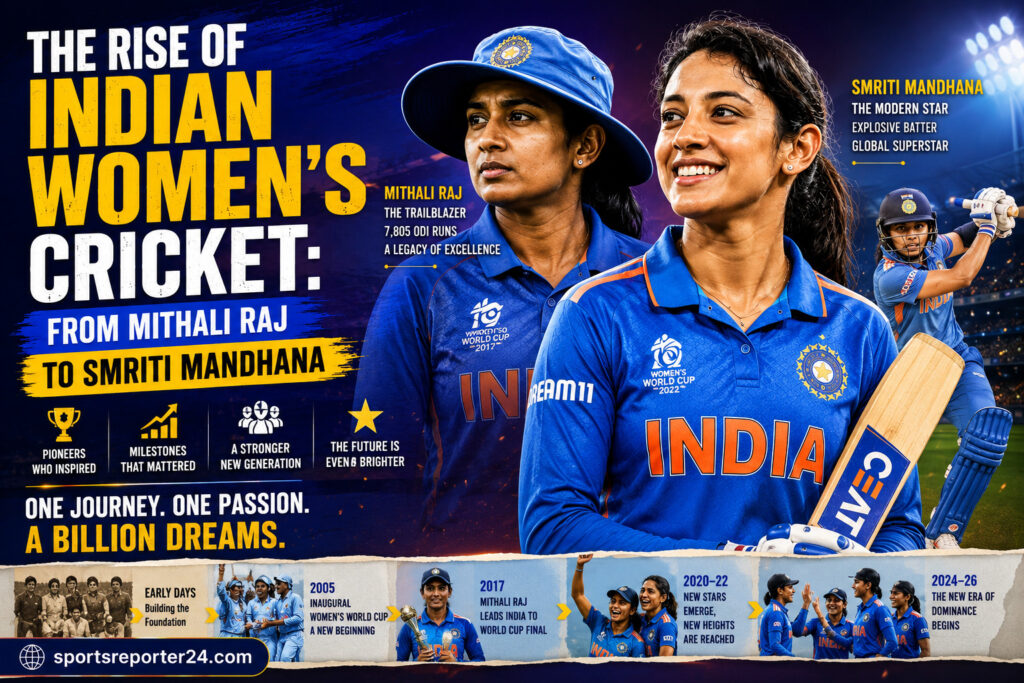
Indian women’s cricket has undergone one of the most remarkable transformations in the country’s sporting history. A sport that once struggled for consistent attention, limited opportunities and widespread recognition has developed into a major part of India’s cricket culture.
At the centre of that transformation are two generations of players. Mithali Raj represented the foundation of modern Indian women’s cricket, while Smriti Mandhana has become one of the leading faces of the new era.
Their careers belong to different periods, but together they tell the story of how Indian women’s cricket moved from fighting for recognition to competing for global titles.
Mithali’s generation had to build credibility. Mandhana’s generation is benefiting from that foundation while pushing the sport toward a more professional and commercially successful future.
The journey has not been easy, but by 2026, the results are impossible to ignore.
Mithali Raj: The Player Who Changed the Conversation
When Mithali Raj made her international debut in 1999, women’s cricket in India was still far from the mainstream.
There were talented players, passionate supporters and a national team, but the sport did not have the commercial visibility or professional infrastructure enjoyed by men’s cricket.
Mithali’s longevity helped change that.
Her international career lasted more than two decades, during which she became India’s greatest women’s ODI run-scorer. The BCCI records her as the highest run-scorer in women’s ODIs, with 7,805 runs at an average of 50.68. She also led India to two Women’s World Cup finals.
Those numbers only tell part of her story.
Mithali became a symbol of consistency. She was rarely defined by one spectacular tournament. Instead, she built her reputation through years of dependable performances.
Her elegant batting style and calm approach gave Indian women’s cricket a reliable star at a time when the team needed greater visibility.
The 2005 World Cup Final Was a Turning Point
India’s appearance in the 2005 Women’s Cricket World Cup final was an important moment.
The team did not win the tournament, but reaching the final demonstrated that India could compete with the world’s strongest women’s sides.
For Mithali and her teammates, it was also evidence that Indian women’s cricket could aspire to something bigger.
The result did not immediately transform the sport. However, it helped establish a foundation for the generation that followed.
More girls began seeing international women’s cricket as something worth pursuing, while players could point to the national team as a genuine professional sporting pathway.
Mithali’s Captaincy Built Belief
Mithali’s influence became even more significant through leadership.
She captained India during some of the most important years in the team’s development and helped establish higher standards of professionalism and consistency.
Her leadership style was generally calm and measured.
Rather than relying on dramatic gestures, she often led through experience and performance. Younger players entering the national team had an established international cricketer to learn from.
That mentoring effect became particularly important as India’s talent pool expanded.
Mithali also continued to perform at the highest level even as the team around her changed.
Her career eventually became a bridge between two generations of Indian women’s cricket.
The 2017 World Cup Created a New Wave
The next major turning point came at the 2017 Women’s Cricket World Cup.
India reached the final again, this time with a younger generation beginning to emerge.
Although England won the final, India’s campaign attracted enormous attention.
Harmanpreet Kaur’s spectacular 171 against Australia became one of the defining performances in Indian women’s cricket, while younger players gained valuable exposure.
One of those players was Smriti Mandhana.
The tournament helped introduce a new generation of Indian cricketers to a much larger audience.
It also demonstrated that women’s cricket could generate excitement, drama and large-scale fan interest.
Smriti Mandhana: The Face of a New Era
If Mithali represented stability and longevity, Smriti Mandhana represents the modern, aggressive and commercially visible side of Indian women’s cricket.
Mandhana made her international debut in 2013 and quickly established herself as an attacking opening batter. The BCCI notes that she had already made her domestic debut for Maharashtra at just nine and went on to become one of the world’s leading opening batters.
Her batting style immediately attracted attention.
Mandhana’s elegant drives, aggressive strokeplay and ability to score quickly made her particularly suited to the modern limited-overs game.
She was not simply producing runs. She was becoming a recognizable sporting personality.
That distinction matters.
The growth of women’s cricket has been helped enormously by players who can attract audiences beyond traditional cricket followers.
Mandhana became one of those players.
From Inspiration to International Star
Mandhana’s rise also shows the influence of the previous generation.
Interestingly, BCCI archives include an interview from Mandhana’s early career in which Mithali Raj spoke highly of the teenager and predicted that she would take on greater responsibility for India.
That relationship represents something bigger than one senior player encouraging a youngster.
It shows how sporting generations build upon one another.
Mithali helped establish the credibility of Indian women’s cricket. Mandhana entered a stronger system and helped turn that credibility into wider popularity.
Today, young Indian players can look at Mandhana in much the same way that an earlier generation looked at Mithali.
The WPL Changed the Financial Landscape
One of the biggest differences between Mithali’s era and Mandhana’s era is the emergence of professional franchise cricket.
The Women’s Premier League has given Indian women cricketers access to a major domestic T20 competition, international teammates, professional coaching environments and significant financial opportunities.
For younger players, the WPL can provide a faster route from domestic cricket to national recognition.
The league also allows players to compete alongside some of the world’s best cricketers.
This has created an ecosystem that simply did not exist during the early stages of Mithali’s career.
Mandhana has become one of the biggest stars of the WPL, combining franchise success with her international reputation.
The 2025 World Cup Completed a Historic Journey
The biggest achievement of India’s recent generation came in 2025.
India won its first Women’s Cricket World Cup, finally converting decades of near misses into a world title.
Mandhana played a significant role in that campaign. According to the BCCI, she finished the tournament as India’s leading run-scorer and also became the only Indian batter to have scored centuries in all three international formats in women’s cricket.
The victory represented more than another trophy.
It completed a journey that had begun with players like Mithali Raj.
The generation that once fought to be taken seriously had helped create the platform for a generation capable of becoming world champions.
Harmanpreet Kaur Connects the Two Generations
The story between Mithali and Mandhana is not complete without Harmanpreet Kaur.
Harmanpreet belongs to the generation that emerged during India’s transition from the Mithali era toward the current team.
Her explosive 2017 World Cup innings became a defining moment for Indian women’s cricket.
She later took on the captaincy and became one of the senior figures responsible for guiding the team through a period of rapid change.
In 2026, Harmanpreet remains an important part of India’s international setup, with Mandhana serving as vice-captain.
That combination of experienced leadership and younger stars has helped India maintain continuity.
Professionalism Has Transformed the Sport
The biggest change may not be visible in any individual player’s statistics.
It is the professional environment surrounding the players.
Today’s Indian women cricketers have access to better fitness programs, more international matches, professional franchise competitions, improved facilities and greater commercial opportunities.
The BCCI has also increasingly invested in the women’s domestic and international structure.
As a result, young players can now enter the system with a clearer idea of what a professional cricket career can look like.
That is a major difference from the environment in which Mithali began her career.
Young Players Are Carrying the Story Forward
The rise of Indian women’s cricket does not stop with Mandhana.
Players such as Jemimah Rodrigues, Richa Ghosh, Deepti Sharma, Shafali Verma and a growing group of younger domestic cricketers are helping create greater depth.
The India A pathway is particularly important.
In 2026, leg-spinner Prema Rawat moved into the senior squad after impressive performances for India A, including eight wickets during India’s successful Women’s Asia Cup Rising Stars campaign.
This kind of pathway means India’s future is increasingly being built through a wider talent pool.
The national team is no longer dependent on a handful of established names.
Women’s Cricket Is Reaching New Audiences
Another major change is the relationship between players and fans.
Social media has allowed women cricketers to build personal brands and communicate directly with supporters.
Players can share training sessions, match-day experiences, celebrations and life away from cricket.
That visibility has helped make them more relatable, particularly to younger fans.
Mandhana has been especially successful in becoming a recognizable face of Indian sport.
Her popularity shows how women’s cricket has moved beyond being simply a sporting competition. It has become part of India’s wider entertainment and sporting culture.
The 2026 Team Is Building on the Past
India’s women’s team continues to benefit from the foundations created by previous generations.
In 2026, the side has already achieved another historic milestone by winning a Test at Lord’s by 270 runs against England. The BCCI described the result as a defining achievement for a young Indian side and a reflection of the continued growth of women’s cricket in the country.
This is significant because the development of women’s cricket cannot be measured only through T20 leagues.
Success across formats demonstrates that India’s players are becoming more adaptable and capable of competing in different conditions.
The team’s progress therefore extends beyond the popularity of franchise cricket.
From Mithali’s Bat to Mandhana’s Drives
The contrast between Mithali Raj and Smriti Mandhana perfectly illustrates how Indian women’s cricket has evolved.
Mithali played in an era when simply becoming a successful professional female cricketer was itself a challenge. She spent more than 20 years proving that Indian women could compete at the highest level.
Mandhana emerged into a world where women’s cricket had already gained greater recognition.
She has been able to combine international cricket with franchise opportunities, major sponsorships and enormous social-media visibility.
But Mandhana’s success would be difficult to imagine without the groundwork laid by Mithali and her contemporaries.
The younger generation inherited a platform that earlier players had fought to create.
What the Future Could Look Like
The future of Indian women’s cricket appears increasingly promising.
India now has a world champion team, a major professional T20 league, a stronger domestic structure and a growing pool of young players.
The challenge is maintaining that momentum.
Winning one World Cup is difficult. Building a team capable of competing for major trophies consistently is even harder.
India will need to keep investing in grassroots cricket, improve pathways for players from smaller cities, develop more specialist fast bowlers and continue creating opportunities for young talent.
The next generation must also be prepared to handle the expectations that now accompany Indian women’s cricket.
That is a very different challenge from the one faced by Mithali.
A Legacy That Keeps Growing
Mithali Raj and Smriti Mandhana are connected by more than their statistics.
They represent two chapters of the same story.
Mithali helped Indian women’s cricket establish credibility. She became a world-class batter, a respected captain and an inspiration to thousands of young girls.
Mandhana inherited that foundation and helped take Indian women’s cricket into an era of greater visibility, professional opportunity and global popularity.
The BCCI’s decision to honour Mithali with its Lifetime Achievement Award in 2026 is recognition of the role she played in building that history. The same awards also recognized Mandhana as India’s Best International Cricketer among women for the fifth time.
Those two honours, given in the same era, capture the transformation beautifully.
One player helped open the door.
Another helped show the world how far Indian women’s cricket could go.
And with a new generation now coming through, the story is far from finished.