
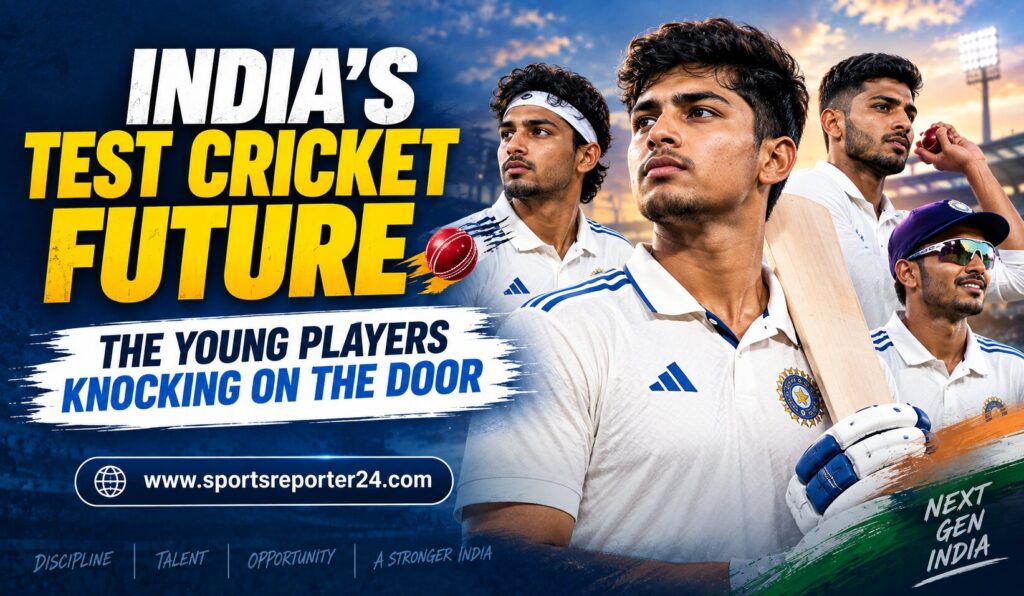
Indian Test cricket is entering an important phase. After years of relying on a remarkable generation of established stars, the team is now gradually building a new identity around younger players. Shubman Gill has taken over as Test captain, while players such as Yashasvi Jaiswal, Sai Sudharsan, Dhruv Jurel and Nitish Kumar Reddy are increasingly becoming part of the conversation about India’s long-term red-ball future.
The transition will not happen overnight. Test cricket demands patience, technical discipline and the ability to perform over long periods. However, India’s current talent pool suggests that the next generation has plenty of options.
The selection decisions made over the next few years could determine what Indian Test cricket looks like for the rest of the decade.
A New Era for Indian Test Cricket
India’s Test team is already moving into a different phase.
Shubman Gill’s appointment as Test captain has placed leadership responsibility on a younger generation. The current squad also contains a mixture of experienced campaigners and emerging players, giving the selectors an opportunity to develop a team that can compete in different conditions.
In India’s 2026 Test squad for Sri Lanka, players such as Yashasvi Jaiswal, Sai Sudharsan, Dhruv Jurel, Devdutt Padikkal, Gurnoor Brar and Saransh Jain were included alongside senior names.
That mixture is important because India’s next Test team will not simply be created by replacing one senior player with another. It will require several youngsters to establish themselves at roughly the same time.
Yashasvi Jaiswal: Already a Major Part of the Future
Among India’s younger Test batters, Yashasvi Jaiswal is perhaps the clearest long-term option.
He has already moved beyond the “prospect” stage and established himself as an important Test opener. His aggressive approach gives India a different option at the top of the order, while his ability to score big innings has made him one of the country’s most exciting young batters.
The next challenge for Jaiswal is consistency.
Opening in Test cricket requires more than attacking ability. He must be prepared to leave the ball, survive difficult spells and adapt to conditions in countries where the ball moves considerably.
If he continues developing those aspects, Jaiswal could become one of the central figures of India’s batting lineup for many years.
Sai Sudharsan: A Batter With a Long-Format Temperament
Sai Sudharsan is another name that has increasingly entered India’s Test plans.
His calm batting style and ability to build an innings make him an interesting option for red-ball cricket. Unlike players whose strengths are based primarily on explosive scoring, Sudharsan’s game has elements that can suit the longer format.
He has also been involved in India’s A pathway, giving selectors an opportunity to evaluate him in multi-day cricket before placing greater responsibility on him at international level.
The BCCI included Sudharsan in India’s Test squad against Afghanistan in 2026 and subsequently in the Sri Lanka squad, although his availability for Sri Lanka was subject to fitness.
His development could be particularly important if India needs a technically reliable middle-order option in the years ahead.
Dhruv Jurel: India’s Wicketkeeping Competition
The wicketkeeper-batter position could become another fascinating part of India’s Test transition.
Dhruv Jurel has already shown that he can handle pressure behind the stumps and contribute with the bat. His composure and temperament have made him one of the younger wicketkeepers worth watching.
With Rishabh Pant still a major part of India’s plans, Jurel’s challenge is not simply to replace someone immediately. Instead, he has to continue developing until he is ready whenever a regular opportunity becomes available.
His inclusion in India’s 2026 Test squads shows that the selectors continue to view him as part of the wider long-term picture.
Jurel also captained India A in multi-day matches against Sri Lanka in 2026, an experience that can add another dimension to his development.
Nitish Kumar Reddy: The All-Rounder India Could Need
Test teams always value players who can contribute in more than one discipline, and Nitish Kumar Reddy has emerged as an intriguing option.
His ability to contribute with both bat and ball gives the team flexibility. India has traditionally benefited from genuine all-rounders because they can help create a deeper batting order without weakening the bowling attack.
Reddy’s development will depend on how effectively he can translate his skills into consistent red-ball performances.
The selectors included him in India’s 2026 Test squad against Afghanistan, showing that he remains part of the team’s plans.
If he can become a dependable Test all-rounder, he could offer India valuable balance, particularly overseas.
Devdutt Padikkal: Another Batting Option
Devdutt Padikkal is another player who could find himself competing for a long-term place in India’s Test batting group.
His left-handed batting provides variety, while his experience in domestic cricket gives him a foundation in longer-format cricket.
Padikkal’s path to a regular Test position is likely to depend heavily on domestic performances and opportunities with India A. With competition for batting places becoming stronger, consistency will be essential.
His selection for India’s Test squads in 2026 demonstrates that the selectors are continuing to monitor him as part of the broader group.
Gurnoor Brar and the Next Generation of Fast Bowlers
India’s future is not only about batting.
The country has developed an impressive fast-bowling pipeline over the past decade, and younger pacers will eventually be expected to support or replace the current generation.
Gurnoor Brar received his maiden Test call-up in 2026, making him one of the emerging fast-bowling names to watch.
For a young fast bowler, the biggest challenge is often maintaining fitness while learning how to bowl long spells. Test cricket demands much more than the ability to produce occasional bursts of pace.
Brar’s development through domestic cricket and India A cricket will therefore be important.
Manav Suthar and India’s Spin Future
India’s Test identity has traditionally included high-quality spin bowling, and the next generation will need to continue that tradition.
Manav Suthar is one of the young spin options who has received attention at the national level. He earned his maiden Test call-up in 2026 and was included in India’s squad for the Afghanistan Test.
He subsequently remained part of the wider Test group for Sri Lanka.
With Ravindra Jadeja and Kuldeep Yadav providing experience, younger spinners have an ideal environment in which to learn. The ability to bowl long spells, vary pace and exploit different surfaces will determine who eventually becomes a regular.
Saransh Jain: A New Spin Option
The selection of Saransh Jain for India’s 2026 Sri Lanka Test squad was another indication that the selectors are looking beyond the established spin options.
Jain received a maiden Test call-up as India prepared for the two-Test series in Sri Lanka. The ICC highlighted his inclusion as a new spin-bowling option for the team.
His presence does not necessarily mean an immediate role in the playing XI. Instead, it reflects India’s effort to widen its pool of red-ball players.
The Importance of India A Cricket
One of the most important parts of India’s Test future may actually be outside the senior team.
India A cricket provides emerging players with an important bridge between domestic cricket and international cricket. Four-day matches against strong opposition can reveal whether a batter has the patience to build long innings or whether a bowler can maintain discipline over extended spells.
In 2026, the BCCI selected an India A squad for multi-day matches in Sri Lanka featuring players such as Dhruv Jurel, Sai Sudharsan, Devdutt Padikkal, Ruturaj Gaikwad, Harsh Dubey, Saransh Jain and others.
That pathway could become increasingly important as selectors search for India’s next generation of Test specialists.
Ruturaj Gaikwad and Others Still in the Race
The future Test conversation is not limited to the players currently receiving senior opportunities.
Ruturaj Gaikwad, for example, remains an experienced domestic batter with the technique and temperament to remain in the wider discussion. His inclusion in the 2026 India A multi-day squad shows that he continues to be considered within the red-ball pathway.
Similarly, players such as Harsh Dubey, Auqib Nabi and other domestic performers can push their names forward through consistent first-class cricket.
This is why India’s Test future cannot be predicted purely from current international selections. Domestic cricket will continue to play a major role.
The Biggest Challenge: Turning Potential Into Consistency
India has no shortage of talented young cricketers.
The bigger question is whether enough of them can become consistent Test performers.
First-class cricket remains crucial because Test cricket exposes technical weaknesses more severely than shorter formats. A batter may dominate T20 cricket and still struggle against a disciplined Test bowling attack.
The same applies to bowlers. Producing a fast spell is one thing; maintaining accuracy for 15 or 20 overs is another.
For India’s young players, the next few years will therefore be about development rather than rushing into international cricket.
What Could India’s Test Team Look Like in the Future?
India’s future Test XI is impossible to predict with certainty, but the building blocks are becoming clearer.
Jaiswal appears to have established himself as a major batting option. Gill is already leading the side. Players such as Sudharsan, Jurel and Padikkal are competing for greater opportunities, while Reddy offers all-round balance.
In bowling, India continues to have experienced players such as Jasprit Bumrah, Mohammed Siraj, Ravindra Jadeja and Kuldeep Yadav, while younger options are gradually being introduced.
The challenge for the selectors will be finding the right balance between experience and youth.
Conclusion
India’s Test cricket future looks competitive and exciting, but the transition will require careful planning.
Yashasvi Jaiswal, Sai Sudharsan, Dhruv Jurel, Nitish Kumar Reddy, Devdutt Padikkal, Gurnoor Brar, Manav Suthar and Saransh Jain represent different pieces of India’s next-generation puzzle. Some are already established internationally, while others are still trying to earn their first major opportunity.
The most important thing will be patience.
India does not need every young player to become a superstar immediately. It needs a strong system that gives promising cricketers enough opportunities to develop their red-ball skills.
If that happens, the end of one generation of Indian Test cricket could become the beginning of another equally exciting era.