Harmanpreet Singh sat out part of India’s World Cup match against Belgium in August 2026. The reason was simple. India had one player too many on the pitch, and the captain took the yellow card. Moments like that leave new fans puzzled. So this guide gives you hockey rules explained in plain words.
You’ll learn how a match runs, how the field works and who plays where. After that, we’ll cover fouls, cards and the rule changes that arrived in 2026. Whether you’re following the Hockey World Cup 2026 format and results or playing at school, the basics stay the same.
Hockey Rules: How a Match Works
Each team can field up to 11 players, and one of them can be a goalkeeper. Matches run in four quarters of 15 minutes, so a full game lasts 60 minutes. Teams get a short pause between quarters. At halftime, the break runs longer. The side with more goals at the end wins.
A goal counts only when the ball is struck or pushed inside the shooting circle. Once it crosses the line between the posts, the umpire signals a goal. When a match needs a winner, a shootout settles it. For instance, Belgium beat India in a shootout at the 2026 World Cup after a 3-3 draw.
Players can touch the ball only with the flat side of the stick. Feet, legs and hands are off limits for everyone except the goalkeeper. Even so, lofted balls are legal, as long as they aren’t dangerous. Because of that, umpires watch every raised ball closely.
The Hockey Field: Lines, Circles and Goals
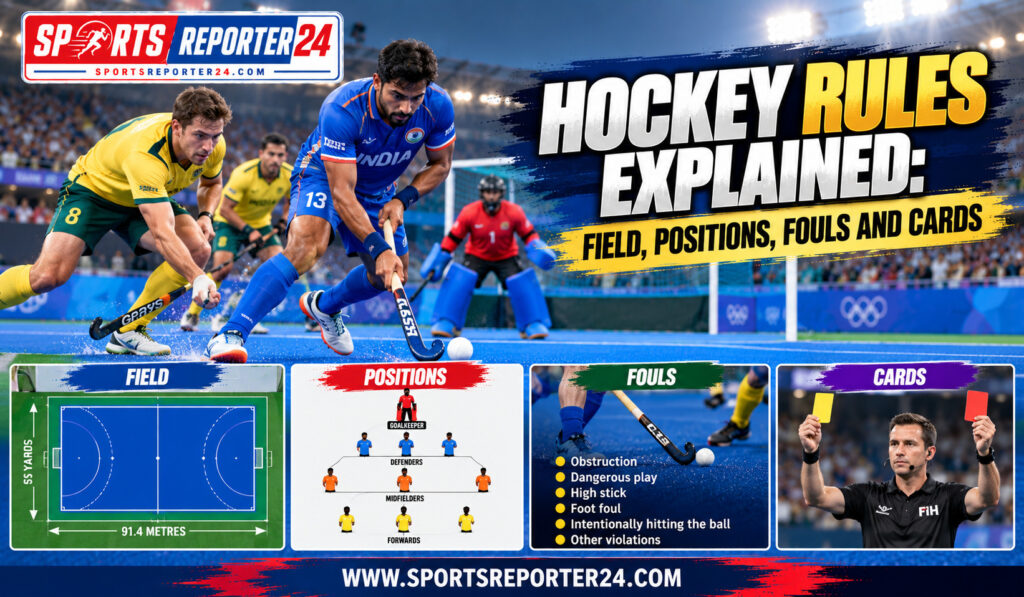
The pitch is long and wide, and lines split it into zones. Each zone has a job, and each line matters for restarts. Here are the key numbers every fan should know:
- Pitch: 91.4 metres long and 55 metres wide
- Goal: 3.66 metres wide and 2.14 metres high
- Shooting circle: marked 14.63 metres from the goalposts
- 23-metre lines: mark the zones used for some restarts
- Penalty spot: 6.4 metres in front of the goal
Everything important happens near the goal. Attackers must shoot from inside the shooting circle to score. Meanwhile, defenders who foul there risk a penalty corner or a penalty stroke. That’s why this small area decides so many matches.
Two umpires control every game. Each one mainly watches one half of the pitch. Even so, they work together on big calls. Sometimes they turn to a video review before making a final decision.
Positions in Hockey: Who Does What
Hockey has four broad roles, though coaches switch them often. A team can also drop the goalkeeper and add an extra outfield player. That usually happens late in a game when a side needs a goal. In fact, India pulled their keeper in the final minutes against Belgium.
Goalkeeper
The goalkeeper wears heavy protective gear and can stop the ball with the body inside the circle. Vincent Vanasch showed the value of that role when he saved Harmanpreet’s and Sukhjeet Singh’s shootout attempts. So a top keeper can swing a game on his own.
Defenders
Defenders protect the circle and start attacks from deep. Many also take penalty corners. Harmanpreet, India’s captain, scored eight goals at the 2026 World Cup, including several from corners.
Midfielders
Midfielders link defence and attack. They win the ball, switch play and cover plenty of ground. Hardik Singh plays that role for India, and he also scored a penalty stroke against Pakistan.
Forwards
Forwards press high and finish chances. Abhishek scored twice in India’s 5-3 win over Pakistan. Meanwhile, Dilpreet Singh and Sukhjeet Singh also scored during the tournament.
Fouls in Hockey and How Umpires Respond
Umpires punish anything that makes play unsafe or unfair. Common fouls include these:
- Obstruction: shielding the ball with the body or stick
- Foot or body contact: the ball hits a player’s foot, leg or body
- Dangerous play: lifting the ball at a player or swinging the stick high
- Stick interference: hitting or hooking an opponent’s stick
Where the foul happens decides the restart. Outside the circle, the other side gets a free hit. Inside the circle, a foul that stops a probable goal brings a penalty stroke. That’s a one-on-one shot from 6.4 metres, so it often means a goal. Smaller fouls near the circle can bring a corner, and the full guide to penalty corner rules in hockey covers every step.
Teams can also ask for a video review. Dilpreet Singh’s referral against Pakistan failed in the 53rd minute. Even so, the system keeps big calls fair. Belgium also challenged an Indian goal in the 7th-8th place match, yet the review found no infringement, and the goal stood.
How Play Restarts After a Stoppage
Hockey restarts quickly, which keeps matches flowing. After a foul, the free hit is taken from the spot of the offence. The player can pass at once or dribble away. However, opponents must stand at least five metres back. When the ball crosses the sideline, the other team hits it back in from that spot.
Rolling substitutions add to the pace. Teams can rotate players freely during play. The main exception comes during a penalty corner, when changes are limited. As a result, coaches plan their rotations carefully, especially late in a close game.
Hockey Cards: Green, Yellow and Red
Umpires use three cards, and each one carries a different cost:
- Green card: a two-minute suspension for a warning-level offence
- Yellow card: a suspension of at least five minutes, set by the umpire
- Red card: permanent removal from the match, with no replacement
While a player sits out, the team plays one player short. That hurts most against strong sides. For example, Aditya Lalage’s yellow card in the 55th minute left India with 10 men against Pakistan. Even so, India held on for a 5-3 win. Tight finishes like that are common, and the record of Indian hockey at the Olympics is full of them.
Hockey Rules Updates for 2026 Every Fan Should Know
FIH updated the Rules of Hockey, with changes effective March 1, 2026. Here are the main ones:
- Too many players: a yellow card goes to the captain if the error materially affects the match
- Aerial balls: defenders may challenge after the receiver’s first touch, while keeping the five-metre safety distance
- Thrown equipment: a penalty corner mask thrown at someone brings a mandatory yellow card if it hits a player or umpire on or above the knee
These tweaks look small. Even so, the first one shaped India’s day against Belgium. Local leagues adopt changes on their own dates, so check your league’s guidance. For example, England Hockey applies the updates from 1 September 2026.
Key Takeaways
- Match length: four 15-minute quarters, so 60 minutes in total.
- Team size: up to 11 players on the pitch, including a goalkeeper.
- Scoring: goals count only from inside the shooting circle.
- Cards: green is two minutes, yellow is five minutes at least, and red is permanent.
- 2026 update: a captain takes the yellow card when too many players affect the match.
FAQs
How long is a hockey match?
A match has four 15-minute quarters, so playing time is 60 minutes.
How many players are in a hockey team?
Each side can have up to 11 players on the pitch, including a goalkeeper.
Can you use your feet in hockey?
No, only the flat side of the stick can touch the ball, apart from goalkeepers inside their circle.
What does a yellow card mean in hockey?
It means a suspension of at least five minutes, so the team plays a player short.
Where must goals be scored from?
Goals count only when the ball is played from inside the shooting circle.
Conclusion
Hockey rules feel simple once you know the field, the roles and the cards. Add the 2026 updates, and you can follow any match with confidence. India’s World Cup games showed each rule in real time, from a yellow card to a shootout. Keep these hockey rules in mind, and the next game will make far more sense.