Argentina led India 2-0 after six minutes at the 2026 World Cup. The second goal came from a penalty corner, converted by Della Torre. One set piece had changed the match. That’s why penalty corner rules matter so much to fans and players alike. This guide breaks down how a corner works, step by step.
You’ll see when a corner is awarded, how teams line up and what the shot rules say. After that, we’ll cover defending, player roles and why conversion decides results. For the wider rulebook, the guide to hockey rules explained covers fouls, cards and field lines.
Penalty Corner Rules in Hockey: When Is One Awarded?
Umpires award a penalty corner when defenders break the rules near their own goal. The main triggers look like this:
- A foul by a defender inside the circle that doesn’t stop a probable goal
- An intentional foul inside the circle against an opponent without the ball
- An intentional foul by a defender outside the circle but inside the 23-metre area
- A defender deliberately playing the ball over their own back line
Compare that with a penalty stroke, which follows a foul that stops a probable goal. A stroke is the bigger punishment, so the umpire must judge whether a goal was likely. Because of that, the line between the two calls can feel thin. Teams therefore fight hard for every decision in the circle.
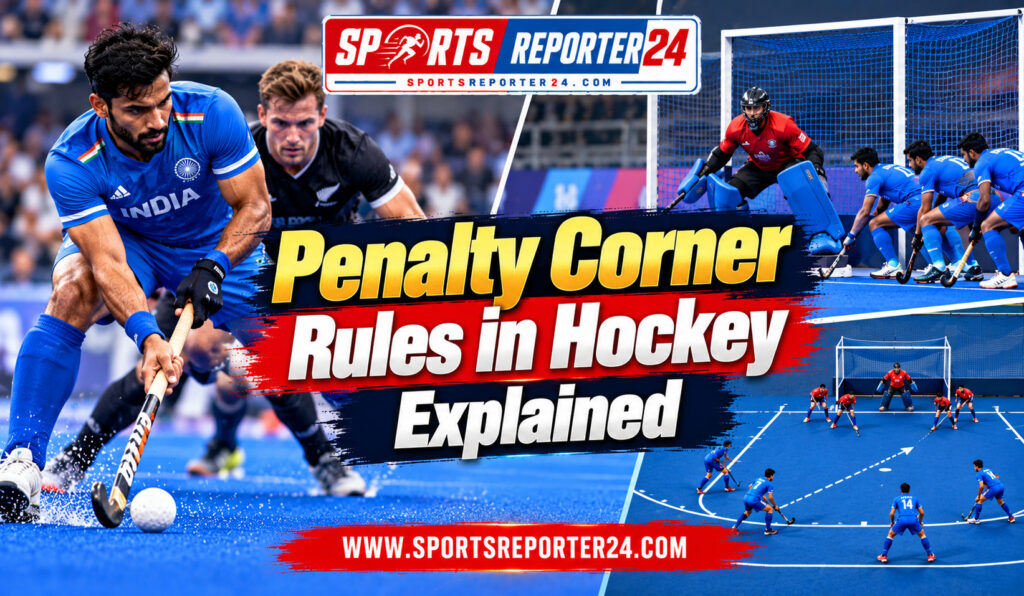
How a Penalty Corner Is Set Up
The setup follows a fixed routine, and every player knows their place. Here’s how it works:
- The ball goes on the back line, inside the circle, at least 10 metres from the nearest goalpost.
- One attacker, the injector, starts the corner by pushing or hitting the ball.
- Up to five defenders, including the goalkeeper, stand behind the back line.
- The other defenders wait beyond the halfway line.
- The remaining attackers stand outside the circle until the ball is played.
The attacking team picks which side of the goal to use. Once the injector plays the ball, everyone can move. Before that, early movers get sent to the halfway line. So discipline matters as much as skill during the first two seconds.
The Shot Rules: Hits, Flicks and the Backboard
The first shot at goal has special limits. If it’s a hit, the ball must cross the goal line below 460 millimetres, which matches the height of the backboard. Flicks and pushes aren’t covered by that limit. Even so, they can’t be dangerous. Before any shot, the ball must also travel outside the circle.
So the standard routine has three steps. The injector plays, a stopper controls and the striker shoots. The drag-flick has become the favoured weapon because it sends the ball high and fast. Harmanpreet Singh scored 10 goals at the Paris 2024 Games, and many came from corners. That haul helped Indian hockey at the Olympics add a second straight bronze.
Penalty Corner Roles: Injector, Stopper and Striker
The Injector
The injector must push or hit the ball accurately and quickly. A weak injection spoils the whole routine. Even a small error gives defenders time to close the gap.
The Stopper
The stopper traps the ball on the edge of the circle. Clean control matters, because the striker needs a steady ball. A bouncing ball ruins the timing.
The Striker
The striker finishes the move. Some prefer a drag-flick, while others use a hit or a deflection. Harmanpreet scored from corners against Wales, England and Belgium at the 2026 World Cup.
Defending a Penalty Corner: Rushers, Masks and Keepers
Defenders have rules to follow too. They can’t cross the back line before the ball is played. Once it moves, the first rusher charges at the shot. Meanwhile, the goalkeeper stays low and reads the flick. Some defenders wear face masks, and FIH now recommends them more strongly.
The 2026 rule changes added a firm sanction. A thrown mask that hits a player or umpire on or above the knee brings a mandatory yellow card. Strong defending can still shut a game down. Germany’s women earned corners against India but couldn’t score, while goalkeeper Bichu Devi and the defence stood firm.
How a Penalty Corner Ends
A corner ends in a few ways. Here are the main ones:
- A goal is scored
- The umpire awards a free hit
- The umpire awards a penalty stroke after a defender’s foul
- The ball moves more than five metres outside the circle
Umpires can also re-award a corner. That happens, for instance, when a thrown mask strikes someone mid-corner, because a bully isn’t possible once a corner is underway. As a result, a single incident can give the attackers a second chance at goal.
Why Conversion Rates Matter in Modern Hockey
Teams earn several corners a match, yet few turn into goals. Conversion is the gap between good and great. Harmanpreet’s two corner goals against Wales gave India a 3-1 win, and Sanjay added another from a set piece. Still, India’s women left the World Cup with corner conversion flagged as a concern.
For the full tournament story, see India’s Hockey World Cup 2026 campaign. Argentina’s early corner against the men shows the other side of the coin. One clean strike can swing a game before the first quarter ends.
Key Takeaways
- Setup: the ball sits on the back line, at least 10 metres from the nearest goalpost.
- Defenders: up to five stand behind the back line, including the goalkeeper.
- First shot: a hit must cross the goal line below 460 millimetres.
- Roles: the injector, stopper and striker each have a clear job.
- 2026 update: a thrown mask that hits someone on or above the knee means a yellow card.
FAQs
What is a penalty corner in hockey?
It’s a set piece that gives attackers a shot at goal after a defender’s foul near the circle.
How many defenders can stand behind the back line?
Up to five defenders, including the goalkeeper, can stand behind the back line.
How high can the first shot go?
A hit must cross the goal line below 460 millimetres, which is the backboard height.
Who takes a penalty corner?
One attacker injects the ball, and a teammate usually stops it for the striker.
Is a drag-flick allowed in hockey?
Yes, drag-flicks are legal as long as the shot isn’t dangerous.
Conclusion
Penalty corner rules look complex, but the routine is simple once you see it. The ball starts on the back line, defenders hold their positions and the striker takes the shot. The 2026 changes add a clear penalty for thrown equipment. Learn these penalty corner rules, and every set piece becomes easier to read.