
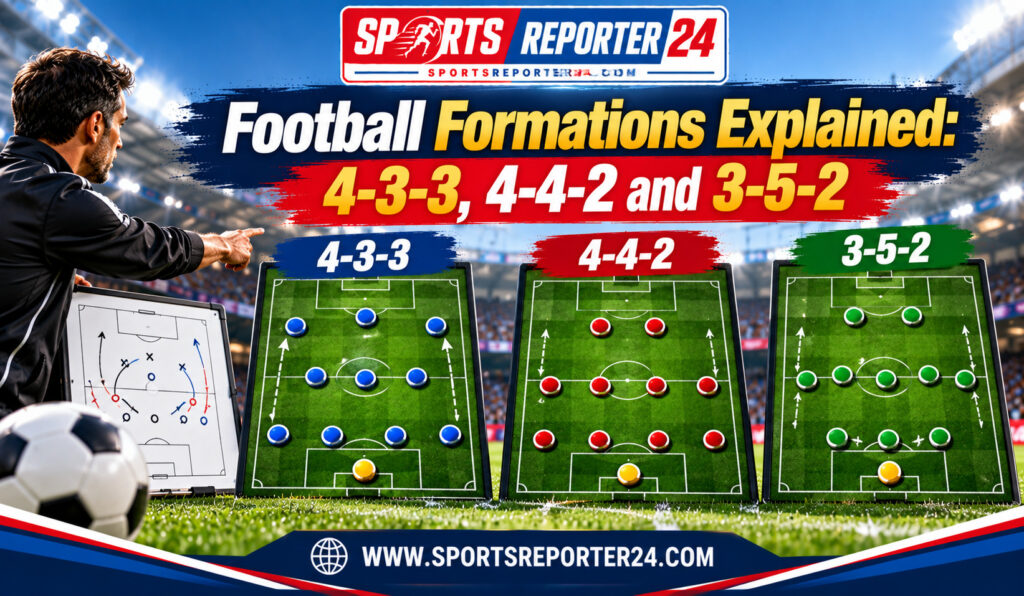
In the 2026 World Cup final, Spain took 15 shots in regulation time, while Argentina took none. That kind of control starts with shape, and shape starts with football formations. So if you’ve ever wondered what the numbers on a team sheet mean, this guide has you covered. Here, we’ll break down 4-3-3, 4-4-2 and 3-5-2 in plain English.
Football formations look like secret codes at first. However, they follow one simple idea: how many players stand in each line. Once you see that, every match becomes easier to read. Along the way, we’ll also show how formations affect pressing, width and even the offside line.
How to Read Football Formations
A team fields 11 players, and one of them is the goalkeeper. Because the keeper isn’t counted in the numbers, the remaining 10 outfield players are listed from defence to attack. So 4-3-3 means four defenders, three midfielders and three forwards.
That’s the whole system. For instance, a 4-4-2 has four defenders, four midfielders and two strikers. Likewise, a 3-5-2 has three defenders, five midfielders and two strikers. Because the numbers always add up to ten, you can check any formation in seconds. Still, the shape on paper isn’t always the shape on the pitch.
The 4-3-3: Width and Pressure
The 4-3-3 is one of the most popular football formations in the modern game. While four defenders protect the goal, three midfielders form a triangle. Meanwhile, three forwards stretch the opposing back line. Usually, those forwards are a central striker and two wide attackers.
Strengths of the 4-3-3
First, the formation gives you natural width, since wingers pin back full-backs and open space for runs in the middle. Second, the midfield triangle makes passing easy, so teams can rotate positions and keep the ball moving. Third, the front three can press together, which helps win the ball high up the pitch.
Weaknesses of the 4-3-3
However, the 4-3-3 can leave gaps. If the wingers stay high, the full-backs can be exposed. Likewise, a lone holding midfielder can get overloaded when a strong central trio attacks. So coaches often ask one midfielder to drop deep and protect the back four. Sides such as Liverpool under Jürgen Klopp and Barcelona under Pep Guardiola are often linked with this shape.
The 4-4-2: Simple and Balanced
The 4-4-2 is the classic English formation. It uses two banks of four, with two strikers up front. Because every player has a clear job, it’s easy to teach and easy to understand. As a result, even amateur teams can pick it up quickly.
Strengths of the 4-4-2
The 4-4-2 is compact, because two tight lines of four make it hard for opponents to play through the middle. In addition, two strikers can work as a pair, with one dropping deep and one running behind. Meanwhile, wide midfielders give width when attacking and cover when defending. For example, Manchester United’s 1999 treble team is often remembered for this shape.
Weaknesses of the 4-4-2
On the other hand, the 4-4-2 can be outnumbered in midfield. When a rival fields a three-man central trio, two central midfielders can struggle. As a result, passes slip between the lines. To fix this, teams often turn one striker into a hybrid number ten. Still, the basic structure stays easy to follow.
The 3-5-2: Wing-Backs and Midfield Control
The 3-5-2 uses three centre-backs, five midfielders and two strikers. Here, the two outer midfielders are called wing-backs. Since they run the whole touchline, defending and attacking, wing-backs need serious fitness.
Strengths of the 3-5-2
First, the formation packs the middle, because three central midfielders sit between the lines. Second, two strikers keep defenders busy. Third, the wing-backs provide width without needing wingers. Looking back, Argentina’s 1986 World Cup winners are often associated with a back-three system.
Weaknesses of the 3-5-2
Then again, the space behind the wing-backs is a problem. If a wing-back is caught high, the outer centre-backs must cover a huge area. Because of this, the formation needs disciplined players and strong communication. Otherwise, teams that lack quick wing-backs can look stretched.
Key Roles in Football Formations
Every shape asks different jobs from its players. In a 4-3-3, one midfielder often sits deep as a holding player, while two others link defence and attack. In addition, the wingers cut inside or stay wide, depending on the plan. Meanwhile, the central striker leads the line and holds the ball up.
In a 4-4-2, the two strikers split the work. One often drops deeper to link play, and the other runs behind the defence. In a 3-5-2, the middle centre-back usually organises the line. Then the wing-backs supply width, so their stamina becomes the key stat. These small roles explain why the same numbers can look very different on the pitch.
4-3-3 vs 4-4-2 vs 3-5-2 at a Glance
Here’s a quick comparison of these football formations to keep in mind:
- 4-3-3: best for width, pressing and passing triangles
- 4-4-2: best for simplicity, balance and compact defending
- 3-5-2: best for midfield control and strong wing-back play
Each formation solves one problem and creates another. That’s why coaches rarely stick to one forever. After all, good football formations are tools, not rules.
Why Football Formations Change During a Match
Formations also shift between attack and defence. A 4-3-3 often becomes a 4-5-1 when the wingers drop back. Meanwhile, a 3-5-2 can turn into a back five when the wing-backs retreat. So the number you see at kick-off is only a starting point.
Coaches also change shape during games. A team chasing a goal may add a striker and push the full-backs forward. Meanwhile, a team protecting a lead might add a defender. In that sense, football formations work like a living plan. They react to the score, the clock and the opponent.
Formations and the Offside Line
Besides tactics, formations shape how teams defend the offside line. A back four can step up together, while a back three might drop deeper to guard the space behind. Because the law punishes attackers who stand beyond the last defender, timing matters. If you want a refresher, our offside rule explained with simple examples guide covers the checklist.
That link helps explain why high lines are risky, since one mistimed step can release a striker. Still, a well-drilled line can trap attackers again and again. That’s why coaches practise defensive movement as much as they practise attacking patterns.
Football Formations in 2026
Shape matters at every level. In July, the FIFA World Cup 2026 final showed how control and structure can decide a match. Since Spain dominated shots and corners, it’s fair to say organisation mattered as much as talent.
Closer to home, the ISL 2026-27 season gives Indian fans a weekly chance to watch tactics at work. Because thirteen clubs face a long double round-robin and a playoff finish, flexible teams should thrive. So watch how each coach adjusts shape from match to match.
How to Choose Between Football Formations
Choosing among football formations starts with players. If a team has two great strikers, a 4-4-2 or 3-5-2 makes sense. If it has strong wingers, a 4-3-3 may fit better. Next comes the opponent, because adding a third midfielder can help against a team with three central midfielders.
Finally, think about fitness and discipline. Because wing-backs run far and pressing forwards need energy, stamina decides a lot. As a result, the best formation isn’t always the most fashionable one. It’s the one your players can run properly, match after match.
Key Takeaways
- Reading numbers: Football formations list outfield players from defence to attack, and the goalkeeper isn’t counted.
- 4-3-3: It offers width and pressing, but it can leave gaps behind wingers.
- 4-4-2: It’s compact and simple, but it can be outnumbered in midfield.
- 3-5-2: It controls the middle, but it needs fit wing-backs.
- Flexibility: Football formations change during a match, so the starting number is only a guide.
FAQs
What do the numbers in football formations mean?
Because they list lines of players, they show how many outfield players stand in each line, from defence to attack.
Which of the football formations is best for beginners?
The 4-4-2 is usually the easiest, because it has clear roles and two compact lines of four.
Why is the 4-3-3 so popular?
Since it gives teams width, a strong midfield triangle and a front three, it can press together.
What is a wing-back in a 3-5-2?
A wing-back is a wide player who, unlike a winger, defends and attacks along the whole touchline.
Can a team change its formation during a game?
Yes, teams often switch shape after goals, injuries or tactical changes.
Conclusion
Football formations are simple once you know the code. Among popular football formations, the 4-3-3 brings width, the 4-4-2 brings balance, and the 3-5-2 brings midfield control. While none is perfect, every coach picks based on players and opponents. As the 2026 season shows, from the World Cup to the ISL, shape often decides who controls the game. Understanding football formations makes every match easier to read. It also makes the numbers on a team sheet far less mysterious.