Red Bull and Ferrari both left Singapore with 26 points. Yet the two teams got there in very different ways. First, Max Verstappen won the race and scored 25. Meanwhile, Ferrari collected 18 for second place and 8 for sixth. That’s the F1 points system explained in one weekend, and it matters more than ever this season.
So this guide breaks down every part of the scoring. It also covers race points, sprint points and the rules for shortened races. It also shows how the drivers’ and constructors’ championships work. Because Kimi Antonelli leads the 2026 title race, the maths has real weight right now.
F1 Points System Explained: The Grand Prix Scale
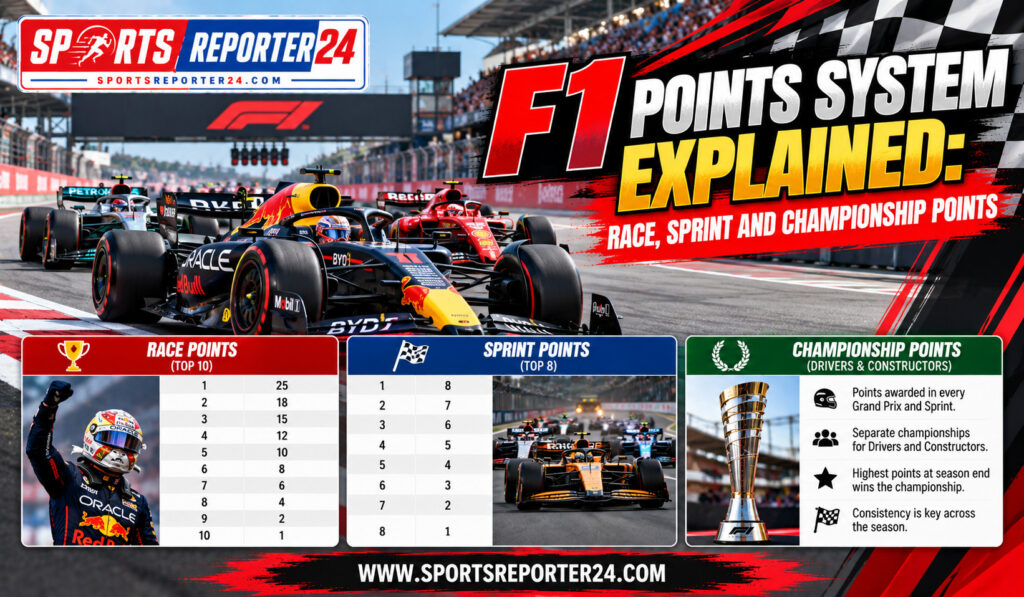
First, only the top ten finishers score in a Grand Prix. The winner earns 25 points, and the scale drops quickly from there. Since 2010, F1 has used the same pattern, so it’s easy to learn. So a win is worth far more than a podium finish further back.
- 1st: 25 points
- 2nd: 18 points
- 3rd: 15 points
- 4th: 12 points
- 5th: 10 points
- 6th: 8 points
- 7th: 6 points
- 8th: 4 points
- 9th: 2 points
- 10th: 1 point
So Singapore shows the scale in action. Because Verstappen won, he took 25, while Charles Leclerc added 18 and Kimi Antonelli collected 15. Lando Norris and Oscar Piastri then scored 12 and 10. Finally, Isack Hadjar grabbed a single point for tenth.
How the Scale Has Changed Over Time
Of course, the modern scale didn’t appear overnight. Before 2003, the winner earned 10 points, with 6-4-3-2-1 behind. Then 2003 widened the scoring to the top eight, on a 10-8-6-5-4-3-2-1 scale. Finally, 2010 brought the 25-point system that fans know today.
Because of that change, wins became far more valuable. As a result, season totals grew a lot. Max Verstappen set the record in 2023 with 575 points, helped by a record 19 victories. So when fans compare eras, the points alone don’t tell the full story.
Sprint Points: A Smaller Prize
Meanwhile, sprint races use a flatter scale. Only the top eight score, and the winner gets 8 points. After that, the points fall by one each place, down to 1 for eighth. As a result, a sprint win is worth about a third of a Grand Prix win.
First, there were six sprint weekends in 2026: Shanghai, Miami, Montreal, Silverstone, Zandvoort and Singapore. By now, all six are done. Because of that, no more sprint points remain this season. Still, the format shaped the standings. For instance, Lando Norris won the Miami sprint, while Antonelli won the Miami Grand Prix.
On a sprint weekend, one driver can score a maximum of 33 points. That’s 8 for the sprint and 25 for the race. On a normal weekend, however, the ceiling is simply 25. As a result, sprint weekends can swing a title fight more than they first appear.
The Fastest Lap Point Is Gone
Older guides still mention a bonus point for the fastest lap. In fact, that rule ran from 2019 to 2024. However, F1 removed it from the 2025 season. The change came after drivers outside the top ten started taking points away from rivals.
So today, finishing position is the only route to points. Pole position doesn’t award championship points either. Because of this, a driver’s total is just the sum of their race and sprint results. So the maths is cleaner for fans.
What Happens When a Race Is Cut Short?
Of course, rain and crashes can end a race early. Since 2022, however, F1 has used a sliding scale for those cases. Before that, the sport simply handed out half points, which caused controversy after the 2021 Belgian Grand Prix. That race was planned for 44 laps but ended during the third lap.
Here’s how the current scale works:
- Fewer than two laps completed: no points
- Two laps up to 25% of distance: 6-4-3-2-1 for the top five
- 25% to 50%: 13-10-8-6-5-4-3-2-1 for the top nine
- 50% to 75%: 19-14-12-9-8-6-5-3-2-1 for the top ten
- More than 75%: full points
Overall, this system is fairer than half points. For example, a race stopped at 60% now rewards a winner with 19 points. That’s closer to the real result. Red flags can trigger these cases, so it helps to know what each F1 flag means when a race stops.
Drivers’ Championship vs Constructors’ Championship
F1 runs two championships at once. First, the drivers’ title goes to the person with the most points. Then the constructors’ title goes to the team whose two cars score the most combined. So there’s no separate scoring for teams.
Singapore again gives a clear example. For instance, Red Bull scored 26 from Verstappen’s 25 and Hadjar’s 1. Ferrari also scored 26 from Leclerc’s 18 and Hamilton’s 8. Meanwhile, McLaren took 22 and Mercedes took 17. So a strong second car can matter as much as one star driver.
However, ties are settled by countback. First, F1 compares wins. If those match, it compares second places, and so on. As a result, a driver with more victories beats a rival on equal points.
Who Gets Classified and Who Doesn’t
Still, finishing high isn’t the only requirement. A driver must also complete enough of the race to be classified. So the usual benchmark is 90% of the winner’s distance. So a driver who retires late can still be classified and score points.
Because of that, this detail matters in chaotic races. For instance, Singapore saw three retirements, including Lance Stroll, Franco Colapinto and Gabriel Bortoleto. Meanwhile, several cars finished laps down. Because only the top ten scored, those laps-down finishers left empty-handed.
The 2026 Title Race in Points
After Round 17 in Singapore, Antonelli leads the standings by 102 points over his Mercedes team-mate George Russell. Even so, six races remain. Meanwhile, Antonelli has won eight Grands Prix this season, including five in a row from China to Monaco. Russell has won three, while Verstappen has taken the last two.
Because no sprints remain, the maximum anyone can score is 25 per race. Since the gap is so big, reports suggest Antonelli could clinch the title as early as Austin on October 25. If not, November’s races should settle it. You can see every remaining date in the F1 calendar for 2026 with race dates, circuits and results.
Strategy also matters because a well-timed stop can gain several places, and each place is worth points. For a closer look, read the guide to an F1 pit stop with tyres, strategy and fastest stop records.
What 102 Points Really Means
A gap of 102 points sounds abstract, so here’s a simple way to see it. Six races remain, and a win scores 25. To catch Antonelli, Russell would need to outscore him by about 17 points per race. That’s a huge ask, because a win against a second place only gains 7.
For that reason, the title looks close to settled. Still, retirements can change everything. For instance, Russell’s late retirement in Malaysia handed Antonelli a big boost. So reliability is worth as many points as raw pace.
Why Points Matter Beyond the Trophy
Points don’t only decide champions. They also shape how much prize money each team receives at the end of the season. As a result, midfield battles for eighth or ninth carry real financial weight. A single point for tenth can matter in a tight constructors’ fight.
That explains why teams fight so hard late in races. Hülkenberg held off Russell at Singapore to finish eighth for Audi, which earned him 4 points. Meanwhile, Russell took 2 after starting 19th. In short, every position has a price tag.
Key Takeaways
- Race points: The F1 points system explained simply is 25-18-15-12-10-8-6-4-2-1 for the top ten.
- Sprint points: The top eight score 8-7-6-5-4-3-2-1.
- Fastest lap: There’s no bonus point since 2025.
- Shortened races: A four-step scale replaced half points after 2021.
- Championships: Team points are simply both drivers’ totals added together.
FAQs
How many points does a Grand Prix winner get?
A Grand Prix winner scores 25 points.
How many points does a sprint winner get?
A sprint winner scores 8 points.
Is there a point for the fastest lap?
No, the fastest lap bonus was removed from the 2025 season.
How do constructors score points?
Teams score the combined points of both their drivers.
Who leads the 2026 championship?
Kimi Antonelli leads Russell by 102 points after the Singapore Grand Prix.
Conclusion
The F1 points system explained here is simple at heart. Winners earn 25, sprint winners earn 8, and the top ten score on race day. Shortened races use a sliding scale, and the fastest lap bonus no longer exists. With Antonelli well clear and six races left, every point from here on carries serious weight. After all, a few places can decide a constructors’ fight, even when the drivers’ title looks settled.