
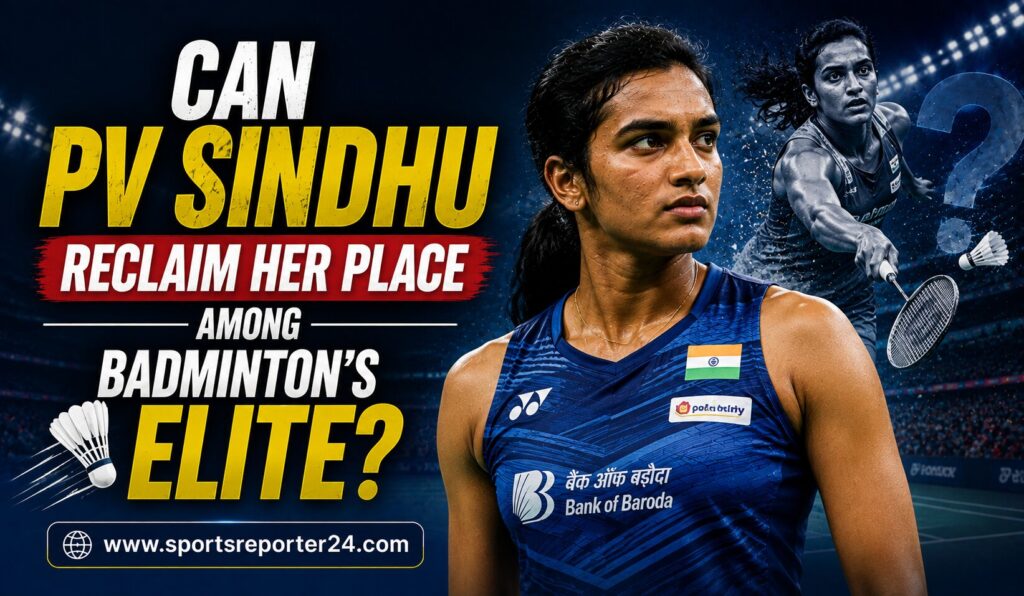
PV Sindhu has already achieved what most badminton players can only dream of. She is a two-time Olympic medallist, a former world champion and one of the most successful Indian badminton players of her generation. Yet, as her career enters another important phase, a new question is beginning to dominate the conversation: Can PV Sindhu reclaim her place among badminton’s elite?
For more than a decade, Sindhu has been one of the biggest names in international badminton. Her powerful attacking game, physical strength and ability to perform under pressure helped her become a regular presence at the biggest tournaments.
But the women’s singles field has changed dramatically.
A new generation of players has emerged, while established stars have become faster, more consistent and tactically sophisticated. Sindhu, meanwhile, has had to deal with injuries, changes in coaching and fluctuations in form.
Her challenge now is not about proving that she belongs at the highest level. She has already done that.
It is about showing that she can once again consistently compete with the world’s very best.
PV Sindhu’s Extraordinary Career
Sindhu’s place in Indian sporting history is already secure.
She won silver at the 2016 Rio Olympics and followed it with bronze at the Tokyo Olympics in 2021. She then became the first Indian badminton player to win the BWF World Championships in 2019.
Her World Championship record is particularly impressive. Sindhu has won multiple medals at the tournament, establishing herself as one of the most successful players in its history.
Her career has also included major titles on the BWF World Tour, Commonwealth Games success and Asian Games medals.
These achievements explain why expectations around Sindhu remain so high.
For an ordinary player, reaching the later stages of major tournaments might be considered a successful career. For Sindhu, fans have become accustomed to seeing her challenge for titles.
That makes any dip in form appear much more significant.
Why Has Sindhu’s Form Become a Talking Point?
One of the biggest challenges for Sindhu has been maintaining consistency against a rapidly evolving women’s singles field.
Modern badminton has become incredibly demanding physically.
Rallies are often faster, defensive transitions are more aggressive and players need to maintain speed throughout long matches.
Sindhu has traditionally relied on her height, reach and powerful attacking strokes. Her steep smashes and ability to attack from the rear court have been among her biggest weapons.
However, opponents have increasingly developed strategies designed to move her around the court and force her into defensive situations.
That means Sindhu needs to continue adapting her game rather than depending solely on the style that made her successful earlier in her career.
A Changing Women’s Singles Landscape
The competition at the top of women’s badminton has become extremely strong.
Players such as An Se-young, Chen Yufei, Wang Zhiyi and Akane Yamaguchi have demonstrated different combinations of speed, defence, patience and attacking ability.
Younger players are also entering the international scene with impressive physical conditioning and fearless playing styles.
For Sindhu, competing against this generation requires more than experience.
She needs to combine her experience with improved movement, consistency and tactical variation.
The good news is that experience itself can be a significant advantage.
Sindhu has played countless high-pressure matches and understands what it takes to compete on the biggest stage.
Sindhu’s Biggest Advantage: Experience
One factor that could help Sindhu make another push toward the top is her enormous experience.
She knows what it feels like to play Olympic finals, World Championship matches and major international tournaments.
She has also experienced both victory and disappointment.
That knowledge can be invaluable.
A younger player may have greater speed or physical freshness, but Sindhu has spent years learning how to manage pressure, prepare for opponents and compete through difficult situations.
If she can combine that experience with improved fitness and tactical discipline, she could still be a dangerous opponent for anyone.
Fitness Will Be Crucial
For Sindhu, physical conditioning could be one of the most important factors in determining the next stage of her career.
At the highest level, badminton is incredibly demanding. Players need explosive movement, endurance, flexibility and rapid recovery between matches.
Sindhu has previously dealt with injuries that affected her rhythm and tournament schedule.
Maintaining a healthy body will therefore be essential.
A consistent run of tournaments can help a player regain confidence, but playing too many events without adequate recovery can create another problem.
Finding the right balance will be important.
Coaching Could Make a Difference
Another major factor in Sindhu’s career has been coaching.
She has worked with several coaches during different stages of her career, each bringing different ideas to her game.
A successful comeback does not necessarily require completely rebuilding her playing style.
Instead, the right coaching team can identify where small tactical changes can produce significant improvements.
For example, Sindhu may benefit from greater variation in pace, more efficient movement patterns and stronger control during long rallies.
The objective should be to make her game less predictable without taking away the attacking strengths that made her successful.
Can Her Attacking Game Still Trouble the Best?
Absolutely.
Sindhu’s attacking ability remains one of her greatest weapons.
Her height gives her a natural advantage when attacking from the rear court, while her reach allows her to intercept shots that shorter players may struggle to reach.
Her smash can still create enormous pressure when she gets the right opportunity.
The challenge is creating those opportunities.
Top players are unlikely to simply allow Sindhu to dictate rallies.
They will try to keep her moving, attack her forehand and backhand corners and prevent her from establishing a comfortable rhythm.
That means Sindhu will need patience.
Instead of trying to finish rallies too early, she may need to construct points and wait for the right moment to attack.
The Mental Side of a Comeback
A comeback is not only about physical preparation.
Confidence is equally important.
When a player has spent years competing for major titles, a period of inconsistent results can create additional mental pressure.
Every early-round defeat generates questions.
Every close loss can lead to discussions about whether the player has passed their peak.
For Sindhu, blocking out that noise could be as important as training.
She does not need to recreate the exact version of herself that won the 2019 World Championship.
The game has changed, and she has changed too.
The goal should be to create the best version of the player she is today.
India’s Badminton Future Adds Another Dimension
Sindhu’s career also has importance beyond her own results.
She remains one of the most recognisable faces of Indian badminton.
A strong comeback would therefore have a wider impact.
India currently has several promising women’s singles players emerging behind her, including younger talents who can benefit from competing alongside an experienced champion.
Sindhu’s continued presence can provide those players with a valuable example of professionalism, preparation and longevity.
At the same time, the emergence of younger Indian players could push Sindhu to maintain high standards.
Competition within a national team can sometimes become an additional source of motivation.
The 2026 Season Could Be Important
The timing of Sindhu’s next phase is particularly interesting because India is preparing for major international competitions.
The 2026 BWF World Championships will be held in New Delhi from August 17 to 23, giving Indian players the opportunity to compete for a world title in front of a home crowd.
Sindhu has already achieved enormous success at the World Championships, and another strong run would add another chapter to her legacy.
However, she does not need to win the tournament to prove that she can compete again.
A consistent run against top-ranked opponents, especially reaching the later rounds, would itself be a positive sign.
What Would a Successful Sindhu Comeback Look Like?
A successful comeback should not be judged only by trophies.
There are several indicators that could show Sindhu is returning to her best.
She would need to regularly defeat higher-ranked opponents, maintain consistency across tournaments and remain competitive during long matches.
Her movement would need to become more efficient, while her attacking game would need to remain a major weapon.
Most importantly, she would need to regain the confidence that allows her to perform aggressively during crucial points.
If those elements come together, there is no reason to assume Sindhu cannot challenge the world’s leading players again.
Why Writing Her Off Would Be a Mistake
There is a tendency in professional sport to judge athletes purely according to their most recent results.
But elite careers are rarely that simple.
Sindhu has already demonstrated an ability to reinvent herself.
She reached the 2016 Olympic final, won another Olympic medal five years later and became world champion in between.
Her career has survived coaching changes, injuries, defeats and changes in the international landscape.
That history makes it difficult to completely dismiss her chances of another strong phase.
She may not dominate the way she did during her peak years.
But she does not necessarily need to.
A more experienced, tactically smarter version of Sindhu could still become a major threat at the biggest tournaments.
Conclusion
Can PV Sindhu reclaim her place among badminton’s elite?
The answer is still open, but there are reasons for optimism.
Her experience, physical advantages, attacking ability and understanding of high-pressure competition give her a foundation that many players would love to have.
The challenge will be turning those qualities into consistent performances against a faster and increasingly competitive women’s singles field.
Fitness, movement, tactical adaptability and confidence will all play major roles.
The upcoming major tournaments could provide an important test of where she stands.
Whatever happens next, Sindhu’s legacy is already secure. But her career may not be finished writing its biggest chapters.
If she can rediscover consistency while adapting her game to the demands of modern badminton, PV Sindhu could still have another serious run among the world’s elite.