For years, badminton in India was often viewed as a sport dominated by a handful of exceptional individual athletes. Players such as Prakash Padukone, Pullela Gopichand, Saina Nehwal and PV Sindhu gradually changed that perception. Today, Indian badminton has reached a stage where success is no longer limited to one or two stars.
A new generation is emerging alongside established champions, creating greater depth across singles and doubles.
The upcoming 2026 BWF World Championships in New Delhi provide an ideal backdrop for this transformation. The tournament will take place from August 17 to 23, bringing the world’s best shuttlers to India and giving the country’s players the opportunity to compete in front of a home crowd.
India’s badminton revolution is therefore not simply about winning medals. It is about building a generation capable of competing consistently at the highest level.
How India Became a Badminton Powerhouse
India’s transformation in badminton did not happen overnight.
For decades, the country produced talented players, but international success was relatively limited compared with badminton powerhouses such as China, Indonesia, South Korea and Denmark.
That gradually changed.
The emergence of Saina Nehwal gave Indian women’s singles a new level of visibility. PV Sindhu then took that success even further, winning Olympic medals and becoming one of the most recognisable badminton players in the world.
At the same time, India’s men’s singles and doubles programs began producing players capable of competing against the world’s best.
The result is a much deeper badminton ecosystem than India had in previous generations.
PV Sindhu: The Veteran Still Setting the Standard
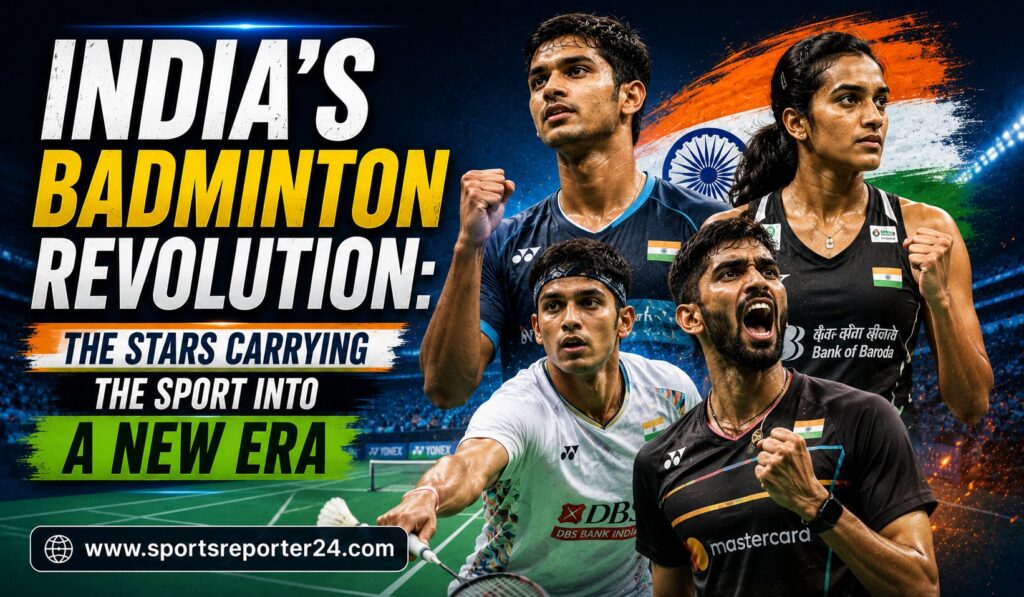
PV Sindhu remains one of the most important figures in India’s badminton story.
Her Olympic success, World Championship title and long international career have established a standard that younger Indian players continue to chase.
Even as a more experienced player, Sindhu remains part of India’s major-event plans. She has been selected to lead India’s women’s badminton challenge at the 2026 Asian Games, alongside emerging players such as Unnati Hooda and Tanvi Sharma.
Her importance goes beyond individual medals.
For younger athletes, Sindhu represents proof that an Indian badminton player can build a sustained career at the very highest level.
At the 2026 World Championships, she will also be chasing another piece of history. A sixth World Championship medal would further strengthen an already extraordinary legacy.
Lakshya Sen: India’s Next Big Singles Hope
Lakshya Sen represents the next stage of India’s men’s singles development.
The young shuttler has already competed at the biggest international events and has demonstrated that he can challenge elite opponents.
His journey has not been completely smooth, however. Maintaining consistency at the highest level remains one of his biggest challenges.
In preparation for the 2026 World Championships, Sen moved his training base to the Badminton Association of India’s National Centre of Excellence in Guwahati to help acclimatise to conditions similar to the New Delhi tournament venue.
That preparation reflects how seriously he is approaching the next stage of his career.
If Sen can combine his attacking ability with greater consistency, he could become one of the central figures of India’s badminton future.
Satwik and Chirag: The Doubles Revolution
Perhaps the biggest transformation in Indian badminton has happened in men’s doubles.
Satwiksairaj Rankireddy and Chirag Shetty have become one of the country’s most successful badminton partnerships and have helped change how Indian fans view doubles competition.
Their combination of power, speed and aggressive attacking play has made them a major force on the international circuit.
They were also part of India’s gold-medal-winning men’s doubles campaign at the 2022 Asian Games. Their continued selection for major events shows how important they remain to India’s medal ambitions.
The challenge for the pair now is maintaining consistency and fitness as international competition becomes increasingly demanding.
Their success has also had a broader effect: young Indian players can now see men’s doubles as a realistic route to international success.
Ayush Shetty: A Name for the Future
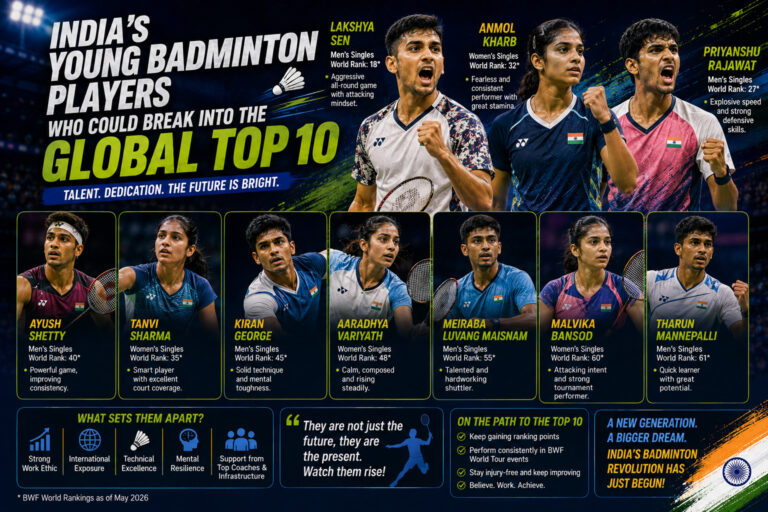
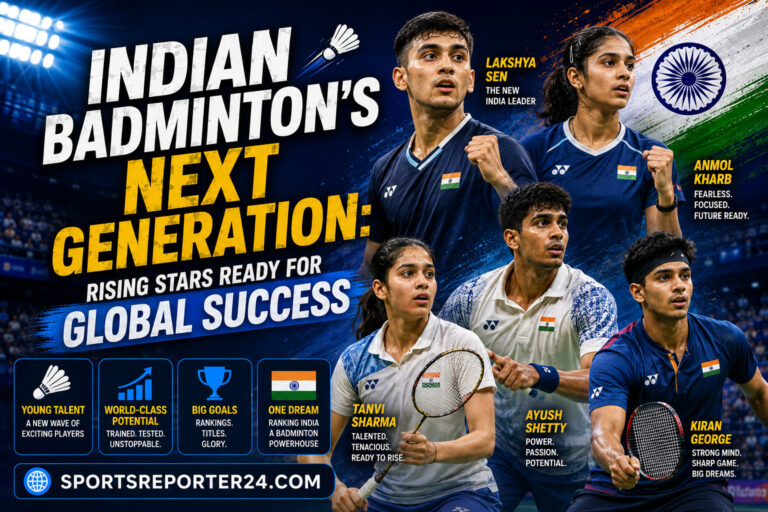
One of the most exciting younger men’s singles players is Ayush Shetty.
His progress has accelerated rapidly, and his silver medal at the 2026 Badminton Asia Championships was particularly significant. According to recent reports, it was the first Asian Championships men’s singles silver won by an Indian male shuttler.
His reward is a major challenge at the 2026 World Championships.
Shetty has been drawn against world No. 1 Shi Yuqi in the opening round.
It is a difficult assignment, but it is exactly the kind of match that can accelerate the development of a young player.
A strong performance against the world’s top-ranked player could give Shetty considerable confidence and international recognition.
Tanvi Sharma and India’s Emerging Women’s Singles Group
The future of Indian women’s badminton cannot depend on Sindhu forever.
That makes the emergence of younger players particularly important.
Tanvi Sharma has become one of the names attracting attention. Her selection for India’s 2026 Asian Games squad reflects the growing confidence in her potential.
She is part of a wider group of young Indian women’s singles players who are trying to establish themselves internationally.
Unnati Hooda is another promising name. She has also been selected for the Asian Games, showing that India’s women’s singles depth is gradually expanding.
The development of these players could determine whether India remains competitive in women’s singles after Sindhu eventually steps away from international badminton.
Treesa Jolly and Gayatri Gopichand: Building Women’s Doubles
India’s women’s doubles program has also been developing.
Treesa Jolly and Gayatri Gopichand have become an important part of India’s international badminton plans.
Their progress matters because women’s doubles has historically not produced the same level of sustained Indian success as men’s singles or women’s singles.
Their continued exposure to major international competitions can help change that.
India’s 2026 Asian Games squad also includes other women’s doubles combinations, showing that the country is attempting to build greater depth rather than depending on one pair.
The Importance of the Next Generation
The most encouraging aspect of India’s current badminton landscape is the mixture of experience and youth.
Sindhu brings years of international experience.
Lakshya Sen represents the established younger generation.
Satwik and Chirag provide elite-level doubles strength.
Then there are emerging players such as Ayush Shetty, Tanvi Sharma, Unnati Hooda, Devika Sihag and others.
India’s 2026 Asian Games squad reflects this combination. The selection includes experienced players alongside several younger athletes who have recently produced strong international results.
This depth could be extremely important over the next four to six years.
Why 2026 Could Be an Important Year
The timing is significant.
India will host the BWF World Championships in New Delhi in August before heading into the Asian Games in Aichi-Nagoya in September.
For Indian players, this creates two major opportunities in the same year.
The World Championships provide the chance to perform on home soil against the world’s elite.
The Asian Games provide another opportunity to compete for medals as part of a large national contingent.
Strong performances at both events could accelerate the growth of Indian badminton even further.
The Challenges India Still Needs to Solve
Despite the progress, India’s badminton journey is not without challenges.
Consistency remains a major issue for several players.
International badminton has become extremely competitive, and reaching a quarter-final or semi-final is difficult even for highly ranked athletes.
India also needs greater depth in women’s doubles and mixed doubles, while men’s singles needs more players capable of regularly challenging the world’s top 10.
Injuries and workload management are another concern, particularly for players competing across multiple tournaments.
The next phase of India’s badminton development will therefore require more than individual talent. Coaching, sports science, fitness, recovery and tournament planning will all matter.
A Sport Moving Beyond a Few Superstars
Perhaps the biggest sign of India’s badminton revolution is that the conversation is no longer limited to one superstar.
There are now multiple players who can create major moments on the international stage.
That changes the expectations around the sport.
Fans are beginning to look beyond medals from individual athletes and expect India to challenge consistently across several categories.
The growth of doubles is particularly encouraging because it provides another route to international success.
Conclusion
India’s badminton revolution is entering an exciting new chapter.
PV Sindhu continues to provide experience and inspiration, while Lakshya Sen represents an important part of the country’s men’s singles future. Satwiksairaj Rankireddy and Chirag Shetty have helped establish India as a serious force in men’s doubles.
At the same time, players such as Ayush Shetty, Tanvi Sharma and Unnati Hooda are creating excitement about what comes next.
The 2026 BWF World Championships on home soil could become another important milestone. With the Asian Games following soon after, Indian badminton has a rare opportunity to showcase both its established champions and its emerging generation.
The real test, however, will be what happens after these major tournaments.
If India can continue developing young players, improve consistency across categories and maintain the high standards established by its biggest stars, the country’s badminton revolution could become much more than a golden period.
It could become the beginning of a long-lasting badminton era.