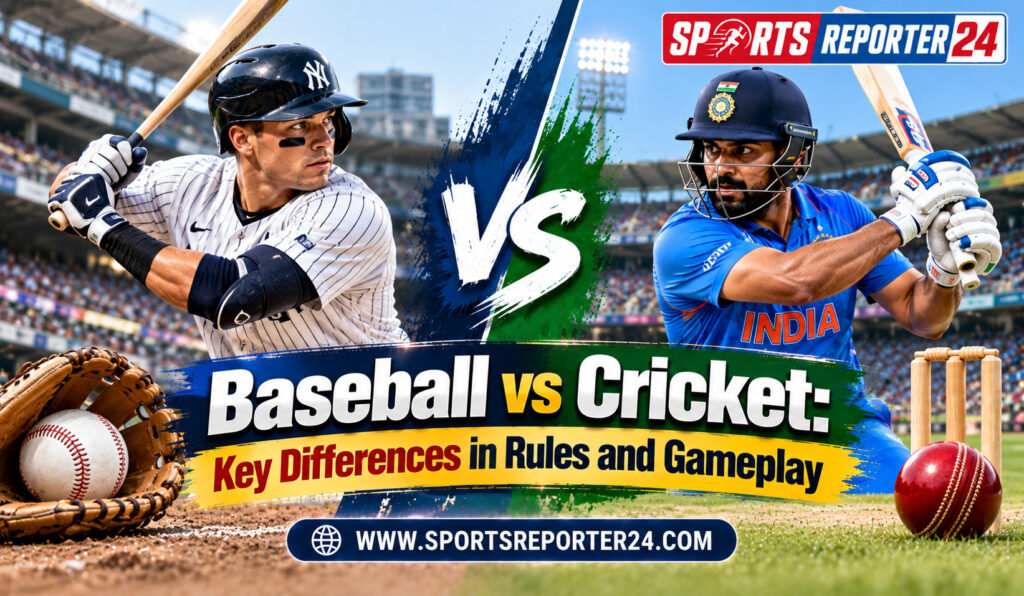
A baseball team needs 27 outs to finish a nine-inning game. A cricket team needs just 10 wickets to end an innings. That gap shows how differently the two sports count the same idea: a bat, a ball and a fight over runs. This guide to baseball vs cricket compares the field, the pitcher and the bowler, scoring, match formats and the newest rule changes.
Baseball vs Cricket: The Basic Idea
Both sports are bat-and-ball games with two sides. One team bats and tries to score runs, while the other fields and tries to get batters out. When the fielding side takes enough wickets or outs, the teams swap roles. The team with more runs at the end wins.
That shared idea is where the similarity ends. Baseball is built on short bursts of action, as each pitch is a mini-contest. Cricket spreads action over long spells with a patient batter. Same idea, different rhythm sums up the whole comparison.
The Field and Team Setup
A baseball field is a diamond with four bases, set 90 feet apart. Fair territory is a 90-degree wedge in front of home plate. Any ball hit outside that wedge is foul. Nine players take the field for the defending team.
A cricket field is an oval, and the action can go in any direction. The key area is the pitch, a strip 22 yards long between two sets of stumps. Eleven players take the field. Because the batter can hit in all 360 degrees, fielders spread around the whole ground.
Pitching vs Bowling
In baseball, the pitcher throws overhand from a mound 60 feet 6 inches from home plate. Speed, spin and location are the weapons. A pitch must cross the strike zone to count as a strike. Three strikes make an out, and four balls give the batter a walk.
In cricket, the bowler delivers the ball with a straight arm and usually bounces it before it reaches the batter. Six legal deliveries make an over. After each over, a different bowler takes charge from the other end. Bowling with a straight arm is a core rule, so throwing the ball is not allowed.
Batting and Hitting Rules
A baseball batter faces one pitch at a time and must decide fast. A hit must land in fair territory to count. A foul ball counts as a strike, except with two strikes already. After a fair hit, the batter runs toward first base.
A cricket batter stands at the stumps and defends them. There’s no foul territory, so any shot is legal. Two batters are always at the crease. They run between the wickets for runs, and they can choose not to run at all.
How Scoring Works
Baseball scores a run each time a runner touches all four bases in order. A home run, which clears the outfield fence in fair territory, scores for the batter and every runner on base. Runs usually come in ones and twos. Big innings happen when several hits fall together.
Cricket scores differently. Batters run the length of the pitch to score one run per crossing. A ball that reaches the boundary on the ground scores four. A ball that crosses it in the air scores six. Extras, such as wides and no-balls, add runs to the batting side’s total.
Outs vs Dismissals
Both sports end a batter’s turn in several ways. Here’s how they compare:
- Baseball: strikeout, flyout, force out and tag out.
- Cricket: bowled, caught, leg before wicket, run out, stumped and hit wicket.
In baseball, each half-inning ends after three outs. In cricket, an innings ends after ten wickets, or when the overs run out. That’s why a baseball game has a fixed number of chances, while a cricket innings can last for hours. A good batter in cricket can bat all day.
Innings and Match Formats
Baseball games run nine innings. Each inning has a top half, when the visitors bat, and a bottom half, when the home team bats. Most Major League games take about three hours. The structure rarely changes.
Cricket has several formats. A Test match lasts up to five days, with two innings per side. A one-day international gives each team 50 overs. A Twenty20 match gives each team 20 overs and finishes in around three hours. As a result, T20 is the closest cricket gets to baseball’s length.
Pace of Play: Pitch Clock, ABS and Reviews
Baseball has changed fast. MLB introduced a pitch clock in 2023, along with bigger bases and limits on defensive shifts. Pitchers get 15 seconds to deliver with the bases empty, and 20 seconds with runners on. These changes cut game time.
In 2026, MLB added the ABS challenge system. Each team gets two challenges per game, and it keeps a challenge if it wins. Only the batter, pitcher or catcher can challenge. Cricket has its own tool, the Decision Review System, where teams can ask for a video check on a dismissal.
Equipment Differences
Baseball uses a round bat and a small, hard ball. Fielders wear a glove on one hand, and the catcher wears extra protection. Batters wear helmets. Everything is built for quick reactions at close range.
Cricket uses a flat-faced bat and a harder ball. Fielders usually play without gloves, except the wicketkeeper. Batters wear pads, gloves and a helmet. Protection is vital in cricket, because fast bowlers can reach very high speeds.
Tiebreaks and Extra Innings
Baseball games that finish level go to extra innings. MLB places a runner on second base at the start of each extra inning to speed things up. The game continues until one team leads at the end of an inning. Draws aren’t expected in normal play.
Cricket handles ties by format. A limited-overs match can go to a super over, where each team bats for one over. A Test match can end in a draw if time runs out. Like rugby’s bonus points, these rules show how each sport manages unclear results.
Fielding Positions
Baseball has fixed defensive positions: pitcher, catcher, first base, second base, third base, shortstop and three outfielders. Each has a clear role. Plays are rehearsed, such as the double play.
Cricket positions have names like slip, gully, point, mid-off and square leg. Captains move fielders around for each bowler and batter. The wicketkeeper stands behind the stumps. Compared with basketball positions, cricket placements are more flexible and tactical.
Umpires and Officials
Baseball games usually use four umpires, one at each base area. The home-plate umpire calls balls and strikes, though the ABS challenge system can now overturn those calls. Others rule on safe or out calls and fair or foul balls. Replay review handles disputed plays.
Cricket uses two umpires on the field and a third umpire watching video. One umpire stands behind the stumps at the bowler’s end and judges leg before wicket. The other stands at square leg. The third umpire checks run outs, catches and boundaries, and helps teams that use reviews.
Strategy and Big Tournaments
Strategy differs by sport. Baseball managers pick pitchers, adjust the batting order and decide when to steal or bunt. Cricket captains set the field, choose bowlers and decide when to declare an innings in Test matches. In both, planning matters as much as talent.
The biggest events reflect those styles. Baseball crowns its champion in the World Series, while cricket stages the Cricket World Cup and big T20 leagues like the Indian Premier League. Fans who follow both often notice how patient each sport feels. Like volleyball’s best-of-five format, these events reward teams that last the distance.
Key Takeaways
- Field: Baseball uses a 90-degree diamond, while cricket uses a 360-degree oval.
- Team size: Nine fielders in baseball, eleven in cricket.
- Innings: Three outs in baseball, ten wickets in cricket.
- Scoring: Four bases for a run in baseball, and runs between wickets in cricket.
- Formats: One standard baseball game, versus Test, ODI and T20 in cricket.
FAQs
How many players are on a baseball team? Nine players take the field for the defending team.
How many players field in cricket? Eleven players take the field.
How many outs end a baseball half-inning? Three outs end each half-inning.
What is a Twenty20 match? It’s a cricket match where each team bats for 20 overs.
Can a cricket batter hit the ball anywhere? Yes, cricket has no foul territory, so shots can go in any direction.
Conclusion
Baseball vs cricket is a comparison between two games that look alike and play very differently. Baseball offers a tight diamond, short bursts and a fixed nine innings. Cricket offers an open oval, long spells and several match formats. Learn the scoring and the dismissals, and both sports become easy to enjoy. Fans who like comparing rules can also try volleyball and its rotation system.