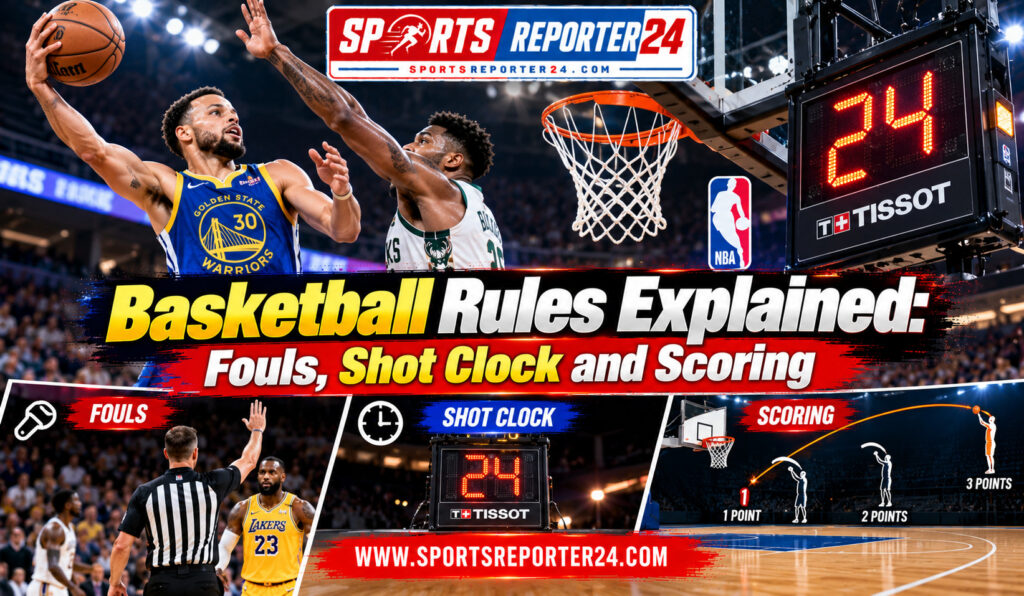
The NBA has played under a 24-second shot clock since the 1954–55 season, and the game never looked back. That one rule turned slow, low-scoring games into the fast ones fans know today. Still, the shot clock is only one piece of the puzzle. This guide to basketball rules covers scoring, fouls, violations and the main differences between the NBA and international play.
Basketball Rules: The Court and the Teams
Each team puts five players on the court at once. The goal is simple: put the ball through the opponent’s hoop. The rim sits 10 feet, or 3.05 meters, above the floor. An NBA court measures 94 by 50 feet, while a FIBA court measures 28 by 15 meters.
Play starts with a jump ball at center court, and the team that wins it attacks first. After that, possession changes through baskets, turnovers and rebounds. Five players per side is fixed, though substitutes can enter at any stoppage. Coaches use these changes to match styles and manage tired legs.
How Basketball Scoring Works
A basket made inside the three-point line scores two points. A shot from beyond that line scores three. A free throw, taken from the foul line after a foul, scores one. The team with the most points when time runs out wins.
The three-point line sits at different distances in different leagues. In the NBA, it’s 23 feet 9 inches at the top and 22 feet in the corners. FIBA uses 6.75 meters. Because of that gap, long shots feel slightly easier in the international game.
The Shot Clock and Game Time
The shot clock forces teams to attack. In both the NBA and FIBA play, a team has 24 seconds to take a shot that hits the rim. If it doesn’t, the other team gets the ball. After an offensive rebound, the clock resets to 14 seconds, which keeps the pace high.
Game length differs by league. An NBA game has four 12-minute quarters, while a FIBA game has four 10-minute quarters. If the score is level at the end, teams play a five-minute overtime. Overtime periods repeat until one team leads.
Dribbling, Traveling and Ball Handling
A player holding the ball must dribble to move. Once a player stops dribbling, the ball can’t be dribbled again. That’s the double dribble rule. Moving more than the allowed steps without dribbling is traveling, and both give the ball to the other team.
Carrying, or palming the ball while dribbling, is another violation. Players also can’t kick the ball on purpose. Traveling is the call fans debate most, because footwork happens so fast. Referees check where the pivot foot lands and how many steps follow.
Personal Fouls Explained
A foul is illegal contact with an opponent. A personal foul covers holding, pushing, hitting and blocking. Offensive fouls, such as charging into a set defender, give the ball to the other team. Defensive fouls on a shooter give free throws.
Players are limited in how many fouls they can commit. In the NBA, a player fouls out after six personal fouls. In FIBA games, the limit is five. Because of this, star players often sit when they pick up early fouls.
Free Throws and the Bonus
When a player is fouled in the act of shooting, he or she shoots free throws. A made shot with a foul is an “and-one,” which earns one free throw. A fouled three-point attempt earns three. No defender can interfere with a free throw.
Teams also have a foul limit in each period. Once a team reaches it, the opponents shoot free throws on later fouls, even when no one is shooting. That state is called the bonus. Smart coaches track team fouls closely late in a quarter.
Other Foul Types
Beyond personal fouls, there are two serious types. A technical foul covers unsporting behavior, such as arguing with an official. A flagrant foul covers excessive or dangerous contact. Both can lead to free throws and possession for the opponent.
In the NBA, a flagrant foul can also bring an ejection. Referees review serious plays on video to confirm the call. NBA coaches can also challenge certain calls. These tools help officials get big moments right.
Common Violations
Not every rule break is a foul. Violations don’t count against a player’s foul total, but they do cost possession. Here are the common ones:
- Three seconds: an attacker can’t stay in the painted area for more than three seconds.
- Five seconds: a player has five seconds to inbound the ball.
- Eight seconds: a team has eight seconds to cross half court.
- Backcourt: once the ball crosses half court, it can’t go back.
- Goaltending: touching a shot on its way down or on the rim is illegal.
The NBA also has a defensive three-second rule. Defenders can’t stand in the paint without guarding someone. The NBA added it in 2001, when it also allowed zone defense. Similar speed-up ideas appear in baseball’s pitch clock, which came to MLB in 2023.
NBA vs FIBA: Key Differences
International basketball and the NBA share the same core. Several small rules, however, change how games feel:
- Game length: 48 minutes in the NBA, 40 in FIBA.
- Fouls: six per player in the NBA, five in FIBA.
- Three-point line: 23 feet 9 inches in the NBA, 6.75 meters in FIBA.
- Court size: slightly larger in the NBA.
Those differences matter in big events. For example, a player with five fouls must sit in FIBA games, but could keep playing in the NBA. Teams that travel between leagues must adjust their strategy.
Positions in Basketball
Basketball uses five traditional positions. The point guard runs the offense and sets up teammates. The shooting guard scores from the outside. The small forward does a bit of everything, while the power forward works near the basket. The center protects the rim and rebounds.
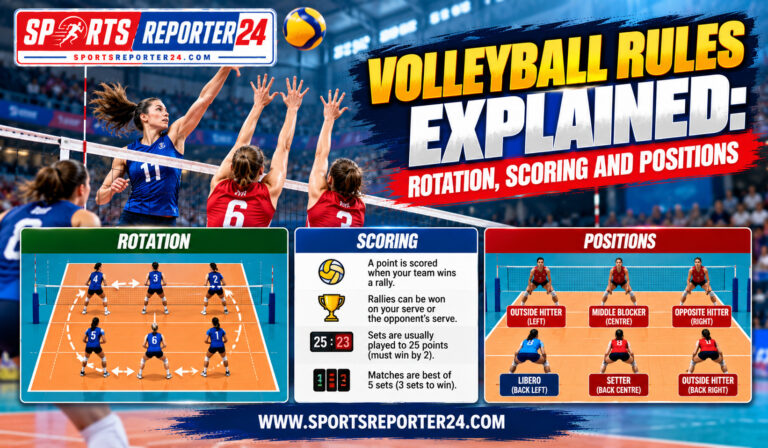
Modern teams often blur these labels, so players switch roles in a game. Still, the labels help new fans follow a lineup. Positions also work differently than in volleyball, where rotation moves players around. In basketball, players choose where to stand within the offense.
Timeouts and Substitutions
Teams can stop play by calling a timeout, and coaches use these breaks to rest players and draw up plays. Each league sets its own number of timeouts and when they can be used. Substitutions are allowed whenever the ball is dead, such as after a foul or a made basket in some situations.
Coaches use substitutions as a tool. A tired star can sit for a moment, while a strong defender comes in for the final possession. Late-game substitutions often decide close contests, because a fresh player can change who gets the last shot. Fans who watch the bench often learn the most.
Basic Offense and Defense
Most offense starts with spacing. Players spread out so defenders can’t guard two people at once. A pick, or screen, is when one player blocks a defender’s path for a teammate. The pick-and-roll, where the screener then dives to the hoop, is one of the most common plays.
On defense, teams use either man-to-man or zone. In man-to-man, each defender guards one opponent. In a zone, each defender covers an area of the floor. In contrast with volleyball’s fixed back-row zones, basketball defenders switch quickly as the ball moves.
Key Terms Fans Should Know
A rebound is gaining control of a missed shot. An assist is a pass that leads directly to a basket. A steal takes the ball from an opponent, and a block stops a shot in the air. A turnover is any loss of possession without a shot.
Then there’s the fast break, which is a quick attack before the defense sets up. A triple-double means a player reached ten or more in three stat categories in one game. These terms show up in every broadcast. Learning them early makes the commentary much easier to follow.
Key Takeaways
- Scoring: One point for a free throw, two inside the arc and three beyond it.
- Shot clock: 24 seconds to shoot, resetting to 14 after an offensive rebound.
- Fouls: Six per player in the NBA and five in FIBA.
- Violations: Traveling, double dribble, three seconds and backcourt cost possession.
- Game time: Four 12-minute quarters in the NBA and four 10-minute quarters in FIBA.
FAQs
How long is the shot clock in basketball?
The shot clock is 24 seconds in both the NBA and FIBA play.
How many fouls before a player fouls out?
A player fouls out after six fouls in the NBA and five in FIBA.
How many points is a free throw worth?
A free throw is worth one point.
How long is an NBA game?
An NBA game has four 12-minute quarters.
What happens if the score is tied at the end?
The teams play a five-minute overtime, and repeat it until someone wins.
Conclusion
Basketball rules reward speed, space and smart decisions. The shot clock forces action, fouls control physical play, and violations protect fair movement. Add the three-point line and the bonus rule, and you can read any game. These basketball rules also compare well with rugby, where scoring is split into very different actions.