
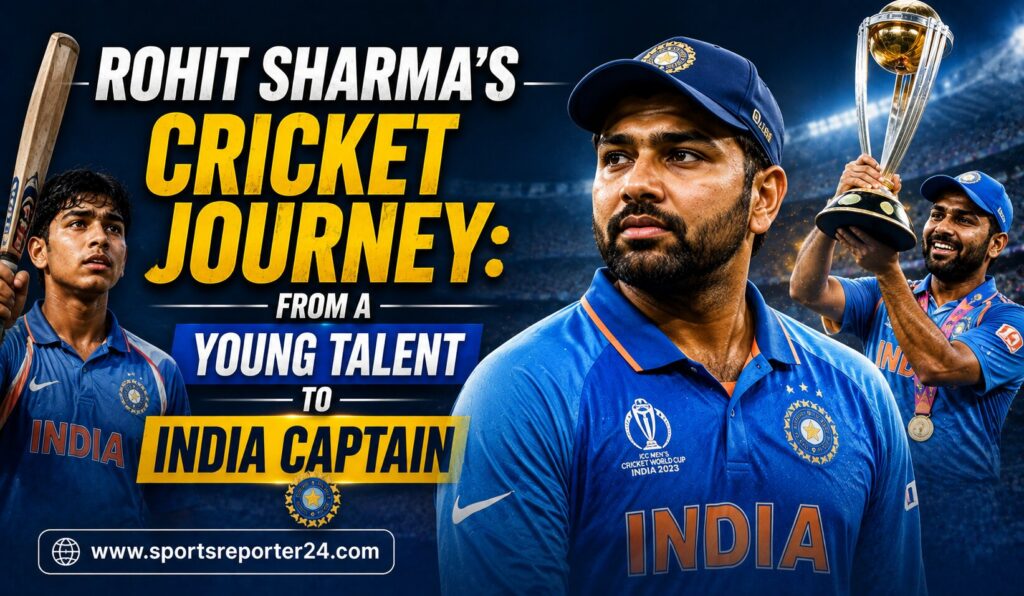
Indian cricket has witnessed many gifted batters, but few have experienced a transformation as remarkable as Rohit Sharma. From a talented youngster trying to establish himself in the national team to one of India’s most successful white-ball batters and captains, Rohit’s career has been shaped by patience, setbacks, reinvention and extraordinary consistency.
Today, the name Rohit Sharma is closely associated with elegant stroke play, enormous sixes, record-breaking ODI scores and calm leadership. However, his journey was not always straightforward. His early international career was promising but inconsistent, and it took an important change in his role for him to become the player the cricket world eventually came to know as the “Hitman.”
The Early Days of Rohit Sharma
Rohit Sharma was born on April 30, 1987, in Maharashtra and developed his cricketing skills from a young age. He progressed through domestic cricket before making his international debut for India in 2007.
His first major opportunity arrived during the inaugural ICC Men’s T20 World Cup in South Africa. Rohit was part of India’s title-winning campaign and made an immediate impression with an unbeaten half-century against South Africa. The performance gave Indian cricket a glimpse of what the young batter could eventually become.
At that stage, however, Rohit was still trying to find his permanent position and role within the Indian team.
He possessed natural timing and an impressive range of shots, but converting talent into consistent international performances proved to be a challenge.
The Struggle to Establish Himself
The early part of Rohit’s international career contained moments of brilliance mixed with periods of inconsistency.
Unlike some young players who quickly become permanent members of the playing XI, Rohit had to wait for opportunities and deal with competition for batting positions. There were also injuries and selection setbacks that interrupted his progress.
His Test debut was delayed for several years. He was originally close to making his Test debut in 2010 against South Africa but suffered an injury on the morning of the match. He eventually made his Test debut against the West Indies in 2013.
When that opportunity finally arrived, Rohit made it count.
He scored a century on Test debut and finished the two-match series with 288 runs, earning Player of the Series honours. It was a powerful reminder that the talent everyone had seen in him during his younger years was still there.
But the biggest transformation in his career was still to come.
The Decision That Changed Rohit Sharma’s Career
One of the most important moments in Rohit Sharma’s cricket journey came when he was promoted to open the batting in limited-overs cricket.
The move eventually proved to be a masterstroke.
Opening gave Rohit the opportunity to spend more time at the crease and play according to his natural style. He could use the fielding restrictions early in an innings while also building a large score once he settled.
The results were extraordinary.
Rohit developed into one of the most dangerous opening batters in world cricket. His ability to combine timing with power allowed him to score quickly without appearing rushed.
The BCCI identifies his promotion to the opening position as one of the biggest turning points in his career. It helped transform him into a record-breaker in both white-ball cricket and, later, Test cricket.
The Rise of the ‘Hitman’
As Rohit became more comfortable at the top of the order, his batting style began producing extraordinary numbers.
He became particularly famous for scoring huge ODI totals.
Rohit holds the record for the highest individual score in men’s ODI cricket: 264 against Sri Lanka in Kolkata in 2014. His ability to accelerate after reaching a century made him capable of turning good innings into enormous ones.
He is also the only batter to have scored three ODI double centuries.
These achievements established Rohit as more than an elegant stroke-maker. He had become one of the most destructive opening batters in international cricket.
His ability to hit sixes was another defining part of his game. His pull shot became particularly famous, while his effortless lofted drives and attacking play against spin made him extremely difficult to contain.
The 2019 World Cup: Rohit at His Best
The 2019 ICC Cricket World Cup was one of the greatest individual tournaments of Rohit’s career.
He scored five centuries during the competition, setting a record for the most hundreds by a batter in a single edition of the men’s ODI World Cup.
His consistency at the top of India’s batting order was remarkable.
Instead of relying on one or two spectacular performances, Rohit repeatedly produced match-winning innings throughout the tournament.
India ultimately fell short in the semi-final against New Zealand, but Rohit’s performances strengthened his reputation as one of the world’s finest ODI openers.
From Mumbai Indians Leader to India Captain
Rohit’s leadership journey developed alongside his batting career.
At the IPL level, he became the captain of Mumbai Indians and built an impressive record. Under his leadership, Mumbai Indians won five IPL titles, establishing Rohit as one of the most successful captains in the tournament’s history.
His captaincy style was different from the stereotypical image of an aggressive leader.
Rohit generally appeared calm and approachable. Instead of constantly displaying emotion, he often focused on tactical decisions, bowling changes and understanding individual players.
That experience became valuable when he eventually took on greater responsibility with the Indian national team.
Becoming India’s Captain
Rohit’s elevation to India’s captaincy marked another major chapter in his career.
He eventually became India’s all-format leader and carried the responsibility during a period when the team was regularly competing for major ICC trophies.
Under his leadership, India reached the 2023 ODI World Cup final and the 2023 World Test Championship final. Although both campaigns ended without a title, India’s performances demonstrated the competitive strength of the team under Rohit.
The biggest reward came in 2024.
The 2024 T20 World Cup Triumph
The 2024 ICC Men’s T20 World Cup became one of the defining moments of Rohit Sharma’s captaincy career.
India went unbeaten throughout the tournament and defeated South Africa in a dramatic final in Barbados.
For Rohit, the victory carried special meaning because India had experienced several disappointing results in major tournaments in the preceding years.
The trophy finally gave him the major ICC title he had been chasing as captain.
His leadership during the tournament was widely praised, particularly for the way he used India’s bowling resources in high-pressure situations. Former India head coach Ravi Shastri described Rohit as one of the best captains in white-ball cricket and praised his tactical decision-making during the tournament.
Retirement From T20 Internationals
Immediately after India’s T20 World Cup triumph, Rohit announced his retirement from T20 international cricket.
The decision came at the perfect moment: he was leaving the format as a World Cup-winning captain.
Rohit finished his T20I career with 4,231 runs and five centuries, according to the BCCI’s player profile. He also played in every edition of the Men’s T20 World Cup from its beginning in 2007 through 2024.
Rather than allowing the format to define the final stage of his career, Rohit chose to step away after achieving the trophy he wanted most.
Rohit Sharma’s Legacy as a Batter
Rohit’s statistics tell only part of the story.
His ODI career includes three double centuries, including the record 264, while his five centuries at the 2019 World Cup remain a landmark achievement.
But his influence is also connected to the way he bats.
Rohit showed that explosive batting does not always require reckless cricket. His biggest shots often came from timing, balance and an exceptional ability to read the ball early.
His success against both pace and spin made him a complete white-ball opener.
The Leadership Lessons From Rohit’s Career
Rohit Sharma’s journey also offers an important lesson about development.
He was never simply an overnight superstar.
He had to deal with inconsistent periods, injuries, selection uncertainty and questions about whether he would fulfil his early potential.
The change came when he found the role that suited his natural abilities.
His career demonstrates that talent sometimes needs the right position, the right responsibility and enough time to mature.
As a captain, he also developed a reputation for trusting his players and remaining calm during pressure situations.
What Makes Rohit Sharma’s Journey Special?
The most interesting part of Rohit’s story is the transformation.
The young player who entered India’s setup in 2007 eventually became a record-breaking opener, IPL-winning captain, India’s national captain and a World Cup-winning leader.
He did not follow a perfectly smooth path.
Instead, his career was built through adaptation.
That is why Rohit Sharma’s cricket journey remains so inspiring. It shows that early struggles do not necessarily determine the final destination of a player’s career.
Conclusion
Rohit Sharma’s journey from a young Indian cricket talent to an international superstar and captain is one of modern cricket’s most fascinating stories.
His career has included extraordinary batting records, difficult periods, leadership challenges and one of the biggest achievements possible in international cricket: leading India to a T20 World Cup title.
Although his T20I career has ended, his influence on Indian cricket remains significant. The younger generation of Indian players has grown up watching Rohit’s batting and leadership, and many have learned from the way he approaches the game.
From the promising youngster of 2007 to the experienced leader who lifted the 2024 T20 World Cup trophy, Rohit Sharma’s story is ultimately about evolution.
He did not become the ‘Hitman’ overnight. He grew into the role through years of cricket, setbacks, reinvention and belief in his own ability.