Six players, one net, and a rotation order that never stops turning. That’s the basic shape of volleyball, yet the rotation rule trips up even regular viewers. Once you know the scoring, the court positions and the three-touch limit, matches make far more sense. This guide to volleyball rules covers every key law, from the serve to the final point. It also explains each player’s role.
Volleyball Rules: The Court, Net and Teams
A volleyball court measures 18 meters long and 9 meters wide. A net splits it into two equal halves of 9 by 9 meters. Men’s nets stand 2.43 meters high, while women’s nets stand 2.24 meters high. A line three meters from the net, called the attack line, marks the front zone.
Each team fields six players at a time. Three stand in the front row near the net, and three stand in the back row. Six players per side is the standard format for indoor play. A ball that touches any boundary line counts as in, so close calls often go to the hitter.
How Volleyball Scoring Works
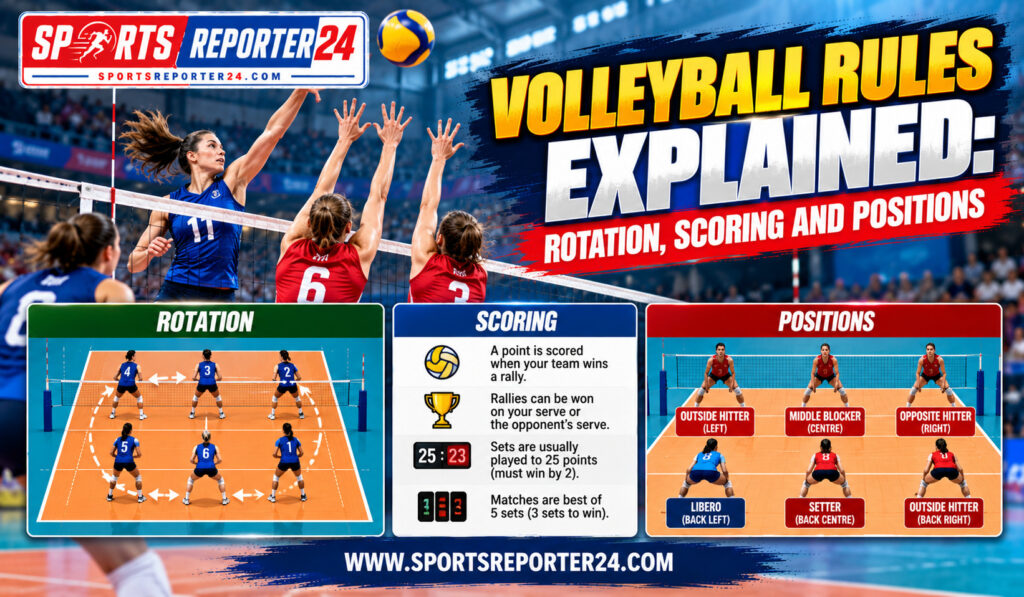
Modern volleyball uses rally scoring. That means a point is awarded on every rally, whoever served. Sets go to 25 points, and a team must lead by two. So a set can run to 26–24, 27–25 or even longer.
A match is usually best of five sets. The first team to win three sets takes the match. If the score reaches two sets each, a fifth set decides it. That deciding set goes to 15 points, again with a two-point lead needed.
Volleyball Rotation Explained
Rotation is the rule that confuses newcomers most. When a team wins a rally on its opponent’s serve, it gains the right to serve. Its players then rotate one position clockwise. The player who moves into the right-back spot becomes the new server.
If the serving team wins the rally, nobody rotates and the same server continues. This is why a strong server can build a long scoring run. Rotation order stays fixed all set, so players can’t swap places freely.
The Six Court Positions
Positions are numbered from 1 to 6. Here’s how they work:
- Position 1: right back, where the server stands.
- Position 2: right front.
- Position 3: middle front.
- Position 4: left front.
- Position 5: left back.
- Position 6: middle back.
At the moment of the serve, players must stay in rotation order relative to their neighbors. That’s called the overlap rule. Once the ball is served, players can move anywhere on court. An overlap mistake gives the point to the opponent.
Player Positions and Roles
Rotation fixes where players stand at the serve, but roles decide what they do. Most teams use five main roles:
- Setter: delivers the second touch to a hitter, like a quarterback.
- Outside hitter: attacks from the left side and often passes serves.
- Opposite hitter: attacks from the right side and blocks the other team’s best hitter.
- Middle blocker: blocks at the net and attacks quick sets.
- Libero: a back-row defensive specialist who wears a different color.
The libero can replace any back-row player without a formal substitution. However, the libero can’t attack the ball above net height. The libero also can’t block. Because of these limits, the role focuses on passing and digging.
The Three-Touch Rule and Ball Contact
Each team may touch the ball up to three times before sending it over the net. The usual pattern is pass, set, then attack. A single player can’t touch the ball twice in a row, except after a block. A block touch doesn’t count as one of the three.
The ball may touch any part of the body, but it must bounce off cleanly. Catching, holding or throwing is a fault. A double contact is also a fault, though a first touch can include a brief second contact. Referees watch these actions closely during fast rallies.
Serving Rules
The server stands behind the end line and must not step on it during the contact. The server has eight seconds to hit the ball after the referee’s whistle. A serve that clips the net and lands in is still legal. A serve that lands out or fails to cross the net loses the point.
Serves come in different styles. Float serves wobble without spin, while jump serves add power and topspin. Skilled servers pick a style that targets weak passers. That’s why serving is a scoring weapon, not just a way to start the point.
Net, Back-Row and Other Faults
Players can’t touch the net during play. They also can’t step fully over the center line into the opponent’s court. Reaching over the net to block is allowed only after the opponent has attacked. A back-row player who jumps from in front of the attack line can’t hit the ball above net height.
Other common faults include a rotation error, a wrong server, and a ball hitting the antenna. Referees signal each one with a clear hand gesture. Knowing these signals helps new fans follow decisions quickly. After each fault, the rally ends and a point goes to the other side.
Substitutions, Timeouts and Challenges
Each team can make up to six substitutions per set. Each team also gets two 30-second timeouts per set. Coaches use them to stop a run or fix a weak spot in defense. Between sets, teams get a short break to reset.
Many elite events also use video challenges. A coach can ask for a review of a touch, a net contact or a ball in or out. A successful challenge changes the call, so teams use them carefully. Rules on challenges vary by competition, so check the event’s rulebook.
Beach Volleyball Differences
Beach volleyball keeps the same basic ideas but changes the format. Two players make a team, so there’s no rotation and no libero. Matches are best of three sets. The first two sets go to 21 points, and a third goes to 15.
The sand court is smaller, at 16 by 8 meters. Players also switch sides every seven points in the first two sets. That rule reduces the effect of wind and sun. Overall, beach volleyball puts more weight on individual skill.
Common Volleyball Terms Fans Should Know
Commentators use plenty of shorthand, so a short glossary helps. An ace is a serve that lands untouched or can’t be returned. A kill is an attack that wins the point directly. A dig is a defensive save of a hard-hit ball, and a block is a net-side wall that stops an attack.
Then there’s the side-out, which means the receiving team wins the rally and gains the serve. A rally is the whole exchange from serve to point. Side-out is the phrase that links scoring to rotation, so it’s worth remembering. Like rugby’s scoring terms, these words make sense fast once you hear them in a match.
Basic Strategy: Offense and Defense
Most teams build their attack around the three-touch pattern. The first touch, a pass, aims for the setter near the net. The setter then places the ball for a hitter with the best chance to score. Good hitters read the block and choose between power and a soft shot over it.
Defense works in layers. Blockers try to stop the ball at the net, while back-row players dig whatever gets through. In contrast with basketball’s man-to-man defense, volleyball defense uses fixed zones that shift with the attack. Communication between players is the key skill, since the ball moves so fast.
Key Takeaways
- Scoring: Rally scoring, with sets to 25 and a two-point lead needed.
- Rotation: Teams rotate clockwise after winning the serve back.
- Touches: Three per team, and no player can hit twice in a row.
- Roles: Setter, outside hitter, opposite, middle blocker and libero.
- Beach version: Two players, no rotation, and sets to 21.
FAQs
How many points are needed to win a volleyball set?
A set goes to 25 points, and a team must lead by two.
How many sets are in a volleyball match?
Most matches are best of five, with a fifth set to 15 points.
What does the libero do?
The libero is a defensive specialist who plays only in the back row.
How many times can a team touch the ball?
A team can touch the ball up to three times before sending it over.
Can the ball touch the line in volleyball?
Yes, a ball touching any boundary line is in.
Conclusion
Volleyball rules are easier than they look. Learn the rally scoring, the clockwise rotation and the three-touch limit, and the game opens up. Add the roles of the setter, hitters, blockers and libero, and you can read any rally. These volleyball rules also make a good starting point for fans who want to compare games like basketball, rugby or baseball vs cricket.