
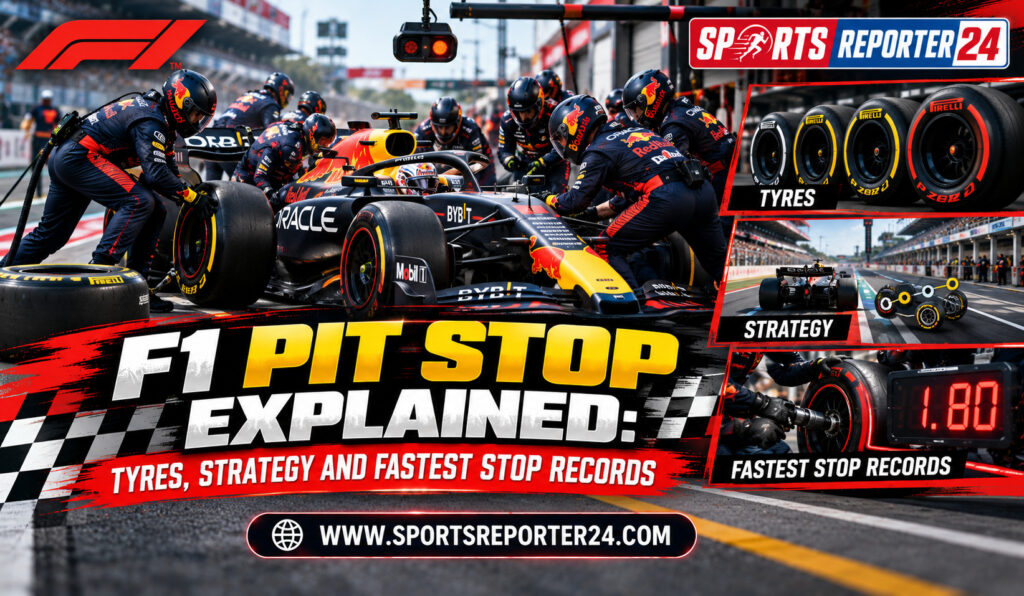
McLaren changed four tyres on Lando Norris’s car in 1.80 seconds. That happened on lap 27 of the 2023 Qatar Grand Prix, and it’s still the world record. So an F1 pit stop explained properly starts with one big question: how can anyone work that fast?
So this guide covers the pit lane, the stop rules and the strategy behind them. It also lists the fastest stop records. Because the 2026 season is in its final stretch, strategy matters more than ever. Here’s the full breakdown.
F1 Pit Stop Explained: What Happens in the Pit Lane
First, a modern pit stop is a tyre change only. Because there’s no refuelling in F1, crews focus on speed. Once the car stops in its box, around 20 crew members swing into action. Within a couple of seconds, all four wheels come off and new ones go on.
Because each wheel is held by a single central nut, a powerful pneumatic wheel gun loosens and tightens it in a fraction of a second. Meanwhile, other crew members lift the car, remove the old wheel and fit the new one. The gun also signals when the wheel is secure, so the driver knows when to go.
So the stationary time is usually around two to three seconds. However, the full cost of a stop is much higher. Drivers must slow down in the pit lane, so the total time lost is often 20 to 25 seconds. That’s why teams only stop when it helps.
Pit lane speed limits
Meanwhile, every driver must stay under the pit lane speed limit. At most circuits it’s 80 km/h, while at some street tracks, including Monaco, it’s 60 km/h. GPS sensors on the cars enforce the limit. As a result, speeding in the pit lane brings a penalty.
A stop in four steps
A stop follows a clear order. Here’s how it unfolds in a blink.
- The driver brakes into the box, and the crew lifts the car.
- The wheel gun operators loosen all four central nuts.
- The old wheels come off, and new ones go on.
- The guns tighten the nuts, the car drops, and the driver launches.
Each step depends on perfect timing. Because crews train for hours, the sequence looks almost effortless. Still, a single hesitation can add tenths of a second. So teams practise stops until they’re second nature.
Why Drivers Must Stop: The Tyre Rules
In a dry race, every driver must use at least two different dry tyre compounds. Because of that, at least one pit stop is mandatory. In fact, it’s the rule that creates strategy. Without it, drivers could simply run one set to the end.
Of course, Pirelli supplies all the tyres. For 2026, it makes five slick compounds, from C1 (hardest) to C5 (softest). It picks three for each race and labels them hard, medium and soft. The colours are white, yellow and red. So fans can tell the compounds apart on TV.
There are also wet-weather tyres. Intermediates carry a green band, while full wets carry a blue one. Pirelli dropped the extra-soft C6 for 2026, because the gap to the C5 was too small. In June 2026, the FIA also extended Pirelli’s deal as sole supplier to the end of 2028. Meanwhile, the FIA scrapped the Monaco two-stop experiment it tried in 2025.
Tyre colours at a glance
- Red: soft, with the most grip and the fastest wear
- Yellow: medium, balanced between pace and life
- White: hard, with the longest life and the least grip
- Green band: intermediate, for damp tracks
- Blue band: full wet, for heavy rain
Strategy: When to Stop and Why
Still, choosing the moment to pit is a craft. Teams watch tyre wear, track position and gaps to rivals. Then they decide whether to stop early or late. Each choice carries risk, so engineers run constant simulations.
Undercut and overcut
An undercut means pitting before a rival. The fresh tyres give a quick lap, so the driver can jump ahead when the rival stops. However, an overcut is the opposite. A driver stays out longer and hopes the rival’s new tyres don’t pay off. So both tactics depend on clean air and good timing.
Safety cars and red flags
Safety cars change the maths. Because a stop under the safety car costs about half the usual time, teams often act fast. As a result, teams often pit the moment it appears. Red flags are even better, since teams can change tyres in the pit lane without losing any race time. For the signals behind these moments, see the guide to what each F1 flag means.
Strategy in Action: 2026 and Beyond
So this season gave several strategy stories. At Sepang, Max Verstappen started on intermediates on a fairly dry track. Heavy rain had delayed the start by more than an hour and a half. Because he read the conditions well, he won after two safety car restarts.
Then in Azerbaijan, George Russell survived two safety car periods and took his third win of the year. Meanwhile, Singapore was calmer. Verstappen led from pole to the flag, so he finished 7.3 seconds ahead of Charles Leclerc. So strategy didn’t need many twists, because he controlled the race.
Yet the 2023 Qatar Grand Prix showed another side. Drivers had to make at least three stops because of a rule limiting each tyre set to 18 laps. Norris started 10th and finished third. As a result, McLaren’s record stop helped him on the way.
Fastest Pit Stop Records
First, the fastest stop in F1 history is 1.80 seconds. McLaren set it at the 2023 Qatar Grand Prix on 8 October 2023. Guinness World Records later made it official. That stop beat a record that had stood since 2019. Red Bull’s 1.82 seconds had itself topped an earlier 1.88 from the 2019 German Grand Prix.
| Time | Team and driver | Race |
| 1.80 s | McLaren, Lando Norris | Qatar GP, 2023 |
| 1.82 s | Red Bull, Max Verstappen | Brazilian GP, 2019 |
The 2023 record is even more impressive because of the wheels. In 2019, cars used 13-inch wheels. However, by 2023, they used heavier 18-inch wheels. Even so, McLaren beat Red Bull’s time by 0.02 seconds. Oscar Piastri’s stop in the same race took 2.00 seconds, so both stops were quick.
As of August 2026, the 1.80-second record still stands. So the target remains unbroken, and teams keep chasing it.
When Pit Stops Go Wrong
Speed matters, but errors cost far more. At the 2024 British Grand Prix, a McLaren pit stop mishap cost Norris the lead. So a single slow wheel can wreck a strategy. That’s why crews rehearse stops over and over.
Unsafe releases are another danger. For instance, at 2025 Singapore qualifying, Leclerc was released early from the pit lane and clashed with Norris. As a result, the McLaren’s front wing was damaged. Because of risks like this, teams use lights and strict procedures to control releases.
How Stops Affect the Standings
Finally, every stop can change points. A good stop can gain a place, and each place is worth points. Meanwhile, a slow stop can lose several. The guide to the F1 points system with race, sprint and championship points shows how much each position pays.
With six races left, Kimi Antonelli leads the championship by 102 points. Still, every weekend can bring surprises. The F1 calendar for 2026 with race dates, circuits and results lists every remaining race, from Austin to Abu Dhabi.
Key Takeaways
- Record: The fastest F1 pit stop is 1.80 seconds, set by McLaren in Qatar in 2023.
- Rule: In a dry race, drivers must use two different dry compounds.
- Time lost: A stop typically costs 20 to 25 seconds in total.
- Speed limit: The pit lane limit is 80 km/h at most circuits.
- Safety car: Stops cost far less under the safety car.
FAQs
What is the fastest F1 pit stop ever?
The fastest stop is 1.80 seconds, set by McLaren at the 2023 Qatar Grand Prix.
Do F1 drivers have to make a pit stop?
Yes, in a dry race they must use two different dry compounds.
Is there refuelling in F1?
No, modern pit stops are tyre changes only.
How many compounds does Pirelli supply in 2026?
Pirelli makes five dry compounds, from C1 to C5, plus two wet tyres.
What is an undercut?
An undercut is pitting earlier than a rival to gain time on fresh tyres.
Conclusion
So an F1 pit stop explained in full is a blend of speed, rules and nerve. Crews change four tyres in about two seconds, and the record stands at 1.80. Strategy decides when to stop, while safety cars and red flags can change everything. So the next time a car dives into the pit lane, you’ll know what’s at stake.