Few rules start more arguments than the offside rule. A toe, a shoulder, or a sleeve can cancel a goal, and fans feel it instantly. So here’s the offside rule explained with simple examples, in plain English. By the end, you’ll know when a player is offside, and you’ll see when the flag should stay down.
Even better, the law is still being debated at the top of the game. In 2026, FIFA’s Arsène Wenger pushed a “daylight” idea that would change how offside is judged. We’ll cover that too, because it affects every fan. Along the way, you’ll see how the offside rule shapes tactics, from the back line to the final whistle.
What Is the Offside Rule?
The offside rule stops attackers from camping near the goal and waiting for a long ball. In simple terms, an attacker can’t sit beyond the defenders when a teammate passes. That’s the core idea behind Law 11. Since it has been part of football for well over a century, it still sparks debate.
Being in an offside position isn’t an offence by itself. Instead, a player is only penalised if they become involved in play. That might mean touching the ball, blocking a defender’s view, or challenging for a rebound. So the offside rule has two parts: where you stand, and what you do next.
Here’s a quick memory trick. Think of three questions: where was the ball, where was the second-last defender, and where was the attacker? If the attacker is ahead of both at the moment of the pass, the position is offside. Then ask one more question: did that player get involved? When the answer is yes, the offside rule applies.
When Is a Player in an Offside Position?
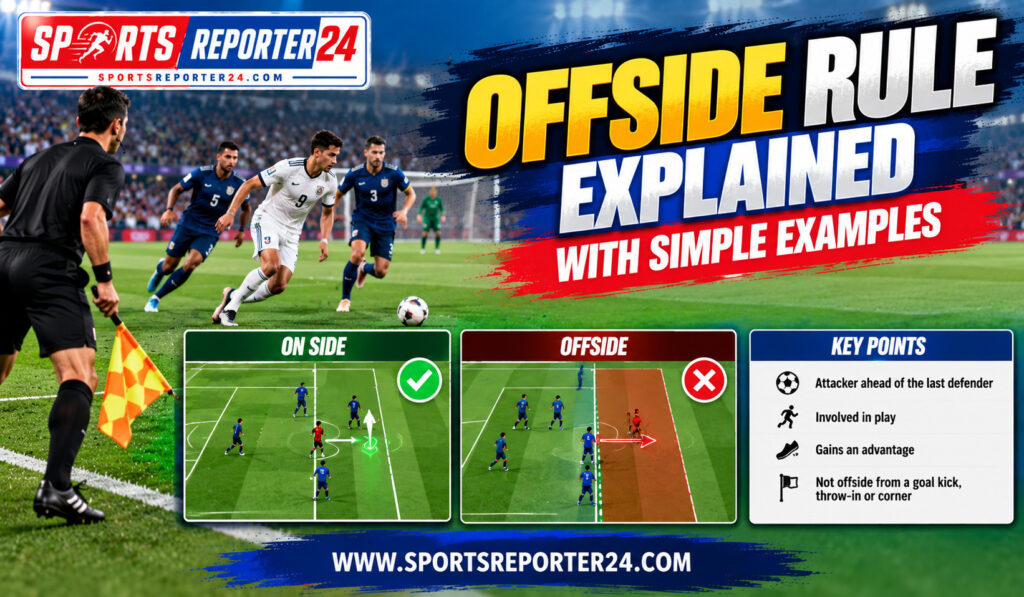
A player is in an offside position when three things are true as a teammate plays the ball. Here’s the checklist:
- They’re in the opponents’ half of the pitch
- They’re nearer to the opponents’ goal line than the ball
- They’re nearer to that line than the second-last opponent
Usually, the goalkeeper counts as one of the last two defenders. Because of this, an attacker is offside only if fewer than two opponents stand between them and the goal line. Meanwhile, being level with the second-last defender is not offside. Also, only the head, body and feet count. Hands and arms don’t.
Simple Offside Rule Examples
Example 1: A Clear Offside
Imagine a striker waiting just inside the box. When a midfielder plays a through ball, the striker stands one step beyond the last defender. Because the striker is nearer the goal line than the ball and the second-last opponent, they’re in an offside position. So if they take the ball, the flag goes up.
Example 2: Level Is Onside
Now picture the same move, but the striker is level with the last defender when the pass is played. Since they’re not nearer to the goal line, they’re onside. Of course, this is where the closest calls happen. Then a boot or a shoulder a few centimetres ahead changes everything.
Example 3: Behind the Ball
Suppose a winger stands behind the ball when a teammate shoots. The winger can’t be offside, because the rule only applies to players nearer the goal line than the ball. Likewise, a player who receives a back pass in their own half is onside. After all, position relative to the ball matters just as much as position relative to the defenders.
Example 4: Offside Position, No Offence
Finally, imagine an attacker standing offside on the far side of the pitch. When the ball goes to an onside teammate, the attacker doesn’t touch it or block anyone. In that case, there’s no offence, so play continues. Position alone isn’t punished unless the player gets involved.
When Can’t a Player Be Offside?
Some restarts are safe for attackers. A player can’t be caught offside directly from a goal kick, a throw-in or a corner kick. Since the ball starts from a set position, defenders have time to organise. So attackers can stand almost anywhere and still receive the ball.
A player also can’t be offside in their own half. Likewise, a player who gets the ball from an opponent’s deliberate pass isn’t offside. The idea is simple, because the offside rule is meant to stop goal-hanging, not normal build-up play. That’s why defenders pushing up as a unit can trap attackers, but only when the timing is right.
What Happens After an Offside Call?
When an assistant referee spots an offence, the other team gets an indirect free kick. The kick is taken from the place where the offside player became involved. Meanwhile, the defending team can quickly restart and switch play. For attackers, that means a lost chance and a reset.
In modern football, VAR has made close decisions more visible. Thin lines on a screen can punish tiny margins, and that frustrates many fans. Wenger himself has argued that these forensic lines took away the benefit of the doubt from attackers. Still, the current law hasn’t changed for professional football, so the same checklist applies.
Wenger’s “Daylight” Offside Trial
Here’s where the debate gets interesting. Wenger, FIFA’s chief of global football development, has pushed a “daylight” version of the law. Under it, an attacker would be offside only if there’s a clear gap between them and the defender. He has said that in cases of doubt, the doubt should benefit the striker.
IFAB, football’s law-making body, didn’t adopt the idea. According to GiveMeSport, a law change needs six of IFAB’s eight votes, and UEFA and the British associations opposed it. However, IFAB agreed in February 2026 to upgrade the trials. As a result, the Canadian Premier League began testing the idea that spring.
Early numbers are interesting. GiveMeSport reports that over the league’s first 11 matches, non-penalty set-piece goals rose from 0.54 to 0.73 per game. So the trial may change where goals come from rather than how many arrive. Meanwhile, critics such as Jamie Carragher fear it would push teams to defend deeper.
Common Offside Rule Mistakes Fans Make
Plenty of fans get the same few points wrong. First, many assume that being ahead of the ball is always offside. It isn’t, because a player in their own half is safe. Second, some believe that level means offside. In fact, level means onside.
Third, people often forget that arms don’t count. A striker can stretch an arm past the last defender, and it won’t matter. Fourth, fans sometimes shout for offside from a throw-in. However, the law says that restart is safe. So when the flag stays down, the referee is usually right, even if it feels wrong.
Who Makes the Call?
Assistant referees run the touchlines and watch the last defender. They have to judge two things at once: the moment of the pass and the positions of every player. That’s hard at speed. Because of this, many leagues rely on VAR to check close goals. Still, the assistant’s first call matters, since the flag often decides whether play continues.
Why the Offside Rule Shapes Tactics
Coaches build whole systems around the offside rule. A high defensive line squeezes space and traps attackers, while a deep line protects against runs behind. Because of this, the choice of shape matters. Our guide to football formations explained shows how back fours and back threes handle the line differently.
The same ideas appear on the biggest stage. Once the tournament ended, the FIFA World Cup 2026 final result showed how control and positioning can decide a match. Closer to home, the ISL 2026-27 season lets you watch how Indian clubs play the line.
Key Takeaways
- Position: A player is offside if nearer the goal line than the ball and the second-last opponent.
- Level: Being level with the second-last defender is onside.
- Involvement: An offside position becomes an offence only when the player affects play.
- Safe restarts: You can’t be offside from a goal kick, throw-in or corner kick.
- Future: The daylight trial is only being tested, so the current offside rule stands.
FAQs
What is the offside rule in simple words?
A player is offside if they’re nearer the opponents’ goal line than the ball and the second-last defender at the moment of the pass.
Can you be offside from a throw-in?
No, a player can’t be offside directly from a throw-in, a goal kick or a corner kick.
Is level with the last defender offside?
No, a player who is level with the second-last defender is onside.
What is the daylight offside rule?
It’s a proposed change where an attacker is offside only if there’s a clear gap between them and the defender.
Has the offside rule changed in 2026?
No, the daylight idea is only in trials, so the standard offside rule still applies in professional football.
Conclusion
The offside rule looks complicated, but it comes down to position, timing and involvement. Once you know the checklist, most calls make sense. The 2026 daylight trial shows that football’s lawmakers are still debating the offside rule, even after more than a century. For now, the safest advice is to watch the last defender and the ball, because that’s where every flag begins.