
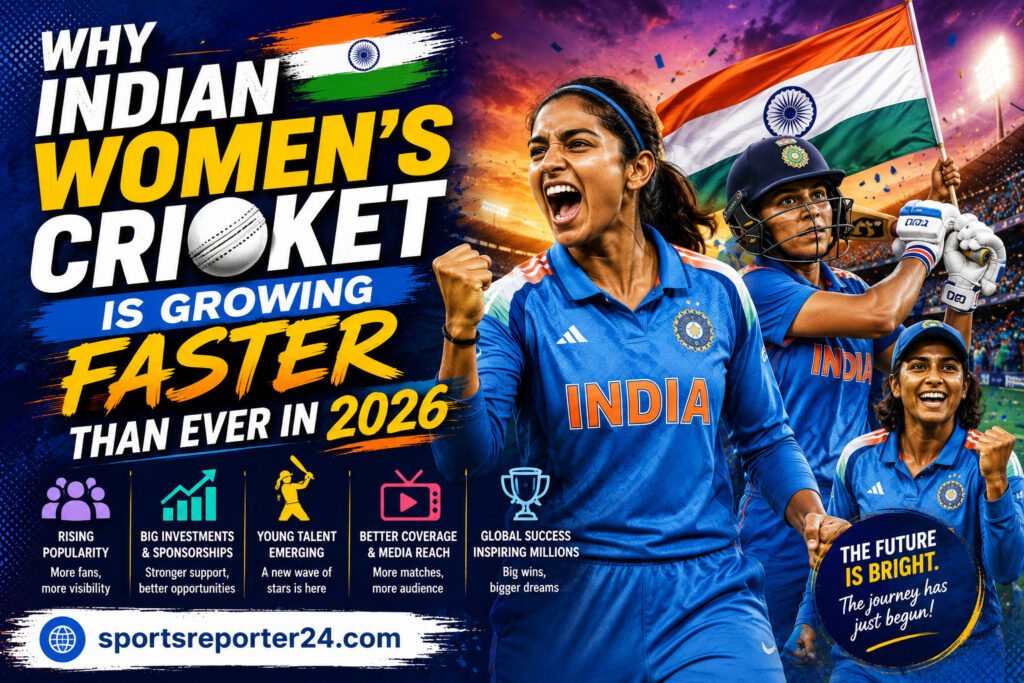
Indian women’s cricket has entered a completely different phase in 2026. What was once viewed as a sport struggling for attention has become one of the most exciting parts of India’s sporting landscape. The transformation has been driven by international success, the rise of the Women’s Premier League (WPL), growing fan interest, stronger domestic pathways and a new generation of players who are increasingly comfortable performing on the biggest stages.
The biggest turning point came in 2025, when India won its first-ever ICC Women’s Cricket World Cup. That historic achievement gave the team a level of visibility and confidence that had been building for years. By 2026, the impact was clearly visible, with interest in women’s cricket continuing to rise. A YouGov survey found that 40.8% of India’s population was actively following women’s cricket in January 2026, up from 38.9% in September 2025.
So, why is Indian women’s cricket growing so quickly in 2026? The answer goes far beyond one tournament or a handful of famous players.
The 2025 World Cup Changed Everything
The first major reason is simple: India finally became world champions.
For years, the Indian women’s team had come close. It reached the Women’s World Cup final in 2005 and again in 2017, but the trophy remained out of reach.
That changed in 2025.
India defeated South Africa in the final to win its first Women’s Cricket World Cup title, creating one of the most important moments in the history of Indian women’s sport. The victory gave players such as Smriti Mandhana, Harmanpreet Kaur, Jemimah Rodrigues, Deepti Sharma and others a place in Indian cricket history.
More importantly, the achievement changed how the public viewed women’s cricket.
The team was no longer simply a promising side hoping to win a major trophy. It was a world champion team with proven ability to perform under enormous pressure.
That success has continued to influence the team in 2026. Smriti Mandhana has spoken about carrying the confidence and hunger from the World Cup into the 2026 T20 World Cup.
The WPL Has Created a Professional Cricket Ecosystem
If the World Cup created the biggest emotional moment, the Women’s Premier League has created the professional structure needed for long-term growth.
The WPL has rapidly become an important part of India’s women’s cricket calendar. Its fourth season in 2026 gave Indian players another opportunity to compete alongside some of the world’s leading cricketers.
The importance of the tournament goes beyond entertainment.
Young Indian players can now share dressing rooms with international stars, experience high-pressure franchise matches and learn from some of the best coaches and players in the world.
The 2026 WPL also demonstrated how quickly the competition has developed. Royal Challengers Bengaluru won their second WPL title, while Smriti Mandhana finished as the leading run-scorer with 377 runs.
That kind of competitive environment gives India’s emerging players an experience that would have been much harder to obtain a few years ago.
The WPL is therefore helping create a stronger pipeline from domestic cricket to international cricket.
Young Players Are Getting Bigger Opportunities
Another reason for the rapid growth is the emergence of young talent.
Indian women’s cricket is no longer dependent on a small group of established stars. Players from younger age groups are increasingly receiving opportunities through domestic competitions, India A tours, franchise cricket and international series.
The Women’s Asia Cup Rising Stars tournament is particularly useful because it provides a bridge between domestic cricket and the senior international level. India A retained the title in 2026, defeating Bangladesh A in the final.
Such competitions give developing players experience against international opposition before they are expected to perform regularly for the senior team.
This is important because the transition from domestic cricket to international cricket can be difficult. The pace is faster, the pressure is greater and mistakes are punished more severely.
By giving young players more exposure earlier in their careers, India is building greater depth.
Smriti Mandhana Has Become a Global Star
The popularity of Indian women’s cricket is also closely connected to the rise of its biggest players.
Smriti Mandhana has become one of the most recognizable faces of women’s cricket globally. Her elegant batting style, consistency and calm personality have helped attract fans beyond traditional cricket audiences.
Her success in the WPL has added another dimension to her popularity.
In 2026, Mandhana once again demonstrated her importance by finishing the WPL as the tournament’s leading run-scorer. She has also remained a key figure in India’s international plans following the 2025 World Cup victory.
But Mandhana is not alone.
Harmanpreet Kaur remains one of India’s most experienced leaders, while Deepti Sharma has become an important all-rounder. Jemimah Rodrigues has also developed into a major personality within the team.
Together, these players provide India with a combination of experience, skill and personality.
Social Media Has Changed Player Visibility
The relationship between players and fans has also changed dramatically.
Indian women’s cricketers now have direct access to millions of followers through Instagram, YouTube and other social platforms. Fans can see their training routines, travel experiences, celebrations and personalities outside the cricket field.
This creates a stronger emotional connection.
Earlier generations of women’s cricketers often received limited media coverage outside major tournaments. Today’s players can build their own audiences regardless of how much traditional television coverage they receive.
For younger fans, this can make women’s cricket feel much more accessible.
Players are no longer simply names appearing on a scoreboard. They are becoming recognizable sporting personalities with individual fan bases.
More Women Are Taking Up Cricket
The growth is also visible at the grassroots level.
A 2026 study commissioned by the BBC and Collective Newsroom and conducted by Kantar reported that women’s participation in cricket in India had doubled since 2020.
That is perhaps one of the most important indicators of long-term growth.
Professional leagues and international trophies can create headlines, but the future of Indian women’s cricket depends on getting more girls involved in the sport.
When young girls see Indian women winning World Cups, earning professional contracts and becoming national celebrities, cricket begins to look like a realistic career rather than an unusual choice.
The effect can be powerful.
More participation means a larger talent pool. A larger talent pool creates greater competition. Greater competition can eventually produce stronger national teams.
Better Financial Opportunities Are Attracting Talent
Professional opportunities have also improved significantly.
The WPL has given women’s cricket a major commercial platform, allowing players to earn through franchise contracts while gaining exposure to sponsors and audiences.
Financial recognition matters because it can influence whether young athletes decide to pursue sport seriously.
A talented teenager who once might have been encouraged to choose academics or another career can now see a potential professional pathway in cricket.
That does not mean every player will become wealthy or internationally successful, but the existence of a professional league has changed the perception of what is possible.
The WPL has also given domestic performers an opportunity to become visible to national selectors.
International Competition Is Becoming More Frequent
Indian women’s cricketers are also gaining more opportunities to play high-quality international cricket.
India’s schedule now includes major ICC tournaments, bilateral series and regional competitions. The 2026 calendar has already included tours and major events, while the Women’s Asia Cup is scheduled for August 28 to September 13.
Regular international cricket is important for development.
Players cannot improve solely through training. They need to experience different conditions, opponents and match situations.
For India, competing against Australia, England, South Africa and other leading teams provides an opportunity to identify weaknesses before major tournaments.
It also creates a stronger competitive mindset.
The 2026 T20 World Cup Provides Another Opportunity
India’s World Cup success in 2025 has created a new challenge: maintaining that standard.
The 2026 ICC Women’s T20 World Cup represents another major opportunity for the team to establish itself as a dominant force in international cricket.
The challenge is different from the 50-over World Cup.
T20 cricket requires explosive batting, aggressive bowling, athletic fielding and quick tactical decisions. India’s players have gained significant experience in this format through the WPL.
That could give the national side an important advantage.
The combination of international experience and franchise cricket means many Indian players are now accustomed to high-pressure T20 matches.
The Role of Better Infrastructure
Growth cannot be sustained by star players alone.
Training facilities, coaching, fitness programs, sports science and domestic competitions all play important roles.
The improvement of women’s cricket requires investment at multiple levels. Elite players need world-class facilities, while younger athletes need access to quality coaching and competitive matches.
The growth of professional cricket has increased attention on these areas.
As more players enter the system, the challenge will be ensuring that talent from smaller cities and towns also receives opportunities.
India has enormous sporting potential outside its traditional cricket centres. If young female cricketers from different regions can access proper facilities and coaching, the talent pool could expand even further.
The Next Generation Could Be Even Stronger
One of the most exciting aspects of Indian women’s cricket in 2026 is that the current stars are not the end of the story.
They are helping create a pathway for the next generation.
Young players now have role models who have won World Cups, played franchise cricket and competed internationally. They can also learn from experienced professionals much earlier in their careers.
India A competitions, domestic cricket and the WPL provide multiple stages for these players to develop.
The result could be a national team with greater depth than ever before.
Instead of worrying about replacing one star when she retires, India could have several players ready to compete for her position.
Why the Growth Could Continue
The most important thing about India’s women’s cricket boom is that several factors are working together.
International success creates attention. The WPL provides professional opportunities. Social media builds player popularity. Grassroots participation expands the talent pool. Domestic cricket creates competition. And better financial opportunities make professional cricket more attractive.
Each factor strengthens the others.
That is why the current growth feels different from earlier periods of popularity.
It is becoming an ecosystem rather than a temporary wave of enthusiasm.
A New Era for Indian Women’s Cricket
Indian women’s cricket has already crossed an important line.
The question is no longer whether women’s cricket can attract Indian audiences. The evidence from 2026 shows that it can.
The bigger question is how far the sport can grow from here.
The 2025 World Cup provided the breakthrough moment. The WPL has provided a professional platform. Young players are entering the system with greater ambitions, while established stars continue to raise expectations.
India’s upcoming international competitions will test whether the team can maintain its position at the top.
But regardless of individual results, the broader direction is clear.
Indian women’s cricket is becoming deeper, more professional and more commercially visible. More girls are participating, more players are becoming household names and more opportunities are being created for future stars.
The next generation will grow up in a cricketing environment very different from the one experienced by today’s veterans.
That may ultimately be the biggest sign of progress.
In 2026, Indian women’s cricket is not simply growing faster than ever. It is building the foundations of a sustainable sporting movement that could shape the future of women’s cricket in India for many years to come.