Indian Badminton Next Generation
Indian badminton has entered an exciting new phase. For more than a decade, players such as PV Sindhu have carried the hopes of millions of fans on the biggest international stages, while Lakshya Sen has emerged as one of the country’s leading men’s singles players. But the future of Indian badminton will not depend on only a few established names.
A new generation is beginning to make its presence felt.
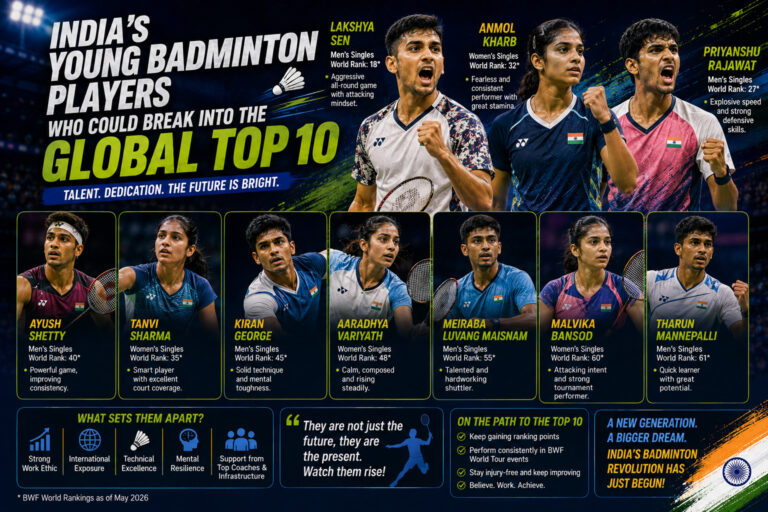
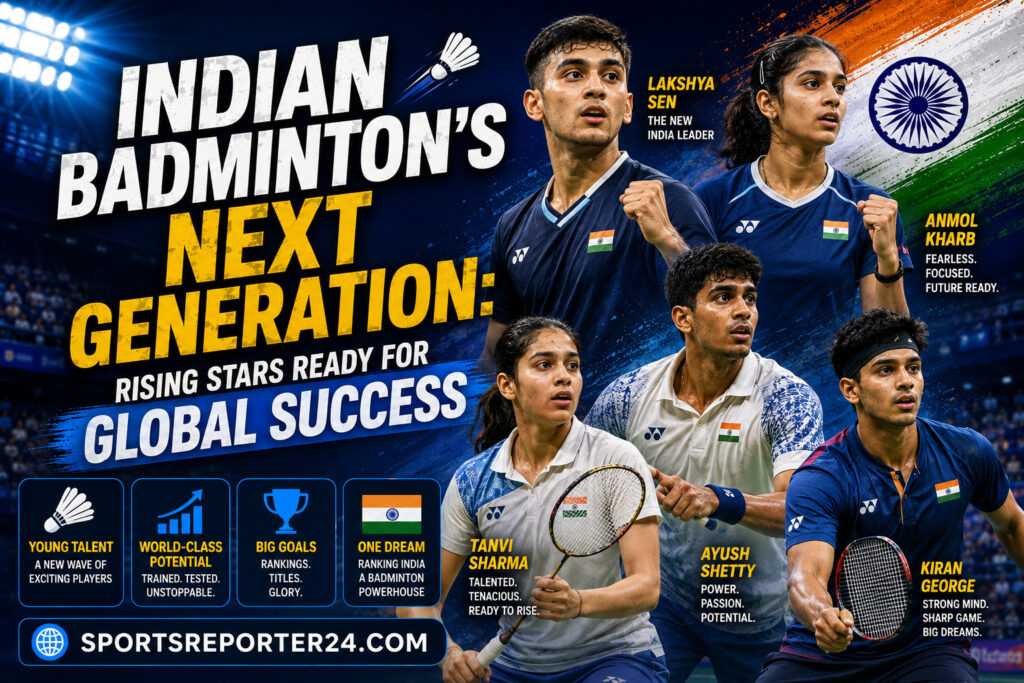
Players such as Ayush Shetty, Anmol Kharb, Unnati Hooda, Tanvi Sharma and Priyanshu Rajawat are among the young Indian shuttlers attracting attention. Some are already competing against experienced international players, while others are still developing their games and gaining valuable exposure.
The timing could hardly be better. The 2026 BWF World Championships are being held in New Delhi from August 17 to 23, giving India’s emerging players an opportunity to compete on home soil against some of the biggest names in world badminton.
The question is no longer whether India has badminton talent.
The bigger question is: who can turn that talent into sustained success at the highest level?
The Legacy Left by PV Sindhu
Before looking at India’s next generation, it is important to understand the standard PV Sindhu has created.
Sindhu became one of the defining figures in Indian sport through her performances at the Olympics and World Championships. Her success helped make badminton a mainstream sporting conversation in India and showed young athletes that an Indian woman could consistently compete against the best players in the world.
Her journey also created something equally important: belief.
Young badminton players growing up today have examples of Indian athletes winning major international medals. They do not have to imagine whether such success is possible. They have already seen it happen.
That influence extends beyond women’s singles.
Sindhu’s achievements, along with the success of Saina Nehwal, Kidambi Srikanth, Lakshya Sen and the doubles combination of Satwiksairaj Rankireddy and Chirag Shetty, have helped establish India as a serious badminton nation.
Now the next generation has the responsibility of building on that foundation.
Lakshya Sen and the New Men’s Singles Challenge
Lakshya Sen represents an important bridge between India’s established generation and its emerging stars.
Born in Almora, Uttarakhand, Sen developed through India’s competitive junior badminton system and eventually became a major international player. He has won Commonwealth Games gold, a World Championships bronze and a Thomas Cup gold, while his fourth-place finish at the Paris Olympics showed that he could compete deep into the biggest tournaments.
His journey is important for younger Indian players because it demonstrates that the path from junior success to senior international competition is possible.
But Lakshya cannot be expected to carry Indian men’s singles alone.
India needs a group of players capable of challenging for titles, reaching deep stages of major tournaments and pushing each other in training.
That is where players such as Ayush Shetty and Priyanshu Rajawat become important.
Ayush Shetty: One of the Biggest Young Names to Watch
Among India’s emerging men’s singles players, Ayush Shetty has perhaps generated the strongest recent momentum.
The Mangaluru-born shuttler has been developing rapidly and produced a major breakthrough in 2026 by reaching the final of the Badminton Asia Championships. That performance announced his arrival at the senior international level.
His progress has not been completely smooth.
A minor elbow injury suffered in June disrupted his momentum and was followed by several early tournament exits. Yet setbacks like these are part of the development of a young athlete.
What makes Shetty particularly interesting is the timing of his breakthrough.
He is entering the international spotlight while Indian badminton is looking for its next generation of men’s singles stars. At the 2026 World Championships, Shetty faces an enormous challenge against China’s world No. 1 Shi Yuqi in the opening round.
On paper, it is a difficult draw.
But difficult matches can also become career-defining opportunities.
Playing a world No. 1 gives a young player an opportunity to measure his speed, tactical discipline, stamina and mental strength against the highest standard in the sport.
Whether Shetty wins or loses, the experience could prove valuable for the years ahead.
Anmol Kharb: A Young Name in Women’s Badminton
India’s next generation is not limited to men’s singles.
Anmol Kharb has emerged as one of the young names worth watching in women’s badminton. Her development is particularly interesting because Indian women’s badminton is entering a transitional period.
Sindhu remains a major name, but Indian badminton needs more players capable of challenging internationally.
Kharb represents that possibility.
The Badminton Association of India’s player rankings list Kharb among India’s registered players, reflecting her progression through the domestic badminton structure.
For a young player, the transition from domestic success to international consistency can be difficult. International opponents bring different styles, faster rallies and greater tactical variety.
Kharb’s next challenge will therefore be turning promising performances into regular results.
If she can make that transition, she could become one of the important faces of India’s women’s badminton future.
Unnati Hooda and the Rise of India’s Teenage Talent
Another young player generating attention is Unnati Hooda.
Hooda has been part of India’s emerging women’s singles group and has already gained experience against senior international competition.
Her development is important because the women’s singles pipeline needs depth.
A successful badminton nation cannot rely on one superstar. It needs several players competing at different levels, creating healthy competition for national selections and major tournaments.
The emergence of younger players such as Hooda gives Indian badminton exactly that possibility.
The transition will take time, however. Junior success does not automatically translate into senior titles. Physical development, tournament experience, travel, injury management and the ability to handle pressure all become more important as players move up the rankings.
That is why the next few seasons could be crucial for Hooda.
Tanvi Sharma: A Name for the Future
Tanvi Sharma is another young Indian player who has attracted considerable attention.
Her rise through the junior ranks has placed her among the country’s most promising young women’s singles players. Before moving fully into senior badminton, players at this stage often face an important challenge: adapting to the greater physical and tactical demands of the professional circuit.
Tanvi’s development is worth following because India needs young women’s singles players who can eventually challenge the world’s leading athletes.
The 2025 junior circuit already highlighted her potential. ESPN noted that Tanvi was among India’s leading hopes at the BWF Junior World Championships, alongside Unnati Hooda.
The road from junior standout to senior champion is long.
But every successful senior career begins with this stage of development.
Priyanshu Rajawat: Another Men’s Singles Contender
While Ayush Shetty has recently captured significant attention, Priyanshu Rajawat remains another young Indian player who could become an important part of the country’s men’s singles future.
Rajawat’s emergence has demonstrated that Indian men’s singles has more depth than it did several years ago.
That depth matters.
The presence of several talented players means Indian badminton can potentially avoid becoming overly dependent on one individual. Players can challenge each other domestically, train alongside one another and learn from different playing styles.
The ultimate goal is not simply to produce one replacement for Lakshya Sen.
It is to create a generation capable of competing together.
Why India Needs More Than One Superstar
The biggest lesson from the country’s recent badminton history is that sustained success requires depth.
Saina Nehwal and PV Sindhu helped establish India’s position in women’s singles. Lakshya Sen and other men’s singles players strengthened the men’s side. Satwik and Chirag demonstrated that Indian doubles could compete with the world’s best.
The next step is building a larger ecosystem.
Imagine an Indian badminton squad where several men’s singles players are capable of beating top-20 opponents, multiple women’s singles players are challenging for major titles, and doubles teams are regularly reaching the later rounds of Super 750, Super 1000 and World Championship events.
That would change India’s position in global badminton.
Young players are therefore not simply competing to replace established stars.
They are competing to expand India’s overall strength.
The Biggest Challenge: Moving From Potential to Performance
Being labelled a future star can be both an advantage and a burden.
Young players receive attention when they win important matches. But expectations can rise quickly after one breakthrough tournament.
The real test begins after opponents start studying them.
International badminton is extremely tactical. Once a player becomes known for a particular strength, opponents begin developing strategies to neutralize it.
A young player therefore needs to keep evolving.
A powerful smash is not enough.
A good net game is not enough.
Speed alone is not enough.
The best players develop multiple ways to win.
This is one of the biggest lessons emerging Indian shuttlers can learn from Sindhu, Lakshya and other established stars.
Mental Strength Could Make the Difference
Physical fitness and technical ability are obvious requirements in professional badminton. But mental strength may ultimately separate future champions from talented players.
Young athletes must learn how to handle losing close matches, travelling constantly, playing in unfamiliar conditions and returning from injuries.
They must also learn how to perform when expectations are high.
Lakshya Sen’s journey provides a good example. His Olympic experience showed both the possibilities and the emotional difficulty of competing at the highest level. Reaching the latter stages of a major event is an achievement, but turning that opportunity into a medal requires extraordinary consistency.
The younger generation will face similar moments.
How they respond to disappointment could determine how far they go.
India’s Coaching System Is Also Evolving
Player development cannot happen without a strong coaching structure.
The importance of coaching is particularly visible in India’s badminton system, where players often work with specialized coaches covering technique, fitness, tactics and mental preparation.
A major development announced in August 2026 was the launch of the Indian School of Coaching Excellence, established through a collaboration involving Olympic and world champion Neeraj Chopra and renowned badminton coach Pullela Gopichand. The initiative is designed to develop a new generation of elite Indian coaches across sports.
For badminton, better coaching depth could eventually have an important impact.
More skilled coaches mean more opportunities for young players to receive high-quality training without having to depend on a very small group of established experts.
The 2026 World Championships Could Be an Important Moment
The BWF World Championships returning to India in 2026 provides an especially interesting backdrop for this new generation.
The tournament will be staged in New Delhi from August 17 to 23, bringing the world’s best badminton players to Indian soil.
Lakshya Sen and PV Sindhu will naturally attract much of the attention.
But emerging players will also have an opportunity to experience what it feels like to compete at one of badminton’s biggest events.
For someone like Ayush Shetty, facing a world No. 1 in his opening match could provide invaluable experience.
For India’s younger women’s players, watching and competing around established stars such as Sindhu can provide another lesson in what elite badminton demands.
Major tournaments are classrooms as much as competitions.
Can the Next Generation Match Sindhu and Lakshya?
It would be unfair to expect young players to immediately reproduce the careers of PV Sindhu or Lakshya Sen.
Their journeys have been unique.
Sindhu’s Olympic and World Championship achievements are extraordinary. Lakshya has already experienced the pressure of major international competition and an Olympic semifinal.
The younger players need time to develop their own identities.
The more realistic question is whether India can produce a group of players who eventually reach similar levels.
The answer could be yes.
Ayush Shetty’s rapid rise, the emergence of Anmol Kharb, Unnati Hooda and Tanvi Sharma, and the continued development of players such as Priyanshu Rajawat indicate that India’s talent pipeline is becoming increasingly interesting.
But potential is only the beginning.
What the Future Could Look Like
The next few years could determine the direction of Indian badminton for the rest of the decade.
By the time the 2028 Olympics arrive, today’s teenage and young senior players could have accumulated several years of international experience.
Some may become world-ranked stars.
Some may develop into doubles specialists.
Others may emerge unexpectedly after a breakthrough tournament.
That uncertainty is part of what makes the next generation so exciting.
India does not need to find another PV Sindhu or another Lakshya Sen.
It needs to create its own next generation of champions.
Final Thoughts
Indian badminton has already reached a stage where young players no longer have to dream about competing internationally. They have established role models, better training systems, greater exposure and a growing domestic audience.
PV Sindhu showed Indian women that Olympic and World Championship success was possible.
Lakshya Sen demonstrated that a new generation of Indian men’s singles players could challenge the world’s best.
Now players such as Ayush Shetty, Anmol Kharb, Unnati Hooda, Tanvi Sharma and Priyanshu Rajawat have the opportunity to take that story forward.
Their journeys will not be identical.
Some will rise quickly. Others may need several seasons before reaching their peak. Injuries, difficult draws and unexpected defeats will inevitably be part of the process.
But that is how sporting careers are built.
The future of Indian badminton is therefore not about finding one player to replace Sindhu or Lakshya.
It is about creating an entire generation capable of carrying India’s badminton ambitions forward.
And if these young shuttlers can convert their early promise into consistency, India’s next badminton era could be even deeper, more competitive and more exciting than the one that came before it.