
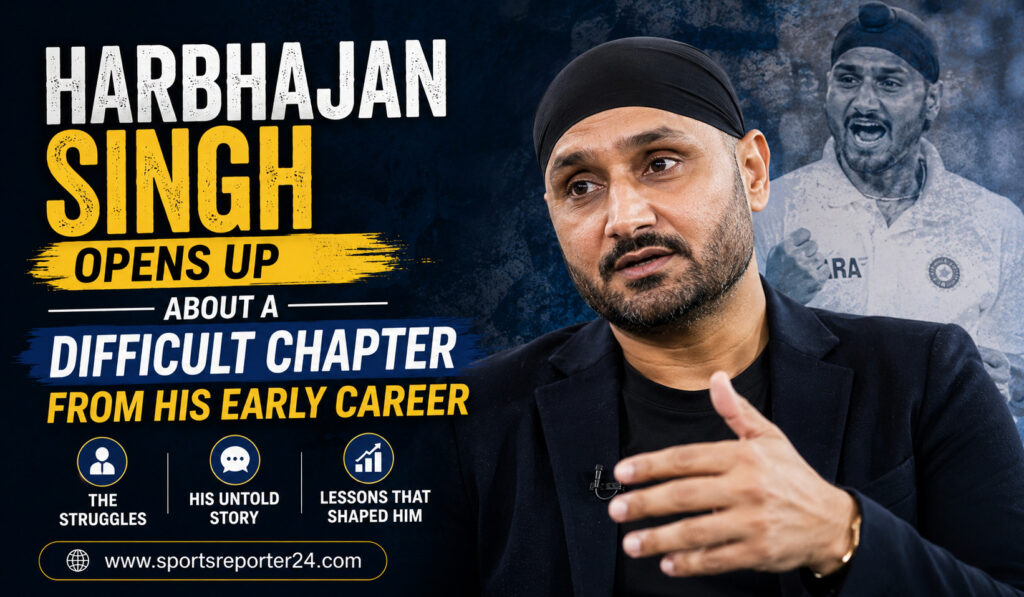
Harbhajan Singh early career
Harbhajan Singh’s cricket career is remembered for unforgettable performances, fierce competitiveness and some of the biggest moments in Indian cricket. But behind the success was a young player who had to deal with difficult experiences long before becoming one of India’s greatest spinners.
More than two decades later, Harbhajan has opened up about one such episode from the early stage of his career.
The former India spinner recently recalled being removed from the National Cricket Academy (NCA) in Bengaluru in 2000. According to his account, the incident was connected to a dispute over the food and diet arrangements provided to trainees.
Harbhajan says he repeatedly complained that the food being served did not match the diet chart displayed at the academy. Eventually, frustrated by the situation, he tore up the chart. He believes that action resulted in his removal from the NCA.
The story offers a different perspective on the early years of a cricketer who would eventually become one of India’s most successful off-spinners.
A Young Harbhajan at the NCA
Harbhajan was among the first group of trainees at the National Cricket Academy.
At that stage, he was still a young cricketer trying to establish himself at the highest level. He had already made his India debut in 1998 and was regarded as one of the country’s promising spin talents.
The NCA was an important part of the development system for young Indian cricketers.
For players like Harbhajan, being there meant access to professional coaching, facilities, training and guidance. It was supposed to help young athletes prepare for the demands of international cricket.
However, Harbhajan’s experience at the academy became complicated by a disagreement over nutrition.
According to his recent account, the academy had a prescribed diet plan that trainees were expected to follow, but the actual food served did not correspond with what was written on the chart.
The Food Dispute That Escalated
Harbhajan has explained that he and other trainees were supposed to receive food according to a diet designed for their training requirements.
However, he says the meals did not match the prescribed plan.
He claims that he complained about the issue several times but saw no improvement.
For a professional athlete, nutrition is not a minor matter.
Training sessions, recovery and physical development all depend on appropriate food. For young cricketers spending long hours in training, maintaining the right nutritional routine can be especially important.
From Harbhajan’s perspective, the problem was therefore not simply about whether the food tasted good.
He believed the academy was failing to provide what had been specified in its own diet plan.
Why Did Harbhajan Tear Up the Chart?
Eventually, according to Harbhajan’s recollection, his frustration reached a point where he tore up the diet chart.
That action became the immediate reason for his removal from the NCA, according to his account.
Harbhajan has said that he considers tearing the chart to have been his only mistake in the incident.
He continues to believe that his underlying complaint was legitimate.
In his recent comments, he argued that someone needed to challenge the situation for changes to happen.
This is important because Harbhajan is not presenting the episode simply as an embarrassing moment from his youth.
He sees it as an example of a young player standing up over something he believed was unfair.
Harbhajan Says the Situation Eventually Changed
One of the more interesting parts of Harbhajan’s recollection is his claim that the diet plan was eventually changed.
According to him, the problem with the food was addressed, but he was removed from the academy in the process.
His argument is essentially that the system changed, even though he personally paid a price for challenging it.
Harbhajan has also alleged that some people within the BCCI did not appreciate individuals who questioned decisions or authority.
Those comments are his personal account of the episode, and there is no need to treat the allegation as independently established fact.
What is clear is that Harbhajan remembers the incident as a significant disagreement during a formative period of his career.
The Incident Reveals His Personality
Looking back at Harbhajan’s career, the story fits an aspect of his personality that was visible throughout his playing days.
He was rarely a quiet competitor.
Whether bowling to the world’s best batters or engaging in intense on-field confrontations, Harbhajan often played cricket with enormous emotion.
That intensity sometimes became controversial.
But it was also part of what made him such a successful competitor.
The NCA episode suggests that his willingness to speak his mind existed even when he was a young player with relatively little power within the cricket system.
For better or worse, that personality became a defining part of Harbhajan’s career.
His Early Career Was Not Always Smooth
The NCA incident happened at a time when Harbhajan was still trying to establish himself in international cricket.
He had made his Test debut against Australia in 1998 but had not immediately become an undisputed member of India’s playing XI.
His path to becoming India’s leading off-spinner involved periods of uncertainty.
There were questions about his consistency, selection and development.
That makes the later success of his career even more remarkable.
Instead of allowing setbacks to derail him, Harbhajan eventually developed into a key member of India’s bowling attack.
The Turning Point Came in 2001
Harbhajan’s career changed dramatically during India’s historic Test series against Australia in 2001.
With Anil Kumble unavailable because of injury, Harbhajan became India’s primary spinner against a powerful Australian batting lineup.
He responded with one of the most memorable bowling performances in Indian Test history.
Harbhajan finished the three-Test series with 32 wickets, becoming the leading wicket-taker in the contest.
His hat-trick in Kolkata against Ricky Ponting, Adam Gilchrist and Shane Warne remains one of the iconic moments of Indian cricket.
The series transformed Harbhajan from a promising young spinner into an established international star.
It also demonstrated how quickly a player’s career can change.
Only a short time after experiencing difficulties during his development, Harbhajan was suddenly at the centre of India’s greatest Test comeback stories.
From Uncertain Prospect to Indian Cricket Star
Following the 2001 Australia series, Harbhajan became a major part of India’s bowling attack.
He formed a successful spin partnership with Anil Kumble and played an important role across formats.
His ability to bowl long spells, attack batsmen and create pressure made him particularly valuable in Test cricket.
He eventually became India’s most successful off-spinner in international cricket.
According to his career record, Harbhajan took more than 700 international wickets across Tests, ODIs and T20Is.
His success also extended into the Indian Premier League.
Harbhajan spent many successful seasons with Mumbai Indians and was part of the franchise’s rise into one of the IPL’s most successful teams.
Why His NCA Story Matters Today
At first glance, an argument about food from 2000 might appear insignificant compared with Harbhajan’s enormous cricketing achievements.
But stories like this provide insight into what happens behind a successful sporting career.
Fans usually remember the wickets, trophies and celebrations.
They rarely see the difficult periods when athletes are young and still trying to understand professional sport.
Harbhajan’s NCA experience shows that his journey included disagreements, frustration and uncertainty.
It also highlights how young athletes can sometimes struggle to make their voices heard within large sporting organisations.
Standing Up Can Have a Cost
There is another lesson in Harbhajan’s story.
Speaking up can sometimes carry consequences, particularly when the person raising the issue has less authority than the organisation they are challenging.
Harbhajan believes he paid a personal price for confronting the problem.
At the same time, he maintains that the underlying issue deserved attention.
Whether one agrees with his decision to tear the chart or not, the episode demonstrates how a moment of frustration can have consequences for a young athlete.
The important part is what happens afterwards.
Harbhajan Did Not Let the Setback Define Him
Perhaps the most important aspect of the story is what happened after the NCA episode.
Harbhajan’s career continued.
He returned to the cricketing pathway and eventually became one of India’s most influential spin bowlers.
His career included Test victories, World Cup appearances, IPL success and major individual milestones.
He became part of India’s successful teams in the 2000s and remained an important player for many years.
That makes the NCA incident a small chapter in a much larger story.
A Career Built Through Resilience
Harbhajan’s career is ultimately a story of resilience.
There were periods when his future in international cricket was uncertain.
There were moments of controversy.
There were difficult relationships and intense public scrutiny.
But he continued competing.
The player who was removed from the NCA as a young cricketer eventually became a veteran who represented India for nearly two decades.
That transformation is perhaps the most interesting part of his story.
What His Latest Revelation Tells Us
Harbhajan’s decision to revisit the incident more than 25 years later suggests that some experiences remain memorable long after a player retires.
For him, the issue was not simply about being removed from an academy.
It represented a moment when he felt that speaking up had consequences.
His comments also show that he still believes the decision to challenge the diet arrangement was justified, even though he accepts that tearing the chart was his mistake.
The episode should therefore be understood as Harbhajan’s recollection of a difficult moment, rather than as a complete independently verified account of everything that happened.
Conclusion
Harbhajan Singh’s latest revelation has brought attention to a lesser-known chapter of his early cricket career.
In 2000, while training at the National Cricket Academy, Harbhajan says he repeatedly complained that the food being provided did not match the prescribed diet chart. After his concerns went unanswered, he tore up the chart and was subsequently removed from the academy, according to his account.
More than two decades later, he still believes that his underlying complaint was justified.
The incident is particularly interesting because of what happened afterwards.
Harbhajan went on to become one of India’s greatest spinners, playing a central role in the famous 2001 Australia series and collecting more than 600 international wickets.
His story is a reminder that sporting careers are rarely straightforward.
Behind every famous achievement are periods of uncertainty, frustration and difficult decisions.
For Harbhajan Singh, the NCA episode was one of those early challenges. It did not define his career—but it became one of the experiences that he still remembers from the long journey that eventually made him an Indian cricket legend.