
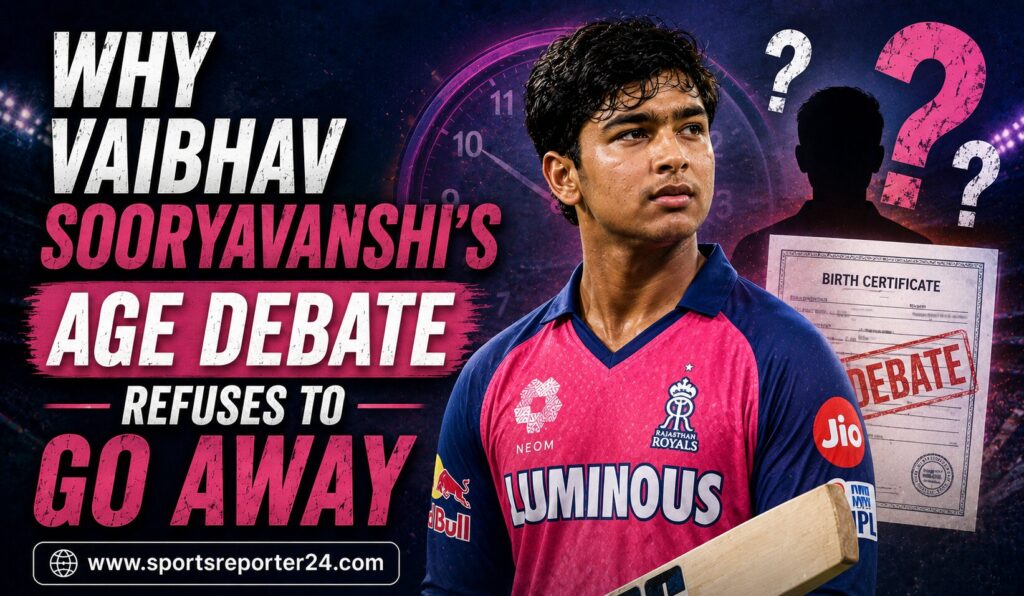
Vaibhav Sooryavanshi has become one of the most talked-about young cricketers in India. His extraordinary batting performances, record-breaking innings and rapid rise through professional cricket have made him a national sporting sensation.
But alongside his success, one question continues to follow him: How old is Vaibhav Sooryavanshi really?
The question has circulated online for several years, particularly after an older interview appeared to conflict with the date of birth officially associated with the cricketer. As his performances became increasingly remarkable, speculation around his age grew louder.
However, it is important to separate questions and speculation from proven facts. There is currently no established evidence that Vaibhav Sooryavanshi has falsified his age. His publicly listed date of birth is March 27, 2011, and his father has publicly defended that date while saying that Vaibhav underwent BCCI age-verification procedures.
So why does the debate refuse to disappear?
The Official Date of Birth
Vaibhav Sooryavanshi is officially listed as being born on March 27, 2011, which makes him 15 years old in August 2026.
That date has been used throughout his domestic and international cricket records. It is also the basis for the age-related records he has achieved.
His early career was extraordinary even before he became an IPL star. He made his first-class debut for Bihar at just 12 years and 284 days and later became the youngest player to make an IPL debut when Rajasthan Royals selected him for the 2025 season.
The extraordinary nature of these achievements is partly why his age has attracted so much attention.
When a teenager competes successfully against adult professional cricketers, people naturally become curious about how someone so young developed such advanced physical and technical abilities.
Where Did the Age Controversy Begin?
The controversy largely comes from an older interview.
Reports have pointed to a 2023 interview in which Vaibhav reportedly gave an age that did not match the birth date subsequently listed in official cricket records. That apparent inconsistency created confusion online.
If the statement from the old interview were interpreted literally, it would suggest that Vaibhav was older than his officially recorded age.
That does not automatically prove that the official birth date is false.
Old interviews can contain mistakes, misunderstandings, translation issues or incorrect reporting. But once a statement is circulated on social media, it can become extremely difficult to correct the narrative.
In Vaibhav’s case, the issue became even more prominent after his remarkable performances against older players.
His Father’s Response
Vaibhav’s father, Sanjiv Sooryavanshi, has rejected suggestions that his son’s age is incorrect.
According to reports, he has maintained that the official birth date is accurate. He has also said that Vaibhav underwent a bone-density test conducted through the BCCI when he was around eight and a half years old and subsequently cleared the age-verification process.
This is an important part of the story because the age debate is sometimes presented online as though there has been an official finding against Vaibhav.
There has not been such a finding established by the sources available.
Instead, there are conflicting claims and questions surrounding an old statement, while his family has consistently defended the official record.
Why His Cricket Makes People Question His Age
One reason the debate has remained alive is Vaibhav’s extraordinary level of performance.
He has repeatedly achieved milestones at ages that are extremely unusual in professional cricket.
At 13, he scored a century for India Under-19 against Australia Under-19. He later became the youngest player to make an IPL appearance and the youngest batter to score an IPL century.
His IPL century in 2025 was particularly remarkable.
Playing for Rajasthan Royals against Gujarat Titans, he scored 101 runs from only 38 balls and reached his hundred in 35 deliveries.
For many fans, watching a teenager produce such powerful hitting against established professional bowlers seemed almost unbelievable.
That disbelief helped fuel online speculation.
But exceptional performance by itself cannot establish a player’s age.
A young athlete can be unusually talented, physically advanced or simply far ahead of their peers. Cricket history contains numerous examples of teenagers performing at senior level.
The Power-Hitting Question
Some of the speculation has also focused on Vaibhav’s physical strength.
Former Pakistan fast bowler Junaid Khan was among those who questioned whether a player officially listed as being so young could generate such power.
These comments contributed to the wider social-media discussion, but they remain opinions rather than evidence of an incorrect birth date.
Physical appearance and batting power are not reliable methods of determining someone’s age.
Two teenagers of exactly the same age can look completely different and possess very different levels of athletic development.
That is why formal documentation and recognised verification procedures matter more than visual assumptions.
Why the Debate Became Bigger After His IPL Success
Before the IPL, the age discussion was largely limited to cricket followers.
His IPL breakthrough changed everything.
Suddenly, Vaibhav was playing in front of huge audiences, competing alongside international stars and generating headlines around the world.
His 2025 century made him a global cricket story.
Then his performances continued to attract attention, making the age question even more commercially and journalistically interesting.
The more records he broke, the more people revisited the original claims.
This created a cycle:
extraordinary performance → discussion about his age → old interview resurfacing → social-media speculation → renewed attention.
That cycle explains why the controversy has proved difficult to eliminate.
Social Media Has Made the Situation More Complicated
Another reason the Vaibhav Sooryavanshi age debate refuses to disappear is the speed at which information travels online.
A short video clip or screenshot can be shared thousands of times without the original context.
Once a claim becomes viral, later explanations often receive far less attention.
This is particularly problematic when dealing with a young athlete.
A teenager’s personal identity, family and education are involved, while online speculation can quickly turn into accusations.
There is therefore a difference between asking legitimate questions about publicly available information and presenting an unverified allegation as fact.
What Has Actually Been Established?
Looking at the available information, several points can be separated clearly.
Vaibhav’s officially recorded birth date is March 27, 2011.
His father has publicly defended that date.
His father has also stated that Vaibhav underwent BCCI age-verification testing.
There has been an older interview that has been cited as inconsistent with the official date, which is the main reason the debate continues.
But an inconsistency in an old statement is not the same thing as proof of age fraud.
That distinction is essential when discussing the subject responsibly.
Why the BCCI Verification Matters
The BCCI has systems designed to verify the ages of players participating in age-group cricket.
That does not mean every public discussion about a player’s age automatically disappears. However, formal verification is considerably more meaningful than photographs, physical appearance or social-media comments.
Vaibhav’s father has specifically referred to BCCI testing when defending his son’s age.
Therefore, anyone discussing the controversy should acknowledge both sides: the source of the questions and the family’s response.
Does the Debate Affect His Career?
At the moment, the bigger issue may be how the constant discussion affects Vaibhav himself.
He is still only 15.
Despite his extraordinary achievements, he remains a developing cricketer. Former players have recently warned against placing excessive pressure on him, with Brett Lee arguing that the focus should be on protecting the youngster from the weight of expectations rather than obsessing over his age.
Former India spinner Ravichandran Ashwin has similarly called for patience around the teenager and explained that his previous comments about Vaibhav were intended to emphasise the value of learning around an experienced senior team.
These comments highlight a larger question.
At what point does curiosity about a young player’s background become a distraction from his cricket?
The Bigger Story May Be His Talent
Whatever the final public conversation about his age looks like, Vaibhav’s cricketing achievements remain remarkable.
He has progressed rapidly through domestic cricket, Under-19 cricket and the IPL.
His aggressive batting has made him one of the most exciting young players in Indian cricket, while his performances have already created records that will be difficult for future teenagers to break.
The challenge now is ensuring that his development continues without being overwhelmed by expectations.
Conclusion
The Vaibhav Sooryavanshi age controversy continues because there is an apparent discrepancy involving an older interview, combined with the extraordinary nature of his cricketing achievements.
However, it is important not to confuse speculation with established evidence.
His official date of birth remains March 27, 2011, while his father has strongly defended the date and cited BCCI age-verification procedures.
Until credible new evidence emerges, the responsible approach is to describe the issue as an age debate or controversy, rather than declaring that Vaibhav has committed age fraud.
For now, the more important story may be happening on the cricket field.
At only 15, Vaibhav Sooryavanshi has already achieved milestones that most cricketers never reach. His biggest challenge will be turning that extraordinary beginning into a long and successful career while learning to handle the attention that comes with becoming a teenage sporting sensation.