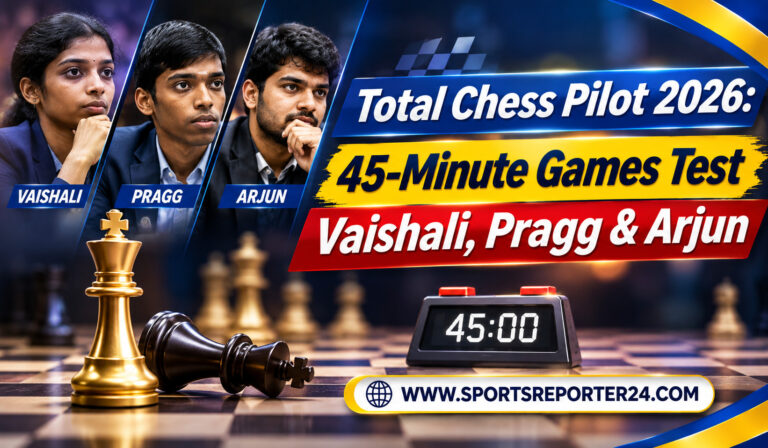
Forty-five minutes for the whole game, plus 30 seconds a move. That’s the clock at Total Chess Pilot 2026, and it’s already testing three Indian stars. Since 11 November, Vaishali, Praggnanandhaa and Arjun Erigaisi have all been in group action. Meanwhile, Vaishali’s blitz wins over Niemann and So set the tone a day earlier.
Fast Classic is new, and the format around it isn’t simple. Even so, the basic idea is easy once you see the pieces. After all, it’s still chess. This guide explains the clock, the scoring, the knockouts and how each Indian player is doing so far. Along the way, you’ll also see where the biggest points are hiding.
What Fast Classic Means at Total Chess Pilot 2026
First, a bit of background: FIDE announced the Fast Classical time control in September 2025. Players get 45 minutes plus 30 seconds per move, starting from move one. In this format, a win earns three points while a draw earns one. Because the games count toward classical ratings, the results carry weight beyond this event. Of course, that raises the stakes for every player.
There’s also a rule that keeps games alive. Here, no draw can be agreed before both players have made 30 moves. That said, the rule only applies to Fast Classic, and rapid and blitz games have no such limit. As a result, early handshakes are off the table.
In short, the aim is to give viewers shorter games than traditional classical chess. In other words, the format tries to keep depth while saving time. Behind the scenes, Norway Chess organizes the Total Chess World Championship Tour, and FIDE approves it. As for timing, the 2026-2027 tour starts here, in Budapest, from 10 to 20 November.
How the Group Stage Works
To begin, the 24 players are split into four groups of six, and each group plays a double round robin. Which means every player meets each rival twice, for ten Fast Classic games in all. Meanwhile, two games are played each day from 11 to 15 November, at 15:00 and 18:30 Budapest time. Also, for Indian fans, the first game starts at 19:30 IST.
Seeds Magnus Carlsen, Fabiano Caruana, Nodirbek Abdusattorov and Wesley So were kept apart. Meanwhile, the other 20 names were drawn at the opening ceremony. Because the scoring is three, one and zero, a decisive game moves the table fast. In fact, day one produced 10 decisive results from 24 games, which shows how sharp the play was.
When players finish level, the blitz ranking from 10 November settles ties. After that, group rank decides the knockout bracket. The group winner goes to Knockout 1, the runner-up goes to Knockout 2, and so on down to Knockout 6. However, only the winner of Knockout 1 becomes the Budapest champion.
The Knockout Math Behind the Title
Once the groups end, each knockout match runs over two days. Meanwhile, each day has seven games in a fixed order: four blitz, two rapid and one Fast Classic. After each day, scores reset, and a level match goes to Armageddon. Here’s how the points work:
- Blitz (3+2): 1 point for a win, half a point for a draw.
- Rapid (15+10): 4 points for a win, 2 for a draw.
- Fast Classic (45+30): 8 points for a win, 4 for a draw.
If you add it up, 20 points are on offer each day. Because of that, one Fast Classic win is worth as much as eight blitz wins. So, the longest game is the most valuable game. At the same time, a player who wins the blitz block can still build a useful cushion. Even so, a cushion can vanish in one long game.
Key dates
First, the knockout semifinals are on 17 and 18 November. Then the finals follow on 19 and 20 November. Beyond that, the Tour itself sends only the four best players to its final tournament. Once that event ends, the FIDE World Combined Champion is crowned.
What the Format Means for Strategy
In the group stage, every game is Fast Classic, so the pace stays steady. As a result, a player can’t lean on blitz tricks to rescue a bad position. Instead, patience and clean technique matter more. Because a draw earns only one point, though, playing for a win is tempting.
However, the knockout stage flips that logic. Speed matters, since the four blitz games come first on each day. Even so, the single Fast Classic game is worth 8 points, and that’s a lot. For that reason, a strong classical player can recover from a rough blitz block. In my view, that’s the smartest part of the design, even though it adds some complexity.
Vaishali, Pragg and Arjun: Where They Stand
As of 12 November 2026, after the first day of Fast Classic games, here’s how the Indian trio looks:
- Vaishali Rameshbabu (Group D): 1 point. She lost the opening game to Maxime Vachier-Lagrave and drew the return.
- Praggnanandhaa Rameshbabu (Group B): 2 points. He drew both games against Vincent Keymer.
- Arjun Erigaisi (Group D): 2 points. He drew both games against Hans Niemann.
Group B also holds Fabiano Caruana, Le Quang Liem, Richard Rapport and Vladislav Artemiev. Caruana and Le led on 4 points after day one. Meanwhile, Group D features Wesley So, Niemann, Bibisara Assaubayeva and Vachier-Lagrave, who led on 4 points.
Two of the three Indians are in the same group, which is a twist. Vaishali and Arjun will meet in round five on 15 November, as the full Group D schedule shows. As a result, a clash between two Indian players could shape the final table.
Could 45 Minutes Suit the Indian Trio?
Here’s my read, and it’s only an opinion. Since the game is longer, forty-five minutes rewards players who prepare well and calculate cleanly. The 30-second increment also keeps time trouble in check. Because of that, quality can beat speed, and that might help Vaishali, who earned a title shot against Ju Wenjun.
Meanwhile, Arjun showed his blitz strength on 10 November. He finished joint fourth on 5½/9, which put him sixth on the blitz ranking. On the other hand, Vaishali scored 4/9 and beat two big names. In contrast, Pragg’s blitz score wasn’t in the reports I found. So, his day one draws are the main evidence.
Still, draws aren’t a bad start in this format. After all, a draw earns a point, and a single win swings the table by three. For instance, Caruana’s first game against Rapport gave him three points at once. As a result, a player on one or two points can jump to the top within a day.
Early Signs From Day One
Ten of the 24 games ended decisively on the opening day. For example, in Group A, Alireza Firouzja and Jan-Krzysztof Duda shared the lead on four points. Firouzja won his opening game against Abdusattorov and held the return game. Likewise, Duda drew his first game against Andrew Hong and won the second.
Meanwhile, in Group C, Ian Nepomniachtchi took the outright lead. Magnus Carlsen faces Anish Giri in that group, along with Mamedyarov, Martirosyan and Abhimanyu Mishra. Meanwhile, Group B’s top spot went to Caruana on the blitz tiebreak. Because both he and Le finished on four, the earlier blitz result decided it.
Because of this, the table can move very quickly. A 3-0 result like Caruana’s win over Rapport opens a gap at once. So, the Indian players can’t afford slow starts for long. Even so, only one of five rounds is done, and plenty of games remain. In fact, Round 2 is being played on 12 November, so the picture may already look different by tonight.
Key Takeaways
- The clock: Each Fast Classic game gives 45 minutes plus 30 seconds per move.
- Scoring: A win earns three points, a draw one and a loss none.
- Knockout value: One Fast Classic win is worth 8 points, and a full day offers 20.
- Indian standings: Arjun and Pragg have 2 points each, while Vaishali has 1.
- Key dates: Knockout semifinals are on 17 and 18 November, and the finals on 19 and 20.
FAQs
What is Fast Classic in this event?
Fast Classic is a time control of 45 minutes plus 30 seconds per move, used for every group game.
Who can win the Budapest title?
Only the winner of Knockout 1, which is made up of the four group winners, becomes the champion.
Which Indian players are in Group D?
Vaishali Rameshbabu and Arjun Erigaisi are both in Group D with Wesley So, Hans Niemann, Bibisara Assaubayeva and Maxime Vachier-Lagrave.
Can players agree a quick draw?
No, because Fast Classic draws cannot be agreed before both players have made 30 moves.
When does the knockout stage start?
The semifinals are scheduled for 17 and 18 November, with the finals on 19 and 20 November.
Conclusion
Total Chess Pilot 2026 asks players to master three clocks, and the 45-minute game carries the most weight. Vaishali, Pragg and Arjun each face a different path, yet none of them has long to find a rhythm. Because a single win can swing the table, the next four group days will matter. Even so, the knockout rounds are where Total Chess Pilot 2026 will truly pick its champion.