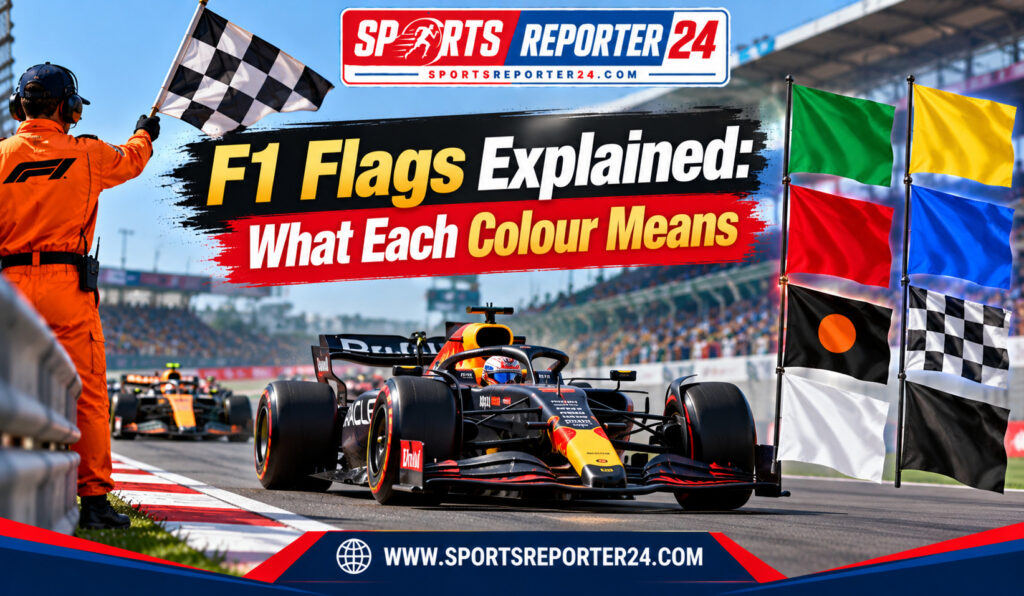
Qualifying for the 2025 Azerbaijan Grand Prix saw six red flags in one session. In fact, that’s a record. Yet red is only one colour in a long list of signals that shape every F1 weekend. So F1 flags explained simply can make races far easier to follow.
So this guide covers every flag you’ll see, from yellow and blue to black and chequered. It also explains how light panels and safety cars fit in. Because the 2026 season has already delivered a rain-delayed start and several safety car restarts, these signals matter more than ever. Here’s what each one means.
F1 Flags Explained: How They Work
First, marshals stand at posts around the track and wave flags to warn drivers. Because each flag carries a strict meaning, drivers must obey it. However, modern F1 doesn’t rely on physical flags alone. Light panels around the circuit and on the steering wheel repeat the signals, so nobody misses a warning.
In total, there are about a dozen signals. Some are common, while others almost never appear. Meanwhile, race control decides when to use each one. So the colour you see on TV usually reflects a decision made seconds earlier.
Yellow Flags: Danger Ahead
Yellow means hazard. So a single waved yellow warns of danger beside or partly on the track. In that case, drivers must slow down and be ready to change line. It’s the most common flag in racing, so drivers see it often.
A double waved yellow is more serious. It means a hazard is blocking the track, or marshals are working on it. So drivers must lift off sharply and be ready to stop. Because of this, overtaking is banned in yellow zones.
In practice and qualifying, drivers must abandon their lap if yellow flags appear. Street circuits see more yellows because run-off areas are small. So Monaco, Baku and Singapore often feature them.
Green Flag: All Clear
The green flag is the simplest one. Because it tells drivers that the danger has passed, it brings relief. After a yellow, the green flag shows the end of the hazard zone. As a result, drivers can accelerate and race again.
Once it appears, it ends a spell of caution and brings the racing back. So it often marks the moment when a gap suddenly closes.
Red Flag: Session Stopped
A red flag stops the session. As a result, cars must slow down and return to the pit lane. Officials use it for crashes, debris or dangerous weather. Because the track is unsafe, nobody is allowed to race on.
Records show how dramatic red flags can be. For instance, in 2023, the Australian Grand Prix was stopped and restarted three times. That’s the most red flags in a single race. Meanwhile, the Azerbaijan qualifying session in 2025 set the record for a single session with six.
Red flags change strategy too. Under a stoppage, teams can change tyres in the pit lane without losing race time. For more on that, see the guide to an F1 pit stop with tyres, strategy and fastest stop records. Scoring changes too when a race stops early, and the F1 points system with race, sprint and championship points explains how.
Blue Flag: Let the Leader Through
The blue flag tells a driver to let a faster car pass. Because it’s mainly aimed at lapped cars, backmarkers see it often. In a race, a backmarker who ignores three blue flags in a row risks a penalty. So drivers usually move aside quickly.
However, the meaning changes between sessions. In qualifying, a blue flag warns a driver that someone on a fast lap is approaching. Therefore, slower cars should stay out of the way. It’s the most debated flag in F1 because timing can be tricky.
Black and White, Black, and Black-Orange Flags
Meanwhile, three dark flags carry penalties or serious warnings. Here’s how they differ.
Black and white flag
Because this flag is split diagonally, it works like a yellow card. It warns a driver about unsportsmanlike behaviour, such as a dangerous move. If the driver doesn’t change their conduct, a penalty follows. Because of that, it’s a final warning.
Black flag
Then there’s the black flag, which means disqualification. So a driver must return to the pits and leave the race. It’s very rare today, and it hasn’t been seen for years. Even so, history includes famous cases. For example, Elio de Angelis received two black flags in his career, in 1981 and 1985.
Black flag with orange disc
Finally, this flag, nicknamed the “fried egg”, signals a mechanical problem. So it orders the driver to pit on the next lap. The reason is safety, since a damaged car could endanger others. So the crew must fix the issue before the driver can rejoin.
Yellow and Red Striped Flag: Slippery Surface
Next, the striped flag warns of a slippery patch ahead. Oil, water or debris are common causes, so drivers take care. Marshals hold it still instead of waving it. That’s so drivers don’t confuse it with a normal yellow flag.
After the warning, drivers must adapt their speed and braking. Because grip is reduced, mistakes are more likely. Meanwhile, the flag usually disappears once the surface is cleaned.
White Flag and Chequered Flag
Meanwhile, a white flag warns that a slow vehicle is on the track. It might be a car with a problem or a service vehicle. So drivers must take care when they approach it.
Of course, the chequered flag needs no explanation. It’s waved at the end of a race or session. In Singapore, Max Verstappen took it 7.3 seconds ahead of Charles Leclerc after 62 laps. That’s the moment every driver works toward.
Safety Car and Virtual Safety Car
Still, flags tell only part of the story. Race control also uses the safety car, which leads the field at reduced speed. Yellow flags and an “SC” board appear while it’s out. As a result, the gaps between cars shrink.
Because safety cars change races, teams plan for them. A pit stop under the safety car costs far less time than a normal stop. In 2026, Verstappen’s Sepang win came after two safety car restarts. Meanwhile, George Russell survived two safety car periods in Azerbaijan. So safety cars have shaped several results this season.
The F1 calendar for 2026 with race dates, circuits and results lists the remaining weekends.
However, the virtual safety car works differently. It slows the whole field without a physical car on track. Drivers must stay within a set pace while the hazard is cleared. So it offers a quicker, lighter response to smaller incidents.
Flags and Delays in the 2026 Season
So this year has shown how flags and delays shape a race. At Sepang, a thunderstorm pushed the start back by more than an hour and a half. Then a chaotic formation lap halted the start again. Because of that, the race only began after long delays.
Once it did, two safety car periods shook up the order. Verstappen reacted best, so he took his first win of 2026. In Azerbaijan, Russell also handled two safety car periods on his way to victory. Meanwhile, Singapore was far calmer, even though Lance Stroll, Franco Colapinto and Gabriel Bortoleto all retired.
Those retirements show why marshals matter. Because each stopped car needs a quick response, yellow flags protect the people working. As a result, flags are as much about safety as they are about racing.
What Drivers Must Do for Each Flag
So a quick summary helps. Because drivers act on flags in different ways, here’s a simple guide.
- Yellow: lift, avoid overtaking and be ready to change line
- Double yellow: slow sharply and be ready to stop
- Red: slow down and return to the pit lane
- Blue: move aside for the faster car
- Black and orange: pit on the next lap
- Chequered: finish the lap and return to the pits
Key Takeaways
- Yellow: Slow down, because there’s danger ahead.
- Red: The session is stopped, and cars return to the pits.
- Blue: A faster car is behind, so let it pass.
- Black and white: It’s a warning for unsportsmanlike behaviour.
- Chequered: The race or session has ended.
FAQs
What does a yellow flag mean in F1?
It warns drivers of a hazard on or near the track.
What does a red flag do?
It stops the session and sends cars back to the pit lane.
What is the difference between a single and double yellow?
A double yellow signals a bigger hazard, and drivers must be ready to stop.
What does the black and white flag mean?
It’s a warning for unsportsmanlike driving, much like a yellow card.
Which flag ends a race?
The chequered flag ends a race or session.
Conclusion
So F1 flags explained in one place give fans a clearer view of every race. In short, yellow warns, red stops, blue clears the way and the chequered flag ends the action. Together with safety cars and light panels, they keep drivers and marshals safe. So the next time a flag appears, you’ll know exactly why.