
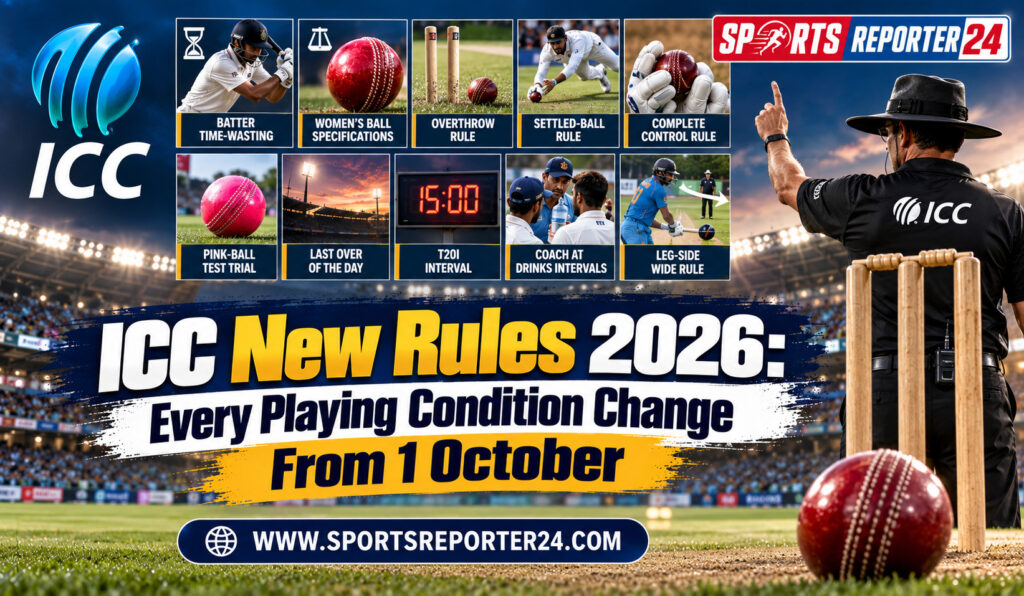
Five penalty runs now hang over any batter who drags their feet between deliveries. That’s just one piece of the ICC new rules 2026 package, which took effect on 1 October. Alongside it came a pink-ball trial for daytime Tests, tighter ball specifications and a permanent wide-ball tweak. So what actually changed, and who does it affect? Here’s a plain-English walk through every playing condition change.
The updated conditions cover men’s and women’s cricket in all formats. They also absorb new MCC Laws that started on the same day. Before we go further, one point matters. The rules apply only to series starting on 1 October or later, while series already underway stay on the old conditions.
What the ICC New Rules 2026 Actually Cover
The ICC published the revised Playing Conditions on 1 October 2026. They now sit in the Rules and Regulations section of its website. According to the ICC, the changes target time-wasting, ball specifications and fielding clarity. Sourav Ganguly, who chairs the ICC Men’s Cricket Committee, said the package also aims to improve the pace of the game.
Scope matters here. The conditions reach Tests, ODIs and T20Is, and a few items are already in force in women’s cricket. Meanwhile, the MCC released a new edition of the Laws with 73 meaningful changes, also effective October 2026. Still, the 1 October start date is the line that decides which series follow the new rulebook. Because of this, two series played a week apart can run under different conditions.
Changes That Apply Across All Formats
Time-wasting penalties for batters
The ICC has refined its time-wasting condition for men’s cricket. If a batter isn’t ready to face the ball within the prescribed time, the umpire gives a warning. A second offence earns a final warning. From the third offence onwards, the fielding side collects five penalty runs. Since repeated offences can also draw Code of Conduct action, the stakes go beyond the scoreboard. The full breakdown of the time-wasting rule in cricket shows how that ladder works.
Ball size and weight
Men’s cricket balls have long had limited tolerance in size and weight. Women’s and junior cricket, however, often shared a single ball. New limits now create three separate specifications, one each for men’s, women’s and junior cricket. As a result, equipment matches each level of the game more closely. The ICC calls the women’s change a tighter tolerance, which means less variation from one ball to the next.
Overthrows, settled balls and complete control
Fielding got clarity too. An overthrow is an attempt to direct the ball at the stumps to stop runs or effect a run-out. A misfield doesn’t count, whether the fielder was stopping the ball or passing it on. Umpires also get more leeway on when a ball is finally settled, which can matter on the last ball of a close game. Our guide to the wide-ball and overthrow rules covers each one in detail.
Run-outs and stumpings now need complete control of the ball. Merely touching it with the hand as it breaks the stumps doesn’t count as holding it. In short, a fielder can’t claim a dismissal by brushing the ball on its way past.
Test Cricket Changes: Pink Balls and the Last Over
Test cricket gets two changes. As a trial, teams may use a pink ball in daytime Tests by mutual agreement. The goal is to cut playing time lost to bad light. Teams must agree before the Test starts, and the choice then stands for the whole match. Switching from red to pink after the start isn’t allowed.
The second change covers the final over of a day. Play no longer ends automatically when a wicket falls in that over. If the over is incomplete and conditions are fit, the remaining deliveries get bowled. The ICC explained that the old approach saved no time, because those balls were bowled the next day anyway. It also rewards the fielding side and keeps the drama alive. The pink ball and last-over changes get a closer look in a separate piece.
ODI and T20I Changes
White-ball cricket gets three updates. T20Is now have a fixed 15-minute innings interval, which can shrink to 10 minutes when time is lost. The head coach or a designate can now enter the field at drinks intervals in ODIs and T20Is. Women’s cricket already allowed this where applicable, so the men’s game is catching up.
The third update is the wide ball. A leg-side wide trial, first announced in June 2025, is now permanent in both formats. Under it, the position of the batter’s legs at the moment of delivery is the reference point for a wide. That holds even if the batter moves across to the off side. The ICC introduced the trial to give bowlers some leniency against batters who shuffle around the crease.
How Teams and Umpires May Adapt
Batters will feel the time-wasting condition first. A slow walk to the crease or a long fuss over the guard now risks a warning. Captains and coaches will probably brief their batters on the three steps before the first ball. That’s a reasonable guess, not a confirmed plan from any team.
Bowling sides get something too. Because the wide reference point now follows the batter’s legs at delivery, a bowler can follow a shuffling batter with more confidence. Test captains, meanwhile, must decide whether to accept a pink ball when the forecast looks gloomy. Still, the umpires carry the heaviest load, since settled balls and complete control both call for judgment. More judgment calls usually bring more debate, so expect some noise early on.
Why the ICC Made These Changes
Pace of play runs through the whole package. Time-wasting by batters drew particular attention after the Lord’s Test between India and England in 2025, according to The CSR Journal. A fixed T20I interval and last-over completion also protect playing time. Meanwhile, the pink-ball trial tackles lost overs, since the red ball is harder for batters to see when light fades.
Clarity is the other theme. Umpires now have firmer definitions for overthrows, settled balls and held balls in run-outs. Of course, clearer wording only helps if everyone reads it the same way. In my view, players and umpires will need a few series to settle in. That’s a fair expectation with any rule change of this size.
What Fans Should Watch Next
Any series starting on or after 1 October falls under the new book. The ICC pointed to the World Test Championship series between Australia and South Africa as one example. Ongoing series, however, continue under the earlier conditions. As of 23 October 2026, that split could matter when you compare matches from different series.
Watch the pink-ball trial in particular. It needs both teams to agree, so uptake will show how Test sides really feel about it. India head coach Gautam Gambhir welcomed the trial, saying it could help teams get results in weather-hit matches. Time-wasting calls will be the other flashpoint. Expect early debate over how umpires apply the prescribed time, and whether warnings arrive quickly or late. Women’s series deserve a look as well, because the tighter ball limits and the overthrow definition apply there too.
Key Takeaways
- Start date: the changes apply to international series starting on or after 1 October 2026.
- Time-wasting: a warning, a final warning, then five penalty runs from the third offence.
- Test cricket: a pink-ball trial for daytime Tests and a new approach to the last over of the day.
- White-ball cricket: a fixed 15-minute T20I interval, coaches at drinks and a permanent wide-ball rule.
- Fielding: clearer definitions of overthrows, settled balls and complete control.
FAQs
When did the ICC new rules 2026 take effect?
They took effect on 1 October 2026 for all international series starting on or after that date.
Do the new rules apply to series already under way?
No, series already in progress continue under the previous playing conditions.
What is the penalty for a batter who wastes time?
The batter gets a warning, then a final warning, and the fielding side receives five penalty runs from the third offence.
Can teams now use a pink ball in daytime Tests?
Yes, as a trial, but both teams must agree before the Test starts and cannot switch afterwards.
Which formats does the wide-ball change cover?
The leg-side wide rule is now a permanent part of the ODI and T20I playing conditions.
Conclusion
The ICC new rules 2026 aim at faster play and clearer decisions. Time-wasting now carries a real price, pink balls get a daytime trial and white-ball wides lean toward the bowler. Fielding definitions are tighter, too. Even so, much depends on how consistently umpires apply the new wording over the coming months.
Keep the 1 October start date in mind, because it decides which series follow the new rulebook. For fans, the safest habit is simple: check when a series began before assuming which conditions apply. That one check will settle most arguments before they start.