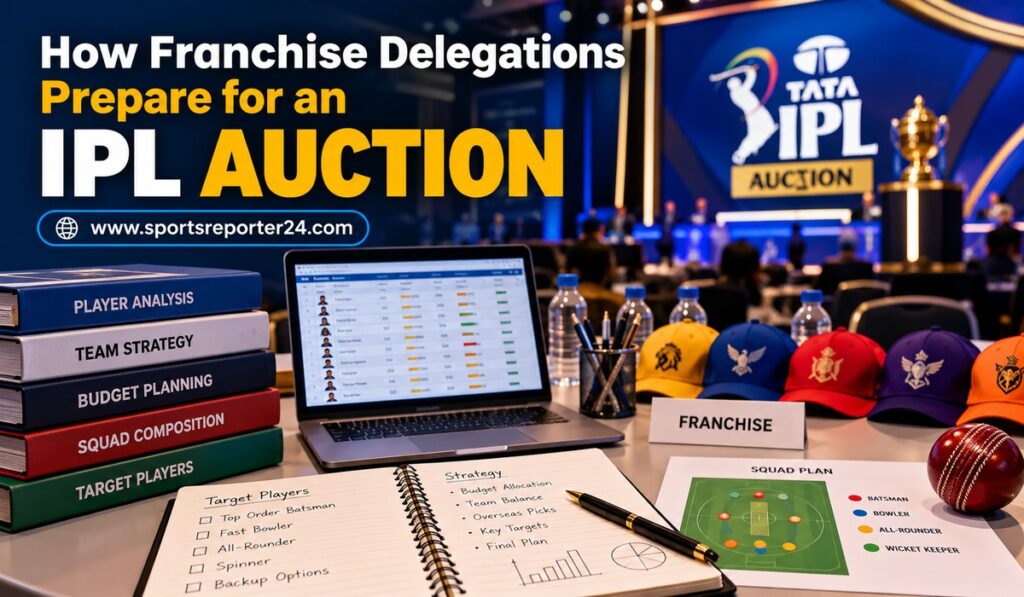
The Indian Premier League (IPL) auction is one of the most important events in franchise cricket. While fans focus on expensive signings and unexpected bidding battles, team management works for months to prepare. Understanding how franchise delegations prepare for an IPL auction reveals the planning, research, financial decisions, and teamwork behind every successful purchase.
Each franchise enters the auction with different requirements. Some need experienced batters, while others search for fast bowlers, all-rounders, or promising Indian players. Therefore, preparation involves much more than selecting famous cricketers.
The IPL 2026 mini-auction took place on December 16, 2025, at Etihad Arena in Abu Dhabi, United Arab Emirates. It featured 350 shortlisted players competing for 77 available squad positions across ten franchises.
Although an IPL auction does not involve a cricket match, its decisions influence performances at venues such as Wankhede Stadium, MA Chidambaram Stadium, and Eden Gardens.
What Is an IPL Franchise Delegation?
An IPL franchise delegation represents a cricket team during the player auction. It brings together decision-makers who evaluate players, manage budgets, and approve purchases.
Usually, a delegation includes:
- Team owners: Oversee major financial decisions and franchise objectives.
- Head coach: Identifies players who suit the team’s playing style.
- Director of cricket: Coordinates squad planning and recruitment.
- Scouting specialists: Research domestic and international talent.
- Data analysts: Compare player statistics and performance trends.
- Management representatives: Monitor auction rules, budgets, and squad limits.
However, delegation structures differ between franchises. Some teams involve their captains in planning, while others rely mainly on coaches and recruitment specialists.
IPL 2026 Auction: Date, Venue, and Important Details
The 2026 mini-auction provides a useful example of how franchises approach player recruitment.
| Auction detail | Information |
| Auction date | December 16, 2025 |
| Venue | Etihad Arena, Abu Dhabi |
| Starting time | 2:30 PM IST |
| Auction format | Mini-auction |
| Participating teams | 10 |
| Registered players | 1,390 |
| Shortlisted players | 350 |
| Available squad slots | 77 |
| Available overseas slots | 31 |
| Highest reserve price | ₹2 crore |
Before the auction, franchises had retained 173 players, including 49 overseas cricketers. Consequently, teams entered the event with different budgets and recruitment priorities.
How Teams Identify Their Squad Requirements
Reviewing Previous Season Performances
Franchise preparation begins with a detailed review of existing players. Coaches examine batting consistency, bowling effectiveness, fielding standards, and performances under pressure.
For example, a team that struggles during the final overs may prioritize specialist death bowlers. Meanwhile, a franchise with an unstable opening partnership might search for an experienced top-order batter.
Management generally evaluates:
- Batting averages and strike rates.
- Powerplay and death-over performance.
- Bowling economy rates and wicket-taking ability.
- Player fitness and availability.
- Performances against different opponents.
- Suitability for home-ground conditions.
Additionally, teams assess how individual players contribute to overall squad balance.
Understanding Home-Ground Conditions
Playing conditions strongly influence recruitment strategies.
Chennai Super Kings regularly play home matches at MA Chidambaram Stadium in Chennai, where slower surfaces can reward effective spin bowling.
Similarly, Mumbai Indians consider the pace, bounce, and batting conditions at Wankhede Stadium.
Kolkata Knight Riders must also evaluate conditions at Eden Gardens, while Royal Challengers Bengaluru consider the characteristics of M. Chinnaswamy Stadium.
Therefore, franchises seek players whose skills complement their home conditions without weakening their away performances.
How Franchise Delegations Research Players
Using Data Analytics and Scouting Reports
Modern IPL recruitment combines traditional cricket knowledge with statistical analysis.
Scouting departments study domestic tournaments, international matches, and franchise leagues worldwide. Moreover, analysts examine specific match situations rather than relying only on career averages.
For instance, a batter with a high overall strike rate might struggle against quality spin bowling. Similarly, a fast bowler may take plenty of wickets but concede excessive runs during the death overs.
Consequently, teams investigate:
- Performance against pace and spin.
- Batting effectiveness in different match phases.
- Bowling variations and control.
- Recent form and workload.
- Fielding ability and positional flexibility.
- Experience in high-pressure matches.
These findings help management distinguish genuine squad requirements from attractive but unnecessary purchases.
Monitoring Domestic Talent
Indian domestic cricket plays an essential role in auction preparation.
Franchises monitor competitions such as the Syed Mushtaq Ali Trophy, Vijay Hazare Trophy, and Ranji Trophy.
Furthermore, scouts attend matches and evaluate emerging cricketers who may offer long-term value.
Young players such as Ayush Mhatre and Vaibhav Suryavanshi illustrate the importance of identifying talent early.
However, strong domestic statistics alone cannot guarantee IPL success. Teams must also assess temperament, adaptability, and technical development.
How IPL Teams Plan Their Auction Budgets
Financial planning is another major responsibility for franchise delegations.
Before bidding begins, management divides its available purse among priority positions. Additionally, teams establish spending limits for individual players.
The following table shows the budgets available to franchises before the IPL 2026 auction.
| Franchise | Available purse |
| Kolkata Knight Riders | ₹64.30 crore |
| Chennai Super Kings | ₹43.40 crore |
| Sunrisers Hyderabad | ₹25.50 crore |
| Lucknow Super Giants | ₹22.95 crore |
| Delhi Capitals | ₹21.80 crore |
| Royal Challengers Bengaluru | ₹16.40 crore |
| Rajasthan Royals | ₹16.05 crore |
| Gujarat Titans | ₹12.90 crore |
| Punjab Kings | ₹11.50 crore |
| Mumbai Indians | ₹2.75 crore |
Kolkata Knight Riders entered with the largest available purse. In contrast, Mumbai Indians had considerably less spending flexibility.
Nevertheless, a larger budget does not automatically produce a stronger squad. Effective spending depends on recruitment priorities and market competition.
Setting Maximum Bidding Limits
Teams commonly prepare several price scenarios before the auction.
For example, management might identify a leading fast bowler as its primary target but establish a maximum affordable price.
If bidding exceeds that limit, the delegation can switch to another shortlisted player.
This approach helps franchises avoid spending too much money on one position.
How Teams Prepare Their Player Shortlists
A successful delegation rarely depends on a single preferred player.
Instead, recruitment specialists create ranked lists covering different playing roles.
These categories commonly include:
- Priority targets: Players who directly address major weaknesses.
- Alternative targets: Suitable replacements if preferred players become expensive.
- Value opportunities: Cricketers who may offer strong performances at affordable prices.
- Development prospects: Young players with long-term potential.
For example, a franchise seeking an overseas all-rounder might assess Cameron Green, Liam Livingstone, and other eligible options based on their availability and playing strengths.
Similarly, teams searching for bowling depth may compare specialists such as Matheesha Pathirana and Ravi Bishnoi, although their bowling roles differ.
As a result, a well-organized shortlist provides flexibility throughout the auction.
What Happens During Mock Auction Sessions?
Many franchises use auction simulations to test their recruitment plans.
During these exercises, staff members recreate bidding situations and introduce unexpected price increases.
For example, a mock auction may test what happens when a rival franchise aggressively pursues the same player.
These sessions help delegations:
- Practise quick financial decisions.
- Evaluate alternative recruitment plans.
- Avoid emotional bidding.
- Improve communication between decision-makers.
- Understand possible budget shortages.
Furthermore, simulations reveal whether a proposed squad remains balanced after expensive purchases.
How Teams Respond to Rival Franchise Strategies
IPL franchises compete against each other for a limited pool of players. Therefore, understanding competitors can influence auction decisions.
Analysts examine rival squad weaknesses, remaining budgets, and available overseas positions.
For instance, several teams may require an experienced wicketkeeper or a specialist fast bowler. Such demand can increase bidding competition.
However, predicting another franchise’s decisions remains difficult.
Consequently, successful delegations focus on their own squad requirements while monitoring changing market conditions.
How IPL 2026 Auction Purchases Demonstrated Different Strategies
The December 2025 auction highlighted several approaches to recruitment.
Kolkata Knight Riders purchased Australian all-rounder Cameron Green for ₹25.20 crore. The franchise also acquired Sri Lankan fast bowler Matheesha Pathirana for ₹18 crore.
Meanwhile, Chennai Super Kings invested ₹14.20 crore each in Prashant Veer and Kartik Sharma, demonstrating the financial importance of promising Indian talent.
Other notable purchases included:
- Liam Livingstone — Sunrisers Hyderabad, ₹13 crore.
- Josh Inglis — Lucknow Super Giants, ₹8.60 crore.
- Ravi Bishnoi — Rajasthan Royals, ₹7.20 crore.
- Venkatesh Iyer — Royal Challengers Bengaluru, ₹7 crore.
These purchases demonstrate how different franchises allocate resources according to their individual recruitment plans.
However, auction prices alone cannot determine whether a signing will succeed. Actual value depends on performances, availability, and team requirements.
How Delegations Manage Overseas Player Restrictions
IPL squad regulations also influence recruitment.
A franchise can maintain a maximum squad of 25 players, including no more than eight overseas cricketers. Additionally, teams can field a maximum of four overseas players in their playing XI.
Therefore, management must balance international experience with sufficient Indian talent.
A franchise that fills its overseas positions too early may struggle to recruit another specialist later.
Similarly, purchasing several overseas players for the same role can create selection difficulties.
As a result, delegations assess squad composition before approving expensive international signings.
Why Communication Matters on Auction Day
The auction environment requires quick decisions, particularly when several teams compete for one player.
Usually, delegation members discuss player value, squad requirements, and available funds before raising another bid.
Clear communication helps teams avoid unnecessary purchases.
For example, a coach might recommend a particular bowler, while a financial representative highlights the effect on the remaining budget.
The delegation must then decide whether the player’s expected contribution justifies the additional expense.
Ultimately, disciplined teamwork supports better auction decisions.
How Franchises Prepare After the Auction
Recruitment planning continues after the auction ends.
Coaches review the completed squad and begin considering potential playing combinations.
Meanwhile, support staff coordinate fitness assessments, player availability, and preseason arrangements.
Teams also identify areas where emerging players may need additional development.
Furthermore, management prepares contingency plans for injuries and international scheduling conflicts.
Although the auction creates the squad, preparation and effective coaching determine how successfully those players work together.
Frequently Asked Questions (FAQs)
1. Who represents an IPL franchise during the auction?
An IPL franchise delegation generally includes owners or their representatives, coaches, cricket directors, analysts, and recruitment specialists. However, the exact composition varies between teams.
2. How early do IPL teams start preparing for an auction?
Many franchises monitor players throughout the cricket season. Formal auction preparation becomes more focused after squad reviews, retention decisions, and the release of auction player lists.
3. How do IPL franchises decide which players to buy?
Teams examine squad weaknesses, player statistics, fitness, playing conditions, and available budgets. Additionally, they compare alternative players before setting bidding priorities.
4. What happens when a franchise exceeds its planned bidding price?
A franchise may stop bidding and pursue another target. However, management can revise its internal price limit if the purchase remains affordable under auction regulations.
5. Why are mock auctions important for IPL franchises?
Mock auctions help teams practise bidding, manage spending limits, and prepare for unexpected competition. Consequently, delegations can make faster and more disciplined decisions during the actual event.